
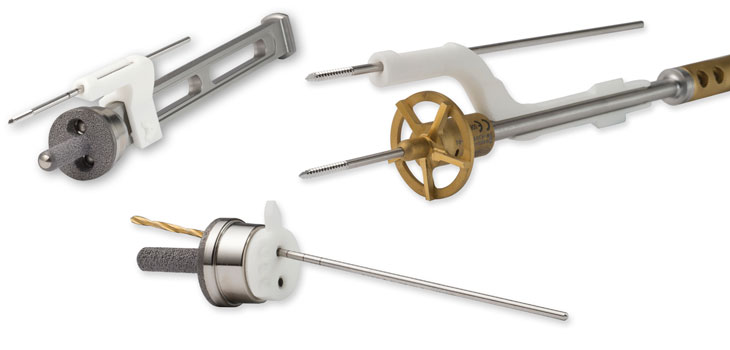
The FDA has given Zimmer Holdings, Inc. permission to market the company’s Patient Specific Instruments (PSI) Shoulder System for reverse shoulder arthroplasty procedures (RSA).
Zimmer’s Patient Specific Shoulder System Cleared for U.S.
2 min read Premium comments
Secondary
The system enables surgeons to plan the implant size and position, as well as bone preparation, including positioning the screw. It does this by utilizing 3D visualization software. European patients and surgeons have had access to the system since last May.
In an August 23, 2013 press release announcing the FDA clearance, Robert Munoz, vice president and general manager for Zimmer Extremities, said the primary challenges with reverse shoulder arthroplasty remain on the glenoid. “With PSI Shoulder, we present our surgeon customers with a powerful new tool to plan the glenoid side of the surgery with the patient’s unique anatomy in full view and functional needs in mind, resulting in a physical reference in the operating room to complete the surgery with confidence.”
“Zimmer’s PSI Shoulder makes you look at the patient in an entirely different way, ” said Dr. Olivier Verborgt, of AZ-Monica hospital, Antwerp Belgium, who has performed several Zimmer PSI Shoulder cases to date. “The planning software and patient-specific instrument guides help you think about what you want to do in the OR, and then actually do it.”
3D Visualization
The 3D visualization software allows a surgeon to create a customized surgical plan for each patient, and then provide patient-specific surgical instruments guides to facilitate placement of the implant corresponding to the personalized surgical plan.
The system complements the company’s Trabecular Metal Reverse Shoulder system for reverse shoulder arthroplasty (RSA) procedures.
Reverse Shoulder Arthroplasty
According to a PubMed, the RSA emerged as a potential solution for those patients who could not be managed effectively with a conventional total shoulder arthroplasty.
In 1987, Professor Paul Grammont revolutionized the design by medializing and distalizing the center of rotation and utilizing a large convex glenoid surface and concave humeral component with a neck-shaft angle of 155°. This design has been highly successful in cuff deficient shoulders, and indications continue to broaden. Many mid-term studies have improved upon the early encouraging results.
Long-term studies are starting to emerge, demonstrating good survivorship, but progressive functional and radiographic deterioration continue to be concerning. Careful patient selection and attention to appropriate technique are required to reduce the current high rate of complications. New prosthesis designs are continuing to develop to address some of these limitations.
Zimmer’s PSI is the latest to attempt to address the limitations described in PubMed.
Author
React:
Discussion
This is a fascinating development. In my practice we've seen similar outcomes with the revised protocol. The key differentiator seems to be patient selection criteria. Has anyone else noticed the correlation with BMI thresholds?
Great point. I'd push back slightly on the conclusion, the sample size in the cited study is too small to draw population-level inferences. That said, the directional signal is compelling and worth a larger RCT.
We implemented a similar approach last year. Early results are promising but we're still gathering 12-month follow-up data. Happy to share our protocol if anyone is interested.
Join the conversation
Orthopedic professionals are discussing this. Sign in and upgrade to read every comment and add your voice.