
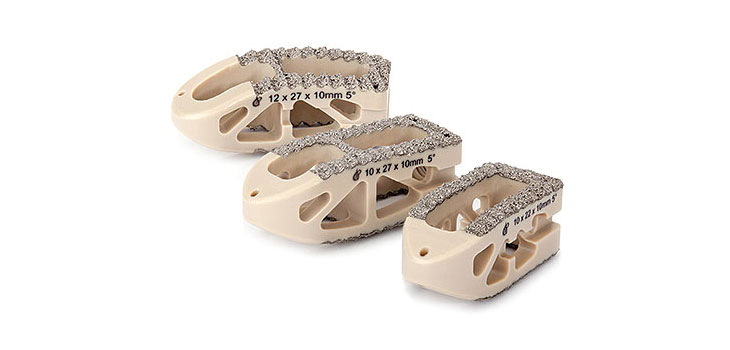
Spinal Elements, Inc. reports on the results of a test comparing its Ti-Bond porous titanium coated PEEK interbody implants with PEEK implants without the coating. The company release defines the coating as random unconnected titanium pores that are biomechanically adhered through a plasma vacuum spray to the surfaces of its PEEK-OPTIMA interbody implants.
Ti-Bond PEEK 5X Stronger Than Naked PEEK
1 min read Premium comments
Secondary
William Walsh, Ph.D. of the University of New South Wales, Australia, performed the device testing. He found that the devices coated with Ti-Bond had a shear strength approximately five times that of the PEEK devices. Histologic review showed that fibrous tissue had formed around the PEEK implant devices while the devices with Ti-Bond coating had bone forming in the porosity of the coating. Walsh examined the samples at the end of four weeks.
“It was very compelling to see the difference between the two specimen groups at such a short time period. The integration of bone into the Ti-Bond coating stands in sharp contrast to the barrier of tissue that formed around the PEEK device, ” commented Walsh on the testing.
Spine surgeon Scott H. Kitchel, M.D. of Eugene, Oregon said, “The potential clinical benefits of this technology are tremendous. Now we have a device that is participating in the fusion process where we did not previously have that option. The ability to get stable fixation in a spinal fusion earlier in the post-operative healing process may lead to improved long-term patient outcomes.” Spinal Elements is headquartered in Carlsbad, California.
Author
React:
Discussion
This is a fascinating development. In my practice we've seen similar outcomes with the revised protocol. The key differentiator seems to be patient selection criteria. Has anyone else noticed the correlation with BMI thresholds?
Great point. I'd push back slightly on the conclusion, the sample size in the cited study is too small to draw population-level inferences. That said, the directional signal is compelling and worth a larger RCT.
We implemented a similar approach last year. Early results are promising but we're still gathering 12-month follow-up data. Happy to share our protocol if anyone is interested.
Join the conversation
Orthopedic professionals are discussing this. Sign in and upgrade to read every comment and add your voice.