
Just three weeks after announcing FDA approval for one-level use of LDR Holding Corporation’s Mobi-C cervical disc, the company announced on August 28, 2013 that the agency has also granted approval for two-level cervical indications.
First and Only Two-Level Cervical Disc Approved in U.S.
3 min read Premium comments
Secondary
The approval makes the Mobi-C the first and only cervical disc in the U.S. approved to treat more than one level of the cervical spine.
Faster Return to Work and Superior to Fusion
In the two-level arm of the investigational device exemption (IDE) trial, the device not only showed that it was as good as anterior cervical discectomy and fusion (ACDF), but blew the charts off the wall by almost doubling the overall success rate over fusion (69.7% vs. 37.4%). In what surely must be music to the ears of worker’s comp payers, the mean return to work time for the Mobi-C was about three weeks sooner than fusion (45.9 days vs. 66.8 days).
Adjacent Segment Degeneration Evidence
There is also the issue of adjacent segment degeneration.
At 24 months in the two-level trial, the percentage of subjects who demonstrated negative radiographic changes from baseline in adjacent segments was 2.9% of Mobi-C patients compared to 18.1% of ACDF patients at the inferior adjacent level; and 13.1% of Mobi-C patients compared to 33.3% of ACDF patients at the superior adjacent level.
In an August 27 interview with OTW, LDR CEO and Founder Christophe Lavigne and Executive Vice President of Global Marketing Joe Ross, told us, “the potential to reduce the rate of adjacent segment degeneration has always been a hypothesized benefit of spine arthroplasty procedures, and the Mobi-C investigators are looking forward to further studying these results and assessing their clinical impact.”
Payers
As spine device makers have painfully learned, approval does not equal coverage. Will payers pay for the device and procedure?
Lavigne and Ross told us that coverage for single-level use of cervical devices has improved over the last 18 to 24 months with UnitedHealthcare, Cigna and WellPoint all issuing favorable coverage decisions. The company officials believe the level-two evidence is equally compelling and will be engaging payers for additional positive coverage decisions. The average age of subjects in the trial was mid-40s, so Medicare coverage may not be as significant as other procedures aimed at older populations.
Davis: “Landmark Event in Spine”
The company could not discuss potential market implications as they had just filed an S1 document expressing their intention to offer shares of the company in an IPO (initial public offering). Gregory A. Hoffman, M.D., orthopedic surgeon and member of the SpineONE Medical Team at Ortho North East in Fort Wayne, Indiana, said, “The population of patients suffering from one- or two-level cervical disc disease is large, and Mobi-C has the potential to make a significant and positive impact to the treatment of those patients.”
Reginald Davis, M.D., director of Neurosciences at Greater Baltimore Medical Center in Baltimore, Maryland, said, “As a spine surgeon I have been following the positive clinical data supporting cervical disc replacement over the last several years including the long-term evidence. I believe that the two-level Mobi-C study conclusions represent a landmark event in spine, as for the first time it has been demonstrated that on-label two-level cervical disc replacement with Mobi-C represents a superior treatment to two-level anterior spinal fusion.”
Mobi-C
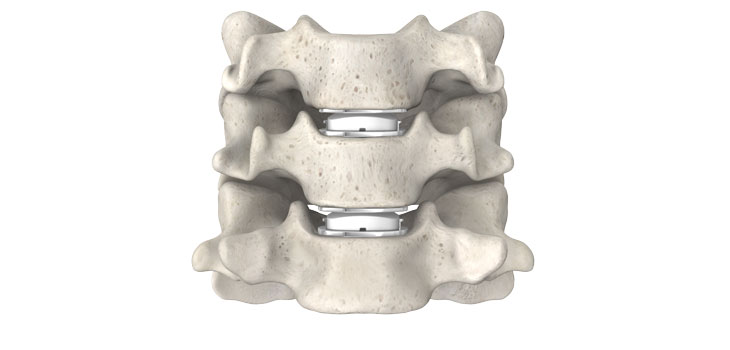
Mobi-C is a cobalt chromium alloy and polyethylene, mobile-bearing prosthesis specifically designed as a bone-sparing, cervical intervertebral disc replacement for both one- and two-level indications. In addition to the mobile-bearing feature, the company says the Mobi-C offers a simplified surgical technique as compared to other, commercially available devices, all of which are approved for one-level use only.
IDE Results
Specific findings comparing Mobi-C to ACDF in the two-level study at the 24-month endpoint included:
- Mobi-C implanted at two contiguous levels demonstrated statistical superiority in overall trial success compared to ACDF. The difference between Mobi-C’s overall success rate of 69.7% and ACDF’s rate of 37.4% represented statistical superiority (p< 0.0001)
- The rate of secondary surgery at the index level for Mobi-C was 3.1% versus 11.4% for ACDF
- The percentage of subjects who demonstrated negative radiographic changes from baseline in adjacent segments was:
- 2.9% of Mobi-C patients compared to 18.1% of ACDF patients at the inferior adjacent level
- 13.1% of Mobi-C patients compared to 33.3% of ACDF patients at the superior adjacent level
- Mean return to work time was 45.9 days for Mobi-C compared to 66.8 days for ACDF
- Mobi-C showed 78.2% improvement in Neck Disability Index based on success criteria versus61.8% for ACDF
- Mobi-C is a safe and effective surgical option at two contiguous levels in the cervical spine from C3-C7 for indicated patients
“This has been a long and rewarding process, ” concluded Lavigne.
Author
React:
Discussion
This is a fascinating development. In my practice we've seen similar outcomes with the revised protocol. The key differentiator seems to be patient selection criteria. Has anyone else noticed the correlation with BMI thresholds?
Great point. I'd push back slightly on the conclusion, the sample size in the cited study is too small to draw population-level inferences. That said, the directional signal is compelling and worth a larger RCT.
We implemented a similar approach last year. Early results are promising but we're still gathering 12-month follow-up data. Happy to share our protocol if anyone is interested.
Join the conversation
Orthopedic professionals are discussing this. Sign in and upgrade to read every comment and add your voice.