
Wound care products are regulated by the Food and Drug Administration (FDA) as a device. Effective immediately, certain products containing live cells will be regulated as a biologic product.
FDA Transfers Some Devices to Biologics Oversight
1 min read Premium comments
Secondary
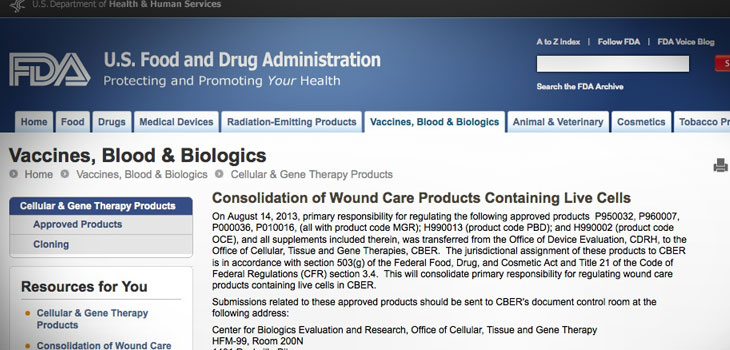
The FDA announced on August 14, 2013 that the agency is transferring oversight responsibilities for certain wound care products containing live cells from the Center for Devices and Radiological Health (CDRH) to the Center for Biologics Evaluation and Research (CBER).
The agency says the move provides the opportunity to further develop and coordinate scientific and regulatory activities between CDRH and CBER. FDA believes that as more wound care products containing live cells are developed such consolidation is necessary for both efficient and consistent agency action.
The agency has created a Web page listing the premarket approval applications and humanitarian device exemptions in CDRH that are being transferred to CBER. Sponsors of these products are encouraged to consult the Web page to find new contact information. The Web page address is: http://www.fda.gov/BiologicsBloodVaccines/CellularGeneTherapyProducts/ucm356173.htm.
According to a notice in the Federal Register, some of the products transferred include the Apligraf diabetic foot and venous leg ulcer treatment from Organogenesis Inc. and the Dermagraft venous leg ulcer skin substitute by Shire subsidiary Advanced BioHealing (now called Shire Regenerative Medicine).
Specifically, the following approved products: P950032, P960007, P000036, P010016, (all with product code MGR); H990013 (product code PBD); and H990002 (product code OCE), and all supplements included therein, has been transferred from the Office of Device Evaluation, CDRH, to the Office of Cellular, Tissue and Gene Therapies, CBER.
For further information, contact: John Barlow Weiner, Office of Combination Products, Food and Drug Administration, 10903 New Hampshire Ave., Bldg. 32, rm. 5130, Silver Spring, MD 20993, 301-796-8930, john.weiner@fda.hhs.gov.
Author
React:
Discussion
This is a fascinating development. In my practice we've seen similar outcomes with the revised protocol. The key differentiator seems to be patient selection criteria. Has anyone else noticed the correlation with BMI thresholds?
Great point. I'd push back slightly on the conclusion, the sample size in the cited study is too small to draw population-level inferences. That said, the directional signal is compelling and worth a larger RCT.
We implemented a similar approach last year. Early results are promising but we're still gathering 12-month follow-up data. Happy to share our protocol if anyone is interested.
Join the conversation
Orthopedic professionals are discussing this. Sign in and upgrade to read every comment and add your voice.