
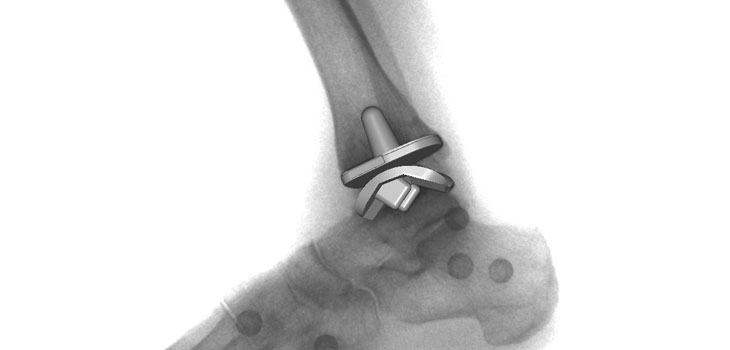
Thromboembolic complications and deep vein thrombosis are as common in patients who have total ankle replacements as they are in those who undergo hip or knee replacement. That is the result of a study presented at the American Orthopaedic Foot and Ankle Society Annual Meeting.
Complications Common After Ankle Replacement
1 min read Premium comments
Secondary
“The incidence of thromboembolic complications after total ankle replacement is between 0 and almost 10%, ” said Alexej Barg, M.D., study author. “In our patient cohort, the incidence was almost 3.5%, which is comparable to data observed in patients undergoing the replacement of a hip or knee joint.”
Barg and the researchers at Kantonsspital Liestal in Switzerland conducted a systematic review of the literature and extracted information on 964 total ankle replacements performed between 2000 and 2009 at 28 different clinics. The majority of studies included were level IV. Barg said there is limited literature on the incidence of thromboembolic prophylaxis after total ankle replacement (TAR).
They found a range of 0% to 10% of patients had thromboembolic complications after TAR and 3.5% of patients had symptomatic deep vein thrombosis following TAR. Twenty of 28 studies described low molecular weight heparin as the method of prophylaxis given to patients for six weeks postoperatively. “We suggest prophylaxis using low molecular weight heparin in patients with known risk factors, ” Barg said.
Author
React:
Discussion
This is a fascinating development. In my practice we've seen similar outcomes with the revised protocol. The key differentiator seems to be patient selection criteria. Has anyone else noticed the correlation with BMI thresholds?
Great point. I'd push back slightly on the conclusion, the sample size in the cited study is too small to draw population-level inferences. That said, the directional signal is compelling and worth a larger RCT.
We implemented a similar approach last year. Early results are promising but we're still gathering 12-month follow-up data. Happy to share our protocol if anyone is interested.
Join the conversation
Orthopedic professionals are discussing this. Sign in and upgrade to read every comment and add your voice.