
Zimmer Spine, Inc. is now the exclusive distributor of SpineCraft, LLC’s APEX Spine System in the U.S., Canada, Australia and New Zealand.
Zimmer Exclusive Distributor of SpineCraft’s APEX
1 min read Premium comments
Secondary
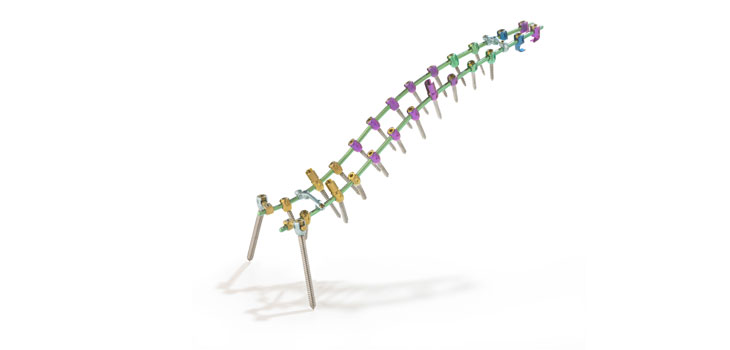
The system is a pedicle screw fixation system that provides immobilization and stabilization in the thoracic, lumbar and sacral spine regions, in the surgical treatment of acute and chronic spinal instabilities and deformities. Designed for skeletally mature patients as an adjunct to spinal fusion, the system consists of longitudinal rods, pedicle screws, hooks, lateral connectors and cross connectors. With a comprehensive range of component sizes, and addresses a broad range of spinal pathologies with a low-profile design that allows surgeons to maximize bone graft.
The system’s custom deformity-correction instruments, according to a July 10, 2013 company announcement, are designed to shorten surgery time while enabling safer, more controlled correction of spinal deformities.
Steve Healy, Zimmer Spine’s president, said the system represents a true union of intuitive design and engineering excellence. “These innovative implants and instrumentation offer powerful correction capabilities with excellent intraoperative flexibility. This state-of-the-art pedicle fixation system represents a natural fit for Zimmer Spine’s expanding portfolio, enabling surgeons to meet the unique needs of their complex spine and deformity patients, as well as patients with degenerative pathologies.”
The APEX system was designed by a team of spine surgeons practicing in the Chicago area. SpineCraft received FDA 510(k) clearance in 2006 and, to date, the system has been used in over 3, 500 clinical cases.
SpineCraft was founded by a business team and U.S. spine surgeons in 2004. The company’s Advisory Board includes: Kamal Ibrahim, M.D., Steven Mardjetko, M.D., Steven Mather, M.D., Anis Mekhail, M.D., and Youssry El-Hawary, M.D.
Author
React:
Discussion
This is a fascinating development. In my practice we've seen similar outcomes with the revised protocol. The key differentiator seems to be patient selection criteria. Has anyone else noticed the correlation with BMI thresholds?
Great point. I'd push back slightly on the conclusion, the sample size in the cited study is too small to draw population-level inferences. That said, the directional signal is compelling and worth a larger RCT.
We implemented a similar approach last year. Early results are promising but we're still gathering 12-month follow-up data. Happy to share our protocol if anyone is interested.
Join the conversation
Orthopedic professionals are discussing this. Sign in and upgrade to read every comment and add your voice.