
A shoulder or rotator cuff injury is no joke. According to the American Academy of Orthopaedic Surgeons each year approximately 200, 000 Americans require shoulder surgery related to repair of the rotator cuff. An additional 400, 000 Americans have surgery for related rotator cuff tendonitis or for partial tears.
Mitek Launches New Rotator Cuff Anchors
1 min read Premium comments
Secondary
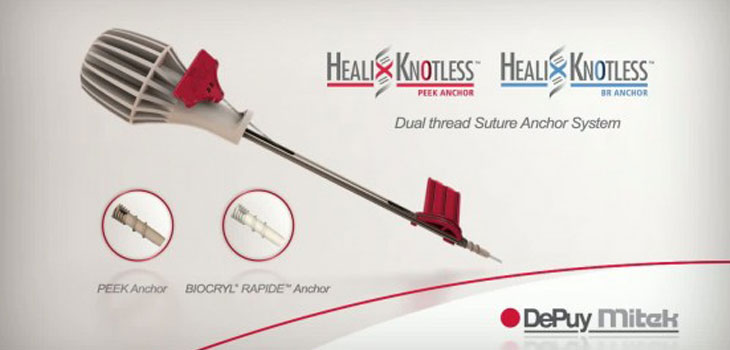
To facilitate shoulder repair, Mitek Sports Medicine, a part of the DePuy Synthes Companies of Johnson & Johnson, has launched a new dual-thread technology to maximize fixation and pull-out strength in both cancellous and cortical bone. Company officials report that the multi-thread design enables fast insertion into bone and eliminates the need for arthroscopic knot tying.
“The Healix Advance Knotless Anchor delivers a reliable and reproducible rotator cuff repair solution, ” said Thomas Knapp, M.D., an orthopedic surgeon with Santa Monica Orthopedic Group. “The type of repair performed depends on several factors including the size of the tear, individual patient anatomy, bone and tendon quality, and surgeon preferences and repair strategies. In my experience, Healix anchors are versatile enough to address the wide range of variables a surgeon may encounter and provide a consistent and reliable repair.”
The Healix anchors are made in three sizes: 4.75mm, 5.5mm and 6.5 mm, and are made of either Biocryl Rapide, a biocomposite material that allows absorption and boney ingrowth at the implant site, or PEEK, a biocompatible thermoplastic material. The anchors hold up to six strands of the company’s Orthocord High Strength Orthopaedic Suture or two strands of high strength tape-suture. The new knotless anchor requires no new instrumentation.
In performance testing, the Healix Advance Knotless Anchors displayed higher pullout strength when compared to other knotless anchors tested in the 4.5mm/4.75mm size range, and equivalent performance when compared to knotless anchors tested in the 5.5mm size.
A company spokesman noted that the cortical threads and flare of the Healix Anchor allows for cortical fixation of suture to bone, which enables more fixation points than other knotless anchors. Other features include an inserter ring that keeps sutures aligned along the shaft and prevents suture wrapping inside the subacromial space and cannula.
Author
React:
Discussion
This is a fascinating development. In my practice we've seen similar outcomes with the revised protocol. The key differentiator seems to be patient selection criteria. Has anyone else noticed the correlation with BMI thresholds?
Great point. I'd push back slightly on the conclusion, the sample size in the cited study is too small to draw population-level inferences. That said, the directional signal is compelling and worth a larger RCT.
We implemented a similar approach last year. Early results are promising but we're still gathering 12-month follow-up data. Happy to share our protocol if anyone is interested.
Join the conversation
Orthopedic professionals are discussing this. Sign in and upgrade to read every comment and add your voice.