
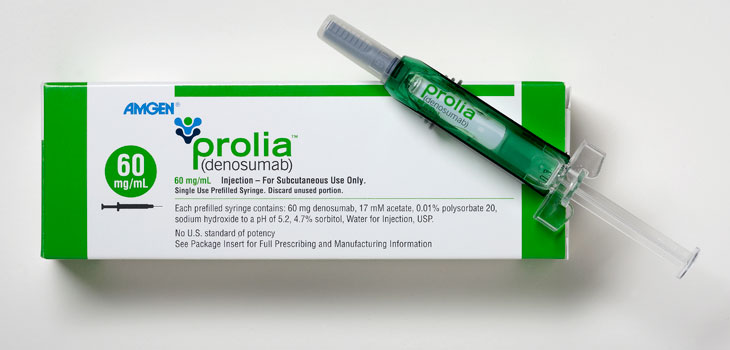
Medtronic Inc.’s Interventional Spine division will be promoting Amgen Inc.’s Prolia (denosub) for the next three years.
Medtronic Promotes Amgen’s Prolia
1 min read Premium comments
Secondary
According to a July 15, 2013 announcement, no later than July 31 Medtronic will begin promoting the drug to spine physicians treating patients who have a history of osteoporotic fracture. The drug is for use in postmenopausal women with osteoporosis at high risk for fractures. Financial terms of this agreement are not being disclosed.
It is estimated that one in two women over the age of 50 will have a fracture related to osteoporosis in their lifetime. Studies also show that only 24% of women who suffered an osteoporotic fracture received treatment during the following year.
Prolia is the first approved therapy that specifically targets RANK Ligand, an essential regulator of osteoclasts (the cells that break down bone).
Prolia is approved in the U.S. for the treatment of postmenopausal women with osteoporosis at high risk for fracture, defined as a history of osteoporotic fracture, or multiple risk factors for fracture; or patients who have failed or are intolerant to other available osteoporosis therapy. Prolia is also approved for treatment to increase bone mass in men with osteoporosis at high risk for fracture, defined as a history of osteoporotic fracture, or multiple risk factors for fracture; or patients who have failed or are intolerant to other available osteoporosis therapy.
Prolia is administered as a single subcutaneous injection of 60 mg once every six months.
Doug King, senior vice president and president of Medtronic Spine, said, “This new agreement increases awareness and access to our current base of orthopedic and spine physicians already treating patients with osteoporotic vertebral compression fractures. Identifying successful treatment options and access to care at the site of service for the growing number of women with osteoporosis at high risk for fracture is our primary objective. We could not have selected a better partner in Amgen, known industry-wide for their treatments and patient care.”
Author
React:
Discussion
This is a fascinating development. In my practice we've seen similar outcomes with the revised protocol. The key differentiator seems to be patient selection criteria. Has anyone else noticed the correlation with BMI thresholds?
Great point. I'd push back slightly on the conclusion, the sample size in the cited study is too small to draw population-level inferences. That said, the directional signal is compelling and worth a larger RCT.
We implemented a similar approach last year. Early results are promising but we're still gathering 12-month follow-up data. Happy to share our protocol if anyone is interested.
Join the conversation
Orthopedic professionals are discussing this. Sign in and upgrade to read every comment and add your voice.