
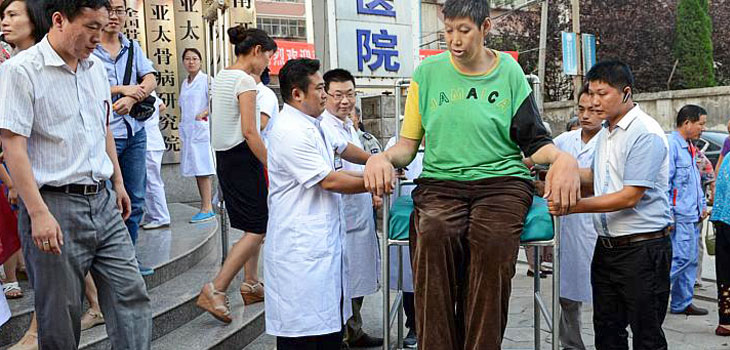
Eight-foot four-inch, Wang Fengjun, Asia’s tallest man, has been hospitalized for a hip replacement in Zhengzhau, China.
Hip Replacement for 8’4” Chinese Actor
1 min read Premium comments
Secondary
Various media outlets, including the Zhengzhau Evening News, reported on July 8, that 37-year-old Fengjun was diagnosed with osteonecrosis of the femoral head four years ago, which results from an interruption of blood supply. Repeated and prolonged pressure on his legs has been linked to his disease.
Fengjun was born to a rural family in Sanmenxia in Henan providence. He has five brothers and sisters, who are normal size. At 2.55 meters, he is 29 centimeters (11 inches) taller than China’s most famous former basketball player, Yao Ming. His agent reportedly claimed Fengjun is even taller than Bao Xinshun, the tallest man in the world listed in the Guinness Book of World Records.
According to published reports, Fengjun began growing 10 centimeters a year starting at age 13. He ceased growing in 2005 at age 29.
Fengjun will receive free treatment in a hospital in Zhengzhou, which will cover the total treatment expense of 500, 000 yuan ($81, 550). It is expected to take two years for him to recover.
He is well known in the country, having played numerous roles on Chinese TV. According to his agent, many companies invite him to participate in their promotion activities. Meanwhile, he still practices flute and saxophone regularly, and he is very good at magic.
To see a video (and a quirky Chinese ad) of Fengjun, click here.
Author
React:
Discussion
This is a fascinating development. In my practice we've seen similar outcomes with the revised protocol. The key differentiator seems to be patient selection criteria. Has anyone else noticed the correlation with BMI thresholds?
Great point. I'd push back slightly on the conclusion, the sample size in the cited study is too small to draw population-level inferences. That said, the directional signal is compelling and worth a larger RCT.
We implemented a similar approach last year. Early results are promising but we're still gathering 12-month follow-up data. Happy to share our protocol if anyone is interested.
Join the conversation
Orthopedic professionals are discussing this. Sign in and upgrade to read every comment and add your voice.