
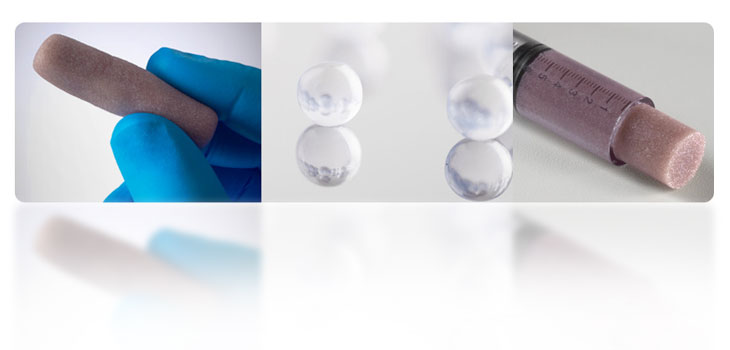
Bone putty made of spherical glass particles has received FDA clearance, according to its manufacturer, Synergy Biomedical, LLC, and is launching its first bone graft product called BioSphere Putty. Company officials claim that BioSphere, which uses a specialized form of 45S5 bioactive glass with a unique sphere shape, provides an optimized bone graft material that outperforms other bioactive products.
Glass Bone Putty Gains Clearance
1 min read Premium comments
Secondary
Among claims for the product is that the spherical shape of the BioSphere particles provides uniform and repeatable resorption and ion release. The 3-D packing of the spheres in a bone defect creates an optimal porosity that allows bone formation throughout the implant. Biosphere Putty is composed of bioactive glass spheres that are combined with a moldable phospholipid carrier. Company officials say that the putty has the highest bioactive glass composition on the market.
“The use of spherical particles has allowed Synergy to identify an optimal form of bioactive glass that improves bone formation, ” stated Mark Borden, Ph.D., CEO and founder of Synergy Biomedical. Established in 2011, Synergy Biomedical is a privately held medical device company focused on bringing biomaterial based products to the orthopedic and spinal markets.
Author
React:
Discussion
This is a fascinating development. In my practice we've seen similar outcomes with the revised protocol. The key differentiator seems to be patient selection criteria. Has anyone else noticed the correlation with BMI thresholds?
Great point. I'd push back slightly on the conclusion, the sample size in the cited study is too small to draw population-level inferences. That said, the directional signal is compelling and worth a larger RCT.
We implemented a similar approach last year. Early results are promising but we're still gathering 12-month follow-up data. Happy to share our protocol if anyone is interested.
Join the conversation
Orthopedic professionals are discussing this. Sign in and upgrade to read every comment and add your voice.