
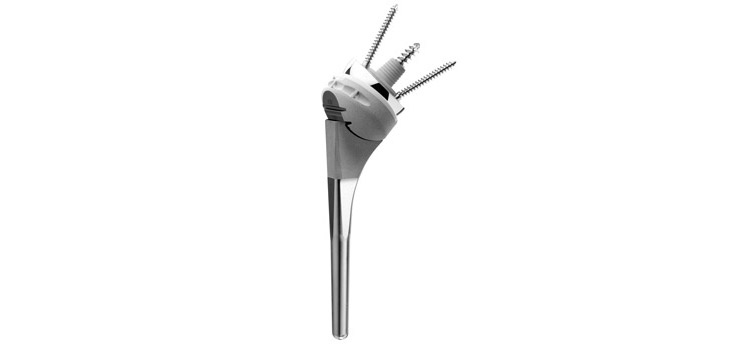
Brian S. Cohen of Adena Health System, Chillicothe, Ohio, became the first U.S. surgeon to install Arthrex, Inc.’s new reverse shoulder implant, according to the company. The Food and Drug Administration approved the Arthrex Univers Revers device on May 31, 2013, and Cohen performed the procedure on a 72-year old-man during a live, international surgery simulcast to Germany and sites across the United States.
First Arthrex Reverse Shoulder Implant Surgery Performed
1 min read Premium comments
Secondary
Reverse shoulder implant surgery is intended to replace the ball and socket of the rotator cuff, giving the patient better range of motion. Following reverse shoulder implant surgery, the part of the human shoulder which once held the socket now holds the ball and vice versa. According to Cohen, by reversing the components of the shoulder, the patient’s mobility is greatly improved and most often leads to a better quality of life after surgery.
Cohen said that his patient suffered a torn rotator cuff injury several years ago and had an extensive course of traditional treatments for pain and mobility. Over time, the tear evolved to the point it had become debilitating and impacted his quality of life. Cohen worked with Arthrex in the design of its new implant. He said, “When I first saw the Arthrex Univers Revers about five years ago, there were certain things that I felt—from doing the procedure—that were missing from the implant which were essential. Some of those changes have been implemented.”
Of his contributions, Dr. Cohen added, “It is nice when people take stock in what you believe is important in helping your patients have a successful outcome, and then to implement them into a prosthesis.” He says that the new device is more cost effective, and uses technology not previously available in reverse shoulder implants.
Adena Health System is an independent, not-for-profit and locally controlled healthcare organization serving the needs of patients in 12 south-central Ohio counties. Adena includes three hospitals, six regional clinics and ambulatory sites located throughout the region.
Author
React:
Discussion
This is a fascinating development. In my practice we've seen similar outcomes with the revised protocol. The key differentiator seems to be patient selection criteria. Has anyone else noticed the correlation with BMI thresholds?
Great point. I'd push back slightly on the conclusion, the sample size in the cited study is too small to draw population-level inferences. That said, the directional signal is compelling and worth a larger RCT.
We implemented a similar approach last year. Early results are promising but we're still gathering 12-month follow-up data. Happy to share our protocol if anyone is interested.
Join the conversation
Orthopedic professionals are discussing this. Sign in and upgrade to read every comment and add your voice.