
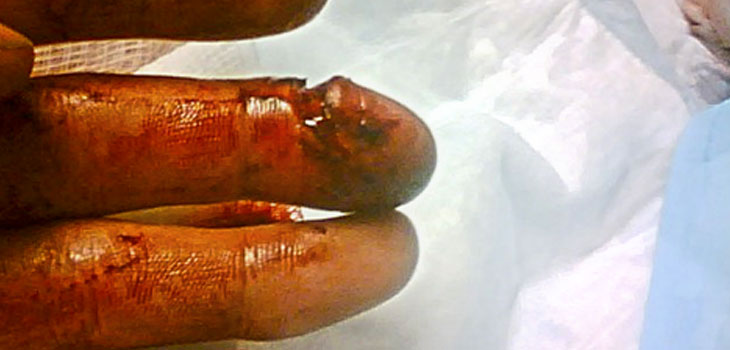
Why, a team of researchers from NYU Langone Medical Center wanted to know, can an amputated fingertip regenerate in as little as two months? In a paper published in the journal Nature, these scientists have used genetically engineered mice to document for the first time the biochemical chain of events that unfolds in the wake of a fingertip amputation. The findings hold promise for amputees who may one day be able to benefit from therapies that help the body regenerate lost limbs.
Fingertip Amputation and Limb Regeneration
2 min read Premium comments
Secondary
“Everyone knows that fingernails keep growing, but no one really knows why, ” says lead author Mayumi Ito, Ph.D., assistant professor of dermatology in the Ronald O. Perelman Department of Dermatology at NYU School of Medicine, in the June 12, 2013 news release. And what about the relationship between nail growth and the regenerative ability of the bone and tissue beneath the nail?
Now, Dr. Ito and his team have discovered an important clue in this process: a population of self-renewing stem cells in the nail matrix, a part of the nail bed rich in nerve endings and blood vessels that stimulate nail growth. And, the scientists have found that these stem cells depend upon a family of proteins known as the “Wnt signaling network”—the same proteins that play a crucial role in hair and tissue regeneration—to regenerate bone in the fingertip.
“When we blocked the Wnt-signaling pathway in mice with amputated fingertips, the nail and bone did not grow back as they normally would, ” says Dr. Ito. Even more intriguing, the researchers found that they could manipulate the Wnt pathway to stimulate regeneration in bone and tissue just beyond the fingertip.
“Amputations of this magnitude ordinarily do not grow back, ” says Dr. Ito. These findings suggest that Wnt signaling is essential for fingertip regeneration, and point the way to therapies that could help people regenerate lost limbs. The team’s next step is to zoom in on the molecular mechanisms that control how the Wnt signaling pathway interacts with the nail stem cells to influence bone and nail growth.
Dr. Ito told OTW, “We have been studying hair/skin regeneration (an excellent regeneration model in mammals) and wanted to know how our knowledge can be extended to understand regeneration of non-regenerative organs such as the limb. The most important finding was that Wnt signaling in epithelial cells is necessary for digit bone regeneration after digit tip amputation.”
Asked what she would like orthopedic surgeons to know about this work, Dr. Ito stated, “Digit bone regeneration is regulated by interactions between mesenchymal bone precursors and epithelial cells, and understanding of epithelial signals may help identify novel treatment for digit bone regeneration after amputations.”
As for how far we are from this work truly helping patients, Dr. Ito commented to OTW, “There would be many experiments needed to be done before the translation to treat human patients. We first would like to test whether transplantation of Wnt-active nail epithelial cells onto digit can induce regenerative response in bone precursor cells in mice.”
Author
React:
Discussion
This is a fascinating development. In my practice we've seen similar outcomes with the revised protocol. The key differentiator seems to be patient selection criteria. Has anyone else noticed the correlation with BMI thresholds?
Great point. I'd push back slightly on the conclusion, the sample size in the cited study is too small to draw population-level inferences. That said, the directional signal is compelling and worth a larger RCT.
We implemented a similar approach last year. Early results are promising but we're still gathering 12-month follow-up data. Happy to share our protocol if anyone is interested.
Join the conversation
Orthopedic professionals are discussing this. Sign in and upgrade to read every comment and add your voice.