
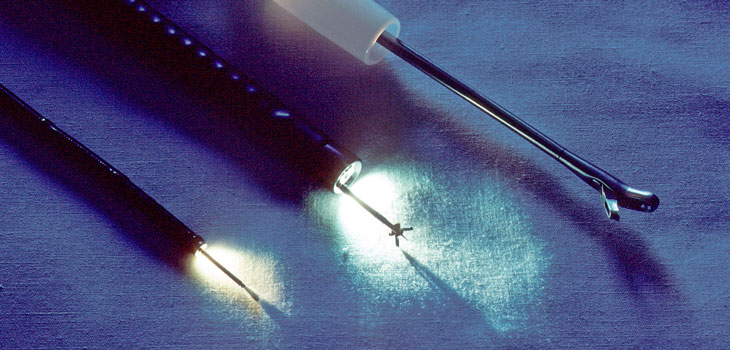
No question about it, in certain situations smaller is better. Researchers who conducted a review of the literature found that in treating patients with an ankle impingement, an endoscopic method is superior to an open surgical procedure, reported Zwiers R. Arthrosc, in Orthopedics Today.
Endoscopy Best for Ankle Impingement Repair
1 min read Premium comments
Secondary
C. Niek van Dijk, M.D., Ph.D., the lead researcher and his colleagues, wrote in their study, “Both the open procedures and the endoscopic approaches yield good outcomes in terms of patient satisfaction. However, complication rates are remarkably lower with endoscopic treatment, and it seems that the time to return to full activity is much shorter.”
To gather their data, van Dijk and colleagues searched the Embase, Medline, Cumulative Index to Nursing and Allied Health Literature databases and found 16 trials that treated patients who had ankle impingement with either open or endoscopic procedures.
They found that the complication rate for endoscopic surgery was 7.2% and a return to full activity took 11.3 weeks compared to 15.9% and 16 weeks for the open surgery group. Arthrosc quoted van Dijk and his colleagues as writing in their report, “Even though the level of evidence of the included studies is relatively low, it can be concluded that the endoscopic procedure is superior to the open procedure.”
Author
React:
Discussion
This is a fascinating development. In my practice we've seen similar outcomes with the revised protocol. The key differentiator seems to be patient selection criteria. Has anyone else noticed the correlation with BMI thresholds?
Great point. I'd push back slightly on the conclusion, the sample size in the cited study is too small to draw population-level inferences. That said, the directional signal is compelling and worth a larger RCT.
We implemented a similar approach last year. Early results are promising but we're still gathering 12-month follow-up data. Happy to share our protocol if anyone is interested.
Join the conversation
Orthopedic professionals are discussing this. Sign in and upgrade to read every comment and add your voice.