
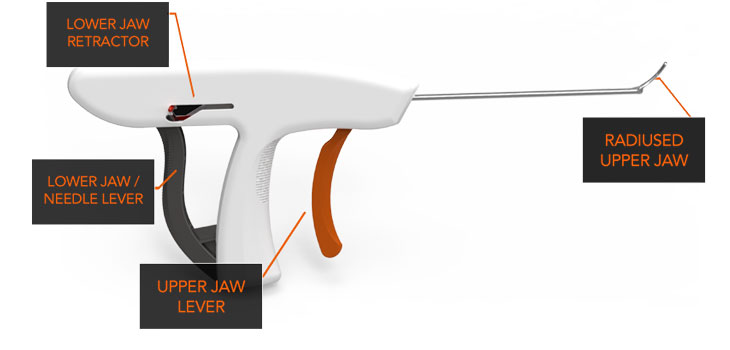
Now available in the U.S. is Ceterix Orthopaedics, Inc.’s NovoStitch suture passer. This device, according to the manufacturer, enables surgeons to place stitches in tight joint compartments, including those in knees, hips and shoulders, during minimally invasive arthroscopic surgical procedures.
Device Enables Stitches in Tight Spaces
1 min read Premium comments
Secondary
According to Justin D. Saliman, M.D., Ceterix founder and chief medical officer, the technology enables surgeons to “freely sew within the tight arthroscopic environment of the knee and allows placement of suture patterns previously considered difficult, if not impossible, to achieve.” The technology may help surgeons avoid removing meniscal tissue in some knee injury cases that are currently considered non-repairable.
Tears of the meniscus, a curved cartilage disc located within the middle of the knee, are among the most common injuries, and meniscal surgery is the single-most commonly performed arthroscopic procedure in the U.S. Surgical treatment options include repair, in which the cartilage is sewn or anchored together; surgical removal of the torn section (partial meniscectomy); or surgical removal of the entire meniscus (total meniscectomy).
“Due to the difficulty of access and the limitations of current arthroscopic instruments, the vast majority of meniscal tears are not repaired, but are either partially or totally resected, ” said John McCutcheon, company president and CEO “This means that almost a million patients each year are undergoing procedures that will significantly increase their risk of osteoarthritis later in life. Our goal is to make meniscectomy less common by providing tools to make repair more feasible.”
Ceterix Orthopaedics was founded in 2010 and is based in Menlo Park, California.
Author
React:
Discussion
This is a fascinating development. In my practice we've seen similar outcomes with the revised protocol. The key differentiator seems to be patient selection criteria. Has anyone else noticed the correlation with BMI thresholds?
Great point. I'd push back slightly on the conclusion, the sample size in the cited study is too small to draw population-level inferences. That said, the directional signal is compelling and worth a larger RCT.
We implemented a similar approach last year. Early results are promising but we're still gathering 12-month follow-up data. Happy to share our protocol if anyone is interested.
Join the conversation
Orthopedic professionals are discussing this. Sign in and upgrade to read every comment and add your voice.