
Michael Berend contends, “For select patients and certain indications dual mobility poly liners are a good alternative. “We’re just not ‘there’ yet with this implant, ” counters Steve MacDonald. “In 2012 I think it’s a good option for revision total hip for instability, but not for primary total hip.”
Berend, MacDonald Square Off Over Dual Mobility Hip Implants
8 min read Premium comments
Great Debates
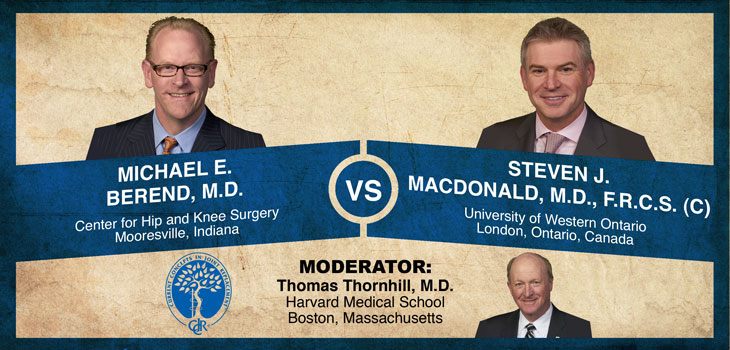
This week’s Orthopaedic Crossfire® debate is “The Dual Mobility Poly Liner: The French Connection.” For the proposition is Michael E. Berend, M.D. from the Center for Hip and Knee Surgery in Mooresville, Indiana; against the proposition is Steven J. MacDonald, M.D., F.R.C.S. (C) from the University of Western Ontario. Moderating is Thomas Thornhill, M.D. from Harvard Medical School.
Dr. Berend: “Why select dual mobility acetabular components? You have to weigh the risks and benefits. The benefits include a proven lower dislocation rate in patients that are high risk for dislocation after total hip replacement. Those have been revision scenarios, patients who are noncompliant due to mental status changes, patients with spasticity, alcohol consumption, or patients with a history of dislocation. I think the added range of motion with dual mobility components does improve prior to impingement, both mechanical and against the pelvis. Prior concerns of polyethylene wear are largely solved with new crosslinked polys that may play a role in combination with dual mobility implants.”
“The risks: second decade failure mechanisms are unknown. Also, metal-metal issues on modular designs may be problematic. At least 1 in 25 patients in the Medicare database undergoing a primary total hip, and up to 14% of revision patients experience a dislocation. Hopefully this can be lowered with the use of a dual mobility component.”
“Large heads have helped, but dislocation continues to be a problem. I think the dual mobility implant may reduce this. It does this through increased jump distance with the larger femoral heads, and increased range of motion (ROM) prior to prosthetic or bony impingement.”
“So what is it? A modular acetabular component fixed to the pelvis, an uncemented or cemented stem with a smaller femoral head, and then a large polyethylene femoral head mated to the acetabular shell…increasing ROM through these combined articulations.”
“The long term data is humbling. There are only midterm studies thus far, except for one study out to 15 years. The take home message is that dislocation is reduced with these implants compared to standard 28, 32, or 36mm implants…with equal survivorship to most clinical studies.”
“There are concerns about volumetric wear with increase in femoral head size. There’s a logarithmic increase in polyethylene wear—at least reported in the volumetric calculation. And with larger femoral heads, perhaps even to 60mm you get the increased ROM, but you’re now exposed to two interfaces, increasing the potential for volumetric wear. Hopefully the use of different articulations and polyethylenes—either with vitamin E or crosslinking techniques—will reduce this in the future. With the increased ROM (at least in the lab thus far) polyethylene wear has not been increased with the combination of crosslinked poly and a dual mobility type interaction.”
“What about the salvage of a well fixed metal-metal implant? There’s no long term data on this, but in some cases it is appealing to swap the femoral head out from a metal-metal articulation to a poly head, and avoid having to remove a well fixed acetabular component.”
“With new devices there are new failure mechanisms; an intraprosthetic dislocation has been reported where the small femoral head can dislocate from the polyethylene head in the cup (this is largely based on neck impingement and polyethylene wear).”
“There continues to be an issue of fixation with monolithic cups; some one piece monolithic cups traditionally used for metal-metal may have trouble with fixation. We have to ensure the bone stock is adequate, that there’s not much dysplasia, and that if you don’t have the ability to use screw fixation or supplemental fixation, that fixation can be obtained. And there are concerns about metal-metal liners… cobalt chrome on polyethylene…into the second decade.”
“So for select patients and certain indications this is a good alternative. Overall it represents about 5% of my primary practice and about 25% of my revision practice.”
Dr. MacDonald: “The original idea was a monoblock shell, a large polyethylene ball, and a smaller ball inside of that. In 2012 we have two options: that option with a monoblock and then a modular shell. With the latter we can get fixation with screws, metal inserts, and the same poly and metal or ceramic head.”
“Does this make sense? We’re talking about a differential hardness bearing. The harder surface normally articulates against the softer surface. In most total hips done globally we do a hard (the metal/ceramic) against the soft (the poly). If you switch it around the wear rate rises exponentially.
“And the basic science on this construct? Zero. We have no published wear data. There is advertised data showing a 94% reduction in wear—as long as you put your shell in at 65 degrees. But if you put the shell in the normal closed position you’re not seeing that. The poly is free to go into a more closed position; that could potentially lead to edge loading and poly failure. We now have two articulating polyethylene surfaces, and we know the potential is there for increased wear and osteolysis. The claim is for improved ROM and stability, but we know from biomechanical studies that ROM of the hip peaks at about 36-38mm. And further growth in the head doesn’t improve the overall stability.”
“We can achieve that same ROM and stability with current implants that have registry published data. One of the constructs is the monoblock shell. The Australian registry and others show that monoblock shells have a higher failure rate than modular shells in most applications.”
“So who is this for? It’s unclear. The technique manuals talk about osteoarthritic patients, rheumatoid patients, revisions, patients with a dislocation risk…that could be every patient.”
“Increased stability is the goal, so let’s look at the dislocation rate. There is a combined paper by David Stulberg with multiple series and a dislocation rate of 0.4%. There are many studies from different centers that have dislocation rates at about 0.5 to 1% with conventional total hips. With the growth of the larger heads all the registry data show that the dislocation rate is decreasing.”
“There is a recent report of a new complication with this particular bearing. It’s ‘intraprosthetic dislocation’…with a 28mm head popping out of the polyethylene. In a large series from Remi Philippot the incidence was about 0.5%. In a recent publication from Moussa Hamadouche the incidence was 7.5% of intraprosthetic dislocations. In particular, it’s when you use a long ball that then exposes the base of the morse taper to the poly. If you look at the published clinical reports, many are from the same center, and most are short term follow up.”
“In a recent review article by Lachiewicz it was said, ‘Caution should be advised in the routine use of dual mobility components in primary and revision THA [total hip arthroplasty].’ I would echo that. They also said, ‘The greatest utility may be to manage recurrent instability in revision total hip.’ There is good registry data to back this up. In a recent work by Nils Hailer there were 228 revisions for recurrent instability, and only 2% were re-revised using dual mobility.”
“We’re just not ‘there’ yet with this implant. In 2012 I think it’s a good option for revision total hip for instability, but not for primary total hip.”
Moderator Thornhill: “Mike, you have a monoblock solid acetabulum you put in…then you stick in poly and a hard surface, squeezing the poly with a smaller head. It seems Steve may be right.”
Dr. Berend: “We agree that for indications of trying to lessen the incidence of known problems, and perhaps accepting other problems that we don’t know. Perhaps the question is, ‘Will the long term complication rate be lower from the hard-hard or different mating of the materials be a lower complication rate than the known complication rate of dislocation or impingement?’”
Moderator Thornhill: “Steve, you said you might use it in some revision situations. Which ones?”
Dr. MacDonald: “I don’t personally use it, but perhaps when you have a recurrently unstable hip…like abductor insufficiency. I use a constrained polyethylene for those scenarios, but this does make sense…and registry data supports its use for recurrent instability. My issue is people using it in a primary application when they’re not paying attention to other techniques.”
Moderator Thornhill: “Mike, abductor dysfunction…will this work?”
Dr. Berend: “If you’re putting a fresh cup in this makes more sense for decreasing loosening of the acetabular component in the revision scenario than using constraint. I think abductor deficiency in primary total hip is probably more common than many of us think. I think the combination of that in patients with extreme high ROM in flexion, adduction, and internal rotation, with excellent acetabular bone stock. I think it’s at least an indication in my hands—especially in smaller acetabular females with smaller acetabular bone stock.”
Moderator Thornhill: “So if the socket is in good position and is stable you would go to a constrained liner. If it’s loose and you’re changing to a fresh acetabular you’d be more likely to go to a new dual mobility.”
Dr. Berend: “Great way to think about it.”
Moderator Thornhill: “You okay with that, Steve?”
Dr. MacDonald: “No. Because constrained liners are not all created equal. Every company has a different one; some have good track records, some don’t. Some allow more ROM, others don’t. The constrained liner I use has a very good ten year clinical track record with cup loosening rates that are much lower than that intraprosthetic dislocation rate.”
Moderator Thornhill: “Steve, what is a ‘long ball?’”
Dr. MacDonald: “An 8 ball, 9 length…not a 0. As you grow that longer neck then you’re exposing the base of the Morse taper to the poly.”
Moderator Thornhill: “Mike, you use this in 5% of your primaries…who are they?”
Dr. Berend: “Two patient populations. Those with extremely high ROM (we and others have shown that preoperative ROM is a predictor of postoperative dislocation). Then it’s with the ultra-obese patient where it’s a goat rope trying to get the acetabulum in and put the screws in, get the liner in. So if I can put in a monolithic cup with good bone stock that’s good.”
Moderator Thornhill: “What about people with osteonecrosis of the femoral head?”
Dr. Berend: “No. I would use an anterior or anterolateral approach to preserve the posterior capsule, and try to get to at least a 36mm head.”
Moderator Thornhill: “Steve, are our materials going to improve such that this concept will survive over the next 30 years?”
Dr. MacDonald: “Perhaps. The weak link now is the smaller diameter ball with the poly, so if we can avoid impingement there, perhaps with second and third generation crosslinked polys we won’t see that failure mechanism. The monoblock shell issue is dissociated from the poly issue…and monoblock shells in the majority of hands are not doing as well as modular shells.”
Moderator Thornhill: “Thank you to both speakers.”
Please visit www.CCJR.com to register for the 2013 CCJR Winter Meeting, December 11–14 in Orlando, Florida.

“You may now view CCJR meeting content on your mobile device on the CCJR MobileTM App. Please scan the QR code to download from iTunes.”
React:
Discussion
This is a fascinating development. In my practice we've seen similar outcomes with the revised protocol. The key differentiator seems to be patient selection criteria. Has anyone else noticed the correlation with BMI thresholds?
Great point. I'd push back slightly on the conclusion, the sample size in the cited study is too small to draw population-level inferences. That said, the directional signal is compelling and worth a larger RCT.
We implemented a similar approach last year. Early results are promising but we're still gathering 12-month follow-up data. Happy to share our protocol if anyone is interested.
Join the conversation
Orthopedic professionals are discussing this. Sign in and upgrade to read every comment and add your voice.