
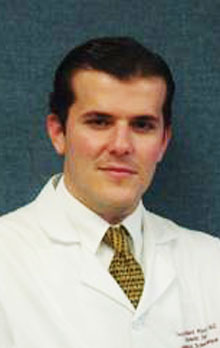
Fernando Villamil, M.D., chief of the Orthopaedic Spine Service at Ashford Presbyterian Community Hospital in San Juan, Puerto Rico, is Lanx, Inc.’s new director of education for Latin America. He also joins the company’s Surgeon Advisory Board.
Villamil Named Lanx Latin America Education Director
1 min read Premium comments
Andrew Cappuccino, M.D., chairman of the company’s advisory board and surgeon at the Buffalo Spine Surgery, Lockport, New York, said Villamil’s surgical expertise “will be invaluable as we look to increase development and awareness of these unique fusion systems and further optimize minimally invasive spine care.
Villamil will oversee all training initiatives for Lanx in the region.
A native of Puerto Rico, Villamil completed his spine surgery fellowship at Harvard Medical School while working at Massachusetts General Hospital and Brigham and Women’s Hospital in Boston, Massachusetts. A June 10, 2013, company announcement said Villamil has extensive experience in treating complex spinal conditions, having performed thousands of fusion surgeries.
Villamil said Lanx’s technologies are among the most innovative available for spine care, enabling surgeons to perform truly minimally invasive fusion. “The Timberline Lateral Fusion System is an especially exciting offering, and in my experience, advances the efficiency of the lateral approach and associated patient outcomes. I look forward to working with my peers in Latin America to develop world class training programs for Latin America, as well as working with my international colleagues on the Surgeon Advisory Board to provide strategic direction to Lanx.”
In addition to the Timberline system, the company develops and markets a full line of fusion devices including the Aspen MIS Fusion System. Lanx is headquartered in Broomfield, Colorado, and distributes its products throughout the world via a network of direct sales representatives and exclusive distributor partners.
Author
React:
Discussion
This is a fascinating development. In my practice we've seen similar outcomes with the revised protocol. The key differentiator seems to be patient selection criteria. Has anyone else noticed the correlation with BMI thresholds?
Great point. I'd push back slightly on the conclusion, the sample size in the cited study is too small to draw population-level inferences. That said, the directional signal is compelling and worth a larger RCT.
We implemented a similar approach last year. Early results are promising but we're still gathering 12-month follow-up data. Happy to share our protocol if anyone is interested.
Join the conversation
Orthopedic professionals are discussing this. Sign in and upgrade to read every comment and add your voice.