
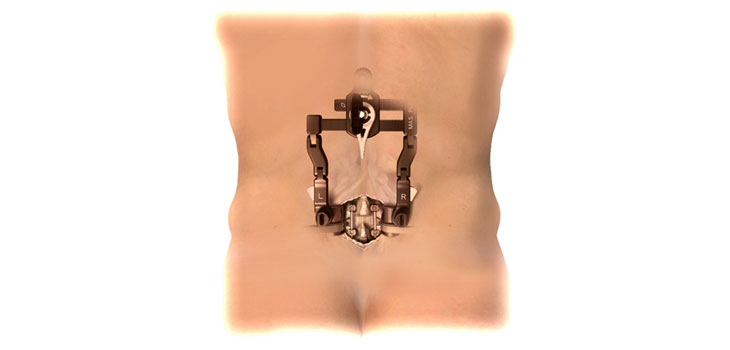
NuVasive, Inc. launched its Maximum Access Surgery Posterior Lumbar Interbody Fusion (MAS® PLIF) procedure on May 31, 2013.
NuVasive Launches Smaller Incision Procedure
1 min read Premium comments
Secondary
After an initial limited launch around the U.S., the procedure is now available for patients and surgeons in Australia, Switzerland, Italy, Germany, and the United Kingdom.
According to the company, the procedure is designed to eliminate the need to retract back muscles as wide laterally as a traditional, or “open, ” PLIF, therefore requiring a smaller incision. By minimizing the amount of muscle disruption, the procedure is intended to help reduce postoperative approach-related muscle pain and to enable a faster recovery for the patient.
The company also said the procedure was uniquely developed by surgeon design and product development teams to cohesively output the access, fixation, interbody, graft delivery, and neuromonitoring components specific to the procedure. The surgeons who played a key role in the innovation and development of the procedure have been instrumental in training other surgeons in both of the NuVasive San Diego and New Jersey state-of-the-art cadaveric labs.
Gurvinder Doel, M.D., said, “The integration effort is undeniable in the final output of the system. Every nuance, from the unique retractor blades, the laterally placed interbody cages, the modular screw option, and the insulated pedicle prep instruments make for a seamless, safe, and reproducible procedure.” Another surgeon, Nitin Khanna, M.D., said the procedure is unique in that it offers “truly reproducible results that embrace traditional surgical principles. The beauty is in the simplicity of the system, which all surgeons can implement in their practice.”
Author
React:
Discussion
This is a fascinating development. In my practice we've seen similar outcomes with the revised protocol. The key differentiator seems to be patient selection criteria. Has anyone else noticed the correlation with BMI thresholds?
Great point. I'd push back slightly on the conclusion, the sample size in the cited study is too small to draw population-level inferences. That said, the directional signal is compelling and worth a larger RCT.
We implemented a similar approach last year. Early results are promising but we're still gathering 12-month follow-up data. Happy to share our protocol if anyone is interested.
Join the conversation
Orthopedic professionals are discussing this. Sign in and upgrade to read every comment and add your voice.