
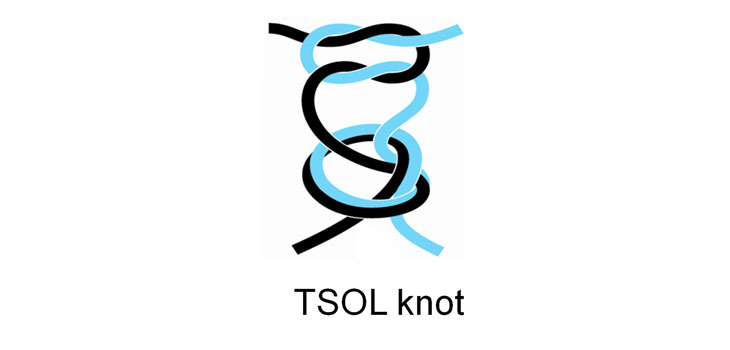
A research team from Mayo Clinic has designed and tested a novel knotting technique that could decrease stress in the OR. The innovation, a two-strand-overhand locking (TSOL) knot, was designed and mechanically evaluated with use of different suture materials and knot configurations and in actual tendon repairs.
No Unraveling in the OR: Novel Knot Technique
2 min read Premium comments
Secondary
The researchers compared the knot holding strength of the TSOL knot with that of a 4-throw square knot with use of three different suture materials that are in common clinical use. With use of braided polyblend suture, the TSOL knot was also compared with five other surgical knot configurations. Finally, the strength of tendon repairs performed with use of the TSOL knot and a 4-throw square knot was studied.
Chunfeng Zhao, M.D. and his team told OTW, “Our team has been active in flexor tendon repair research for over 15 years, and we have explored many techniques to improve strength and healing. Knot unraveling using modern tendon repair techniques has been reported to be a relatively common occurrence; we have seen this in our own laboratory experiments. This is a critical complication that may occur in the repair of any tissue subjected to high-tension loading. Recognizing that both the tensile strength of the suture material and suture holding strength of tissue are typically higher than loads required to unravel commonly used knots, we saw a great opportunity to improve repair strength by overcoming this weak link in the chain.”
Dr. Zhao continued, “The impact of very strong suture materials is greatly limited by the strength of the knot used. When using a high-tensile-strength suture, 4-throw square knots unraveled at tensile loads as little as one-quarter of the intact suture tensile strength. The proposed two-strand overhand locking (TSOL) knot performed better, with failure loads nearly one-half of the intact suture tensile strength. A simple change to the repair technique provides opportunities to take greater advantage of a suture’s strength.”
Asked about the most important findings, Dr. Zhao noted, “Not only did we observe that the TSOL knot was significantly stronger (both statistically and practically speaking) than the other common surgical knots tested, it does not result in a significantly increased knot size. This is particularly important in flexor tendon repair, as the knot is buried between the two repaired tendon ends, and the presence of a large foreign body can negatively impact healing. The type of suture used does influence the mechanical advantage of this new knot over the 4-throw square knot. However, for all suture materials tested, the advantage of the TSOL knot was substantial. This knot is quick and simple to make with or without an assistant.”
React:
Discussion
This is a fascinating development. In my practice we've seen similar outcomes with the revised protocol. The key differentiator seems to be patient selection criteria. Has anyone else noticed the correlation with BMI thresholds?
Great point. I'd push back slightly on the conclusion, the sample size in the cited study is too small to draw population-level inferences. That said, the directional signal is compelling and worth a larger RCT.
We implemented a similar approach last year. Early results are promising but we're still gathering 12-month follow-up data. Happy to share our protocol if anyone is interested.
Join the conversation
Orthopedic professionals are discussing this. Sign in and upgrade to read every comment and add your voice.