
Medtronic, Inc. has received CE Mark for a device used to treat patients with a severe form of spinal curvature to allow them to potentially stand up straighter without pain.
Medtronic Unveils Device to Restore Spine’s S-Shape
2 min read Premium comments
Secondary
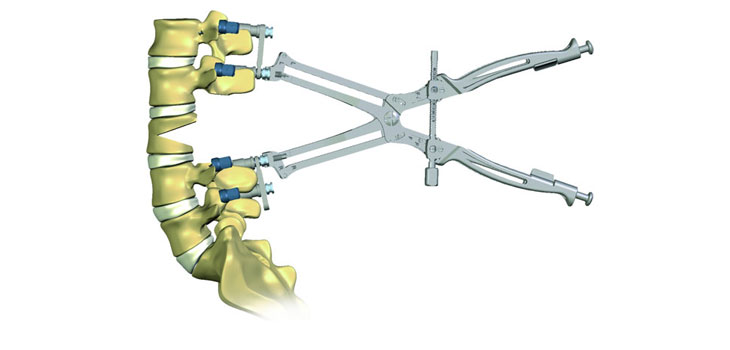
On June 13, 2013, the company announced the launch of the ReDux Plier calling it the “first specialty-designed surgical instrument” in the spinal orthopedic industry which allows physicians in the European Community to perform a more controlled osteotomy closure.
The instrument was developed by Medtronic European Product Development Office based in Tolochenaz, Switzerland, following an original invention by Professor Le Huec, chief of the Spine Unit and chair of the Department of Orthopaedics and Traumatology at the Bordeaux University Hospital, France.
Speaking at the SFCR (Société Française de Chirurgie Rachidienne) congress in Nice, France, Professor Le Huec commented: “The PSO (pedicle substraction osteotomy) procedure is an extremely powerful option for people with severe spinal curvatures, but the potential for complications has historically been very high. The instruments currently available were often too crude for the complex procedure, so working with Medtronic we have been able to produce specially-designed instruments which give surgeons greater control than ever before.”
According to the company’s statement, adult spinal deformity poses many challenges to spine surgeons. In particular, a substantial imbalance in the sagittal plane sometimes cannot be corrected solely with a standard arthrodesis procedure. In these cases, spinal osteotomies must be performed to restore balance in both the sagittal and the coronal planes.
Here is from the company press release:
PSO is a complex and delicate surgical procedure for patients with sagittal imbalance, a condition where the back has lost the characteristic S-shape that allows the skeleton to resist gravity and keep people standing upright. These patients can live in considerable pain, unable to stand or walk properly.”
During a PSO a triangular wedge of bone is removed from the middle of a vertebrae, allowing it to be angled backwards to re-align the spine by increasing the backward curve (lordosis) in the lower (lumbar) spine. This, according to the company, creates a more upright posture and relieves pain.
Surgical procedures which remove bone from the spine, such as PSO, can be extensive and complicated. Problems can include the collapse of vertebrae when compression is applied to close the two sides left after the removal of bone. As the ReDuX Plier is connected directly to the implants, it aims to protect the front of the vertebrae from collapse by driving the kinematic of the closure and dissipating stress onto the bone screws.
The device also provides a progressive correction, ensuring a more controlled procedure at every stage of the operation.
The device is not yet available in the U.S.
Author
React:
Discussion
This is a fascinating development. In my practice we've seen similar outcomes with the revised protocol. The key differentiator seems to be patient selection criteria. Has anyone else noticed the correlation with BMI thresholds?
Great point. I'd push back slightly on the conclusion, the sample size in the cited study is too small to draw population-level inferences. That said, the directional signal is compelling and worth a larger RCT.
We implemented a similar approach last year. Early results are promising but we're still gathering 12-month follow-up data. Happy to share our protocol if anyone is interested.
Join the conversation
Orthopedic professionals are discussing this. Sign in and upgrade to read every comment and add your voice.