
David Lewallen says, “All polyethylene tibias are an underappreciated workhorse for total knee arthroplasty.” “Hold up, ” says Tom Thornhill. “Backside wear is the issue here. And the existing all-poly tibia results are generally [implanted] in low demand patients.”
Lewallen, Thornhill Debate the All-Poly Tibia
8 min read Premium comments
Great Debates
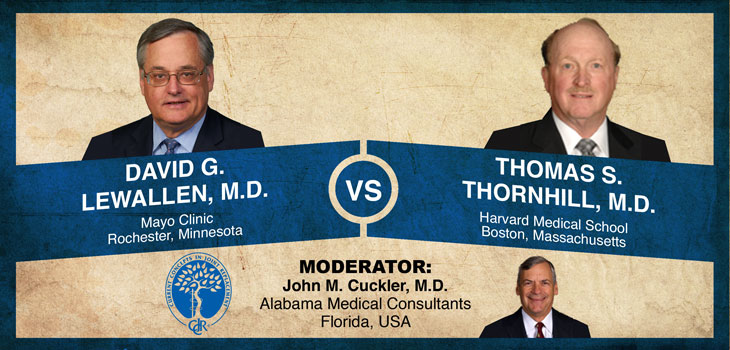
This week’s Orthopaedic Crossfire® debate is “The All Poly Tibia: Cheaper and Better.” For the proposition is David G. Lewallen, M.D. at Mayo Clinic in Rochester, Minnesota; against the proposition is Thomas S. Thornhill, M.D. from Harvard Medical School. Moderating is John M. Cuckler, M.D. from Alabama Medical Consultants in Florida.
Dr. Lewallen: “All polyethylene tibias are an underappreciated workhorse for total knee arthroplasty. There are no ideas more dangerous than the things we think we know for certain. These are all concepts that I’ve learned from mentors, which we’ve subsequently come to learn weren’t so true (‘suction irrigation tubes are good for infected joints, ’ ‘bone loss around failed total joints is to due cement disease, ’ etc.).”
“Modular tibial trays are the gold standard for modern total knee arthroplasty, but the day will come when we look back on this with some perplexity. The biggest challenges we’ve faced the last decade have been polyethylene wear, osteolysis and bone loss. This kind of particulate driven bone resorption is not something that was seen when I was a resident. This is an advent of more modern designs, particularly the modular tibial tray.”
“Anything that drives down particle size can produce significant osteolysis. What we thought we knew for sure was that it was all about the topside, but you have cases like the 28-year-old Geomedic with significant poly wear. At the time of revision we are accustomed to seeing delamination, large sheets of poly…but you can’t find a case of significant blowout lysis with older designs.”
“When you look at insert exchange in the literature it’s usually a bad idea. The results are often poor; there’s often something else wrong that simple poly liner exchange doesn’t solve. And locking mechanisms move at the beginning and then more over time—regardless of design. There is tibial surface abrasion, third party debris—and it’s not just in a single design.”
“There are many reports of locking mechanism backside failure and back surface wear in the literature. If you look at monoblock designs at long term follow-up…very durable results. And yet we put in a modular tray where the results are not as durable.”
“A single surgeon series from Dr. Ranawat with a particular design showed superior results with a monoblock. In a series from Weber they showed several-fold higher problems with revision, radiolucencies, and lysis with modular implants. Our Mayo database contains over 10, 000 patients. We looked at all the different tibial designs and compared the metal-backed to all-poly by different manufacturers. Even when we removed the one design we knew was an outlier, the all-poly implants did better—even when corrected for age, gender, and obesity. So it’s hard to make the case that there’s some great advantage to metal backed trays…and in fact I think there’s probably a disadvantage.”
“Cross-linked poly may help, and we may get some help from the effect it has on reducing wear. But what about the material properties? It’s more expensive, and rotating platforms, stress shielding. Time will tell…in the meantime, use a modular tray only if you must, but otherwise use a cemented all-poly tibia.”
Dr. Thornhill: “There are benefits to all-poly tibia: costs less, good long term results, and compression molded polyethylene. Our polyethylene has improved; there is better wear resistance, better mechanical strength, and better oxidative resistance. And there is no backside wear.”
“But all-poly tibia results are generally in low demand patients, and backside wear is less than it has been. The fact is that as you go into the area where you had metal backed components with holes and screw osteolysis and designs that really weren’t made for cementless fixation (and had a lot of osteolysis)—many of those were the modular designs with significant backside wear.”
“Some things have improved backside wear in modular components. There is improved metal tibial surface, a tendency to go to polished cobalt chrome, stronger polyethylene (so it has better mechanical stability), and less wear on both the femoral/tibial and the backside. There is reduced micromotion with a better locking mechanism and better interference fit.”
“Modularity facilitates intraoperative and revision options. You can change the congruity from a cruciate retaining to a cruciate substituting, but it does require some other changes. You can change the congruency to an ultra congruent; you can also change tibial thickness and increase conformity in a revision where the tibial tray is fine.”
“Dealing with tibial bone loss is important because there is significant weakness. There are data from years ago showing that if you get greater than 8mm of polyethylene, some of the bending moments that occur are not as important. But they are still not good, particularly in situations like in a varus knee where you see a lot of sclerosis on one side and osteopenia on the other side. Once you clear this off you see a significant discrepancy between the medial tibial plateau and the lateral tibial plateau in this varus knee.”
“Cement actually creates a uniform proximal tibial mantle to prevent the bending moments. When you get thick enough polyethylene the moment is decreased, but still not similar to a modular system. As for fixation options, I think we will at some point move to un-cemented designs. The results to date are mixed on these systems. I think the economics may dictate a change in selected patients. But at the present time I’ll stick with modularity because I believe the backside wear problem is less.”
Moderator Cuckler: “David, your opponent suggests that an all-poly tibia should only be used for low demand patients. Do you agree?”
Dr. Lewallen: “I think it’s reasonable to put an all-poly tibia in patients of all ages. I use a cementless monoblock tibial design in some young, active patients because we are studying those patients and learning whether that will be a more durable solution for them. The argument that was just made about bone ingrowth perhaps being more durable than cement fixation over the long term is an untested premise. We have our first prospective, randomized group out to about five years; we need longer follow-up. I use modular trays occasionally, such as with bone deformity, and in some very obese patients I will use a modular tray because it’s technically much easier to do the operation in those patients than it is to put in a monoblock posterior stabilized design.”
Moderator Cuckler: “Is severe osteoporosis a contraindication to the all-poly tibia?”
Dr. Lewallen: “No.”
Moderator Cuckler: “Tom, is there any time you can think of when you wished you had an all-poly tibia?”
Dr. Thornhill: “No.”
Dr. Lewallen: “How about when you’re removing a well fixed one, Tom?”
Dr. Thornhill: “I will use some all-poly tibias. I probably shouldn’t admit this, but I think I’m far enough away from home to be able to say this: in spite of all the trials and checking, I occasionally have a situation where I say, ‘I wish I had an insert that was 2mm thicker.’ That’s when I’m really glad that I have a modular component.”
Moderator Cuckler: “So one of the advantages of modularity is the ability to change either the conformity of the bearing surface or the thickness of the surface at your final trial reduction, correct?”
Dr. Thornhill: “Yes, when I open a knee for other reasons, just the price of opening the knee in most cases, destabilizes it. I put a tibial insert back in that is at least 2mm thicker. And we haven’t mentioned that if you have a primary knee with a bone defect you should use an augment, which is a benefit of a modular system.”
Moderator Cuckler: “How do we balance the cost and the advantage of modularity versus the excellent performance of the all-poly tibia?”
Dr. Thornhill: “If you can have a single tray that can accept many different thicknesses and configurations the fact is that you will drive the cost down. If you argue purely on the basis of cost then there’s a stronger argument for an all-poly tibia. I think that the functionality that you get with modularity and intraoperative decision making—remembering that technical problems are a major cause of failure—I think modularity wins.”
Moderator Cuckler: “David said that the revision of the failed all-poly tibia is almost always more straightforward than the revision of the modular tibial component. True or false?”
Dr. Thornhill: “True.
Moderator Cuckler: “So why not use an all-poly?”
Dr. Thornhill: “I don’t go into an operation with the idea that it’s going to fail. The Mayo data is a massive registry of multiple implants, and they go back to the time when we had all the problems…and backside wear was the major culprit.”
Moderator Cuckler: “David, what about the ability to change the stability mechanism of the tibial component?”
Dr. Lewallen: “There is a bit of a learning curve when you go from modular implants to an all-poly or monoblock. There’s a bit of slop in the knee that goes away once you cement the interfaces. It can be the source of a little more laxity in the knee.”
Moderator Cuckler: “And the difficulty in cleaning the posterior recess of the tibial and femoral components once they are cemented?”
Dr. Lewallen: “Good exposure…it’s a matter of seeing what you are doing.”
Moderator Cuckler: “And adequate exposure is obtained how?”
Dr. Lewallen: “I like to see the entire backside of the tibial component. I don’t like operating through portholes. Particularly for the occasional surgeon it’s important to have excellent visualization to avoid positioning errors and to be able to clean cement out thoroughly.”
Moderator Cuckler: “Tom, I don’t think you’d say that you would get worse exposure than David just because you’re using a modular device.”
Dr. Thornhill: “I think there are two areas of the knee that you really need to see. I was going to argue about clearing cement with a modular system, but it would be somewhat disingenuous of me because I save the posterior cruciate and I put the final insert in when I cement the femur…and I cement all my components at the same time. You need to be able to see the anterolateral part of the tibia in order to prevent abnormal rotation; and I think you need to see the posterolateral part of the tibia in order to ensure that your components are in right and the cement is cleared.”
Moderator Cuckler: “So whichever way you go, get great exposure. Thank you, gentlemen.”
Please visit www.CCJR.com to register for the 2013 CCJR Winter Meeting, December 11–14 in Orlando, Florida.
React:
Discussion
This is a fascinating development. In my practice we've seen similar outcomes with the revised protocol. The key differentiator seems to be patient selection criteria. Has anyone else noticed the correlation with BMI thresholds?
Great point. I'd push back slightly on the conclusion, the sample size in the cited study is too small to draw population-level inferences. That said, the directional signal is compelling and worth a larger RCT.
We implemented a similar approach last year. Early results are promising but we're still gathering 12-month follow-up data. Happy to share our protocol if anyone is interested.
Join the conversation
Orthopedic professionals are discussing this. Sign in and upgrade to read every comment and add your voice.