
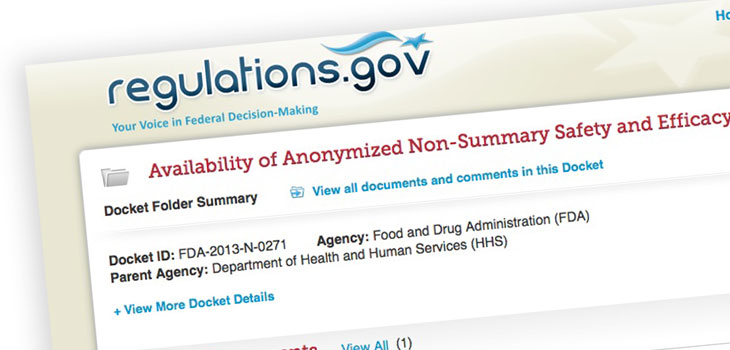
The FDA wants to share your clinical data with “non-FDA experts and other interested parties.”
FDA Proposes Sharing Clinical Data
2 min read Premium comments
Secondary
The agency says data gained from patients participating in clinical trials should be “maximized” for the benefit of society. So the agency is proposing to share clinical and preclinical data derived from marketing applications after de-identifying and masking that data.
Safeguard Commercial Investments
However, the agency says it wants to do it in a way that would “both safeguard the privacy interests of patients enrolled in clinical trials, and appropriately protect the commercial investments of sponsors.”
The proposal contemplates the availability of certain data after appropriate steps have been taken to de-identify it and remove the data’s link to a specific product, study, or application.
The proposal, according to the FDA, does not pertain to unmasked safety and effectiveness data, (i.e., data that can be linked to a specific, identified application) including full study reports; the circumstances under which the disclosed information is already specifically set forth in the Federal Food Drug and Cosmetic Act and FDA’s regulations.
Further, FDA will not make available business-related confidential commercial information contained in product applications, including but not limited to information concerning licensing agreements and information identifying suppliers, unless such information has already been publicly disclosed by the sponsor. Nor will the Agency make available trade secret information under this proposal, ” stated the FDA announcement published in the Federal Register on June 4, 2013.
The agency invites comments on the issues to be considered with regard to such availability and on any limitations that should be placed on the availability of these data. You’ve got until August 5, 2013.
The agency says making that data available to non-FDA experts and other interested parties could make an important contribution to improving the efficiency and effectiveness of medical product development by providing scientific data that may be of value in the generation of new knowledge to facilitate innovation in the development and evaluation of critically needed medical products.
“Analysis of data from multiple clinical and preclinical studies has been used to identify potentially valid endpoints for clinical trials, understand the predictive value of preclinical models, clarify how medical products work in different diseases, and inform development of novel clinical designs and endpoints to the benefit of patients, ” continued the announcement.
The agency says it has considerable expertise in analyzing individual patient level and aggregated clinical trial data, but recognizes the potential to further advance regulatory science by allowing other experts the opportunity to contribute to these efforts. To fully realize the potential of these data, experts outside of FDA would need to become actively engaged in the research.
To read the notice and submit electronic comments, click here.
Written comments may be submitted to the Division of Dockets Management (HFA–305), Food and Drug Administration, 5630 Fishers Lane, rm. 1061, Rockville, Maryland, 20852.
Author
React:
Discussion
This is a fascinating development. In my practice we've seen similar outcomes with the revised protocol. The key differentiator seems to be patient selection criteria. Has anyone else noticed the correlation with BMI thresholds?
Great point. I'd push back slightly on the conclusion, the sample size in the cited study is too small to draw population-level inferences. That said, the directional signal is compelling and worth a larger RCT.
We implemented a similar approach last year. Early results are promising but we're still gathering 12-month follow-up data. Happy to share our protocol if anyone is interested.
Join the conversation
Orthopedic professionals are discussing this. Sign in and upgrade to read every comment and add your voice.