
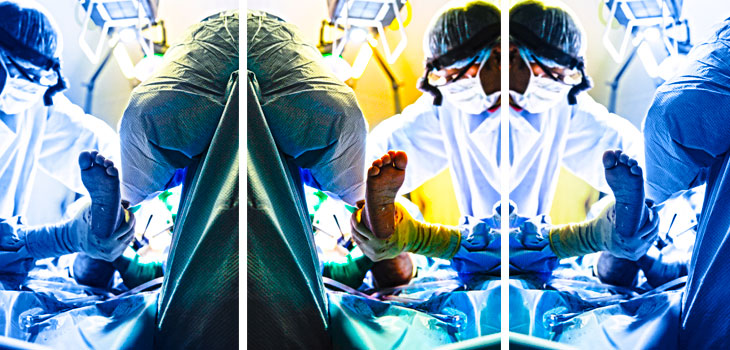
The Edmonton Journal (Canada) reports an uncommon surgery performed for the first time in the area. Orthopedic surgeon Nadr Jomha transplanted a shin bone, complete with the cartilage and meniscus to reconstruct the knee of a 22-year-old man who had suffered a serious workplace injury.
Surgeon Transplants Shin Bone With Meniscus
1 min read Premium comments
Secondary
The patient injured his leg two years ago when a 1, 000-kilogram pump jack weight tipped over on his left leg. He had a five-centimeter tear in the main blood vessel in his leg, a dislocated knee, and rips to three of the four ligaments in his knee.
Jomha initially conducted several surgeries to stabilize the leg and repair the blood vessels, after which he reconstructed the torn ligaments using donated tendons. However, he soon realized there was a more serious problem. The top of the patient’s shin bone had died and begun collapsing.
Jomha contacted a new tissue program in Calgary to see if it had any donated parts that would fit his patient. It did. Jomha had a good match. In the surgery, Jomha sawed off the dead part of the patient’s shin bone and removed it. He made the same cut on the donor bone, leaving the cartilage and meniscus attached.
Jomha transplanted all three components into the leg, securing the donor bone onto the original bone with a plate and screws. Over time, he said, the body replaces the foreign bone with its own bone in a process known as creeping substitution. Unlike live organ transplants, no anti-rejection drugs were required.
Though the patient still has months of rehabilitation ahead, the transplant operation has already made a difference in that he can bend his knee further and with far less pain than before. He hopes he can soon discard his crutches and start to put weight on the leg.
Author
React:
Discussion
This is a fascinating development. In my practice we've seen similar outcomes with the revised protocol. The key differentiator seems to be patient selection criteria. Has anyone else noticed the correlation with BMI thresholds?
Great point. I'd push back slightly on the conclusion, the sample size in the cited study is too small to draw population-level inferences. That said, the directional signal is compelling and worth a larger RCT.
We implemented a similar approach last year. Early results are promising but we're still gathering 12-month follow-up data. Happy to share our protocol if anyone is interested.
Join the conversation
Orthopedic professionals are discussing this. Sign in and upgrade to read every comment and add your voice.