
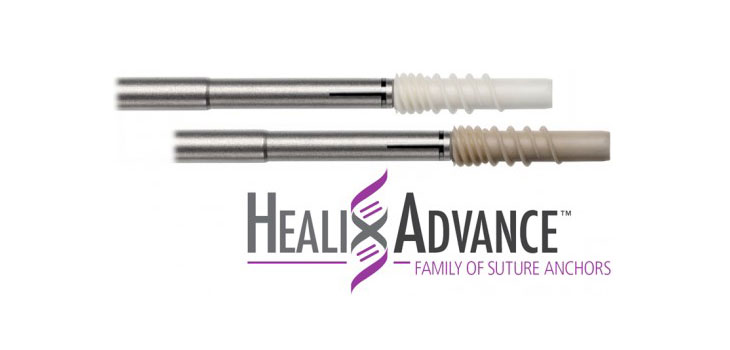
Mitek Sports Medicine, part of the DePuy Synthes Companies of Johnson & Johnson, has launched the Healix 3.4mm Suture Anchor, the company’s smallest dual-thread suture anchor for rotator cuff repair. This is part of a new double-loaded minimally invasive partial thickness rotator cuff repair system—called the Healix Transtend Implant System.
Mitek Launches Smaller Shoulder Repair Screw
1 min read Premium comments
Secondary
The 3.4mm suture anchor is about 38% smaller than conventional suture anchors and features dual-thread technology, which, according to the company’s press release, engages both cortical and cancellous bone for optimal strength.
“The Healix 3.4mm anchor offers me the versatility of BR and PEEK options, and its small diameter enables more precise placement, and occupies less of the footprint than larger suture anchors, ” said Amir Moinfar, M.D., an orthopaedic surgeon and sports medicine specialist at Baltimore Washington Medical Center in Maryland. “However, despite its small size, the Healix 3.4mm anchor has the pullout characteristics needed for medial row fixation and the double-loaded orthocord gives me the opportunity for a variety of spanning options for incorporating lateral fixation.”
Mitek officials say that the Healix Transend implant system enables surgeons to repair a partially torn rotator cuff with optimal fixation strength and minimal trauma to surrounding intact tissue, adding that this percutaneous system maximizes procedural visualization and preserves the patient’s natural anatomy.
Author
React:
Discussion
This is a fascinating development. In my practice we've seen similar outcomes with the revised protocol. The key differentiator seems to be patient selection criteria. Has anyone else noticed the correlation with BMI thresholds?
Great point. I'd push back slightly on the conclusion, the sample size in the cited study is too small to draw population-level inferences. That said, the directional signal is compelling and worth a larger RCT.
We implemented a similar approach last year. Early results are promising but we're still gathering 12-month follow-up data. Happy to share our protocol if anyone is interested.
Join the conversation
Orthopedic professionals are discussing this. Sign in and upgrade to read every comment and add your voice.