
“I believe high flexion designs have no appreciable difference. I used to be excited about these designs, mainly because we like new things, ” says Mathias Bostrom. “Not only do I believe in high flexion designs, I have designed one, ” counters Chitranjan Ranawat.
High Flexion TKA Designs: Bostrom v. Ranawat
6 min read Premium comments
Great Debates
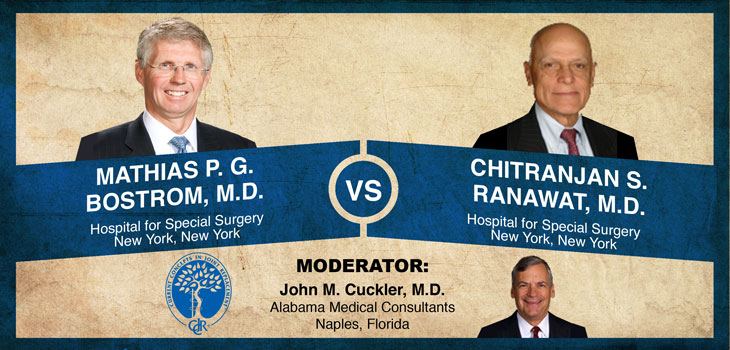
This week’s Orthopaedic Crossfire® debate is “High Flexion TKA Designs: No Appreciable Difference.” For the proposition is Mathias P. G. Bostrom, M.D. and against the proposition is Chitranjan S. Ranawat, M.D., both from Hospital for Special Surgery in New York. Moderating is John M. Cuckler, M.D. from Alabama Medical Consultants in Naples, Florida.
Dr. Bostrom: “I believe that high flexion designs have no appreciable difference. I used to be excited about these designs, mainly because we like new things. Basically, these designs were modifications—they’re not radical differences. There’s a modification of the anterior tibial tray and polyethylene insert, of the tibial post geometry, and some modifications of the posterior femoral geometry.”
“The cutout on the polyethylene gives a bit more room for the patellar tendon. That makes a lot of sense because you wouldn’t have impingement of the patellar tendon on the implant. And when you’re flexing at 90 degrees there’s a fairly high patella contact force, however at higher flexion angles there is less contact force in this region.”
“There were some modifications of the post geometry so that it’s slightly smaller, there was some material removed anteriorly, and there was improved rotation. Some of the companies have had this sort of approach.”
“Finally, you can modify the femoral component itself with a smaller posterior radius, with the thought being that you can get better flexion and less impingement and greater contact areas. There are some reasonably well done studies showing that the high peak stresses at extreme degrees of flexion such as 155 was less with this smaller radius of curvature of the femoral condyle. Again, the idea is to increase the contact area so that there’s better flexion and less impingement.”
“These modifications have been made on both fixed and mobile bearing designs. The articular surface modification is to increase surface contact area in flexion, provide patella relief, and to increase tibial polyethylene component stability.”
“Now, the clinical data. In a prospective study from Scotland where they compared the NextGen standard to high flex components. There was, unfortunately, no significant difference in outcome, including the maximum knee flexion, between those receiving the standard and high flexion designs. Looking at a meta analysis from Canada we also see that there was no clinically relevant difference. There was only about a two degree increase in flexion with the high flex designs. In vitro analyses have shown that there may be a higher degree of loosening; the forces were greater in the high flex designs.”
“So implants that allow a high degree of flexion showed a marked rate of early loosening of the femoral component, which was associated with weight bearing in maximum flexion. My conclusion is that there is no difference. The real determinants of postoperative knee flexion are: preoperative flexion, surgical technique, patient motivation, rehabilitation regimen…and then only a distal fit is implant design itself.”
Dr. Ranawat: “Not only do I believe in high flexion designs, I have designed one. So why use a high flexion knee? We want to obtain motion greater than 120 degrees in most of our patients, especially east of Turkey (i.e., India and other regions) want more motion for activities of daily living. So you want to design a knee which will not have excessive polyethylene wear, will not create problems in the patellofemoral joint, and will not have loosening.”
“So we designed a knee to achieve these goals: The PFC Sigma RP-F. We created the modification in the posterior third of the condyle so that the contact stresses are better after 110 degrees to 155 degrees of motion. It is a modification of a PFC RP knee; there are six sizes. The post has been moved 2mm posteriorly, the jump height is 16mm, and the third condyle is a load-bearing cam and post.”
“In a prospective study we used a patient administered questionnaire, which picks up more detailed information. Between March 2004 and December 2006 we had 106 knees (88 patients; 18 bilaterals); a third of these patients were of Indian or Asian descent. We found that pain was significantly better. The pre-operative range of motion (ROM) was 110.7 degrees; post-op ROM was 124.3; 41% of patients had greater than 130 degrees ROM; 10% had greater than 140 degrees of ROM.”
“We asked patients, ‘How much does the knee affect your sense of well being?’ and 83% said ‘never, rarely, or occasionally.’ We asked, ‘Do you have difficulty putting on shoes/socks?’ and 95% could do it. Also, ‘Do you have difficulty getting in and out of a car?’ and 83% said ‘never, rarely, or occasionally.’ Also, 60% could kneel and 60% could squat.”
“Pain and crepitation was a weakness of this study, as was lack of a control group. Also, it was a non-consecutive series and there was selection bias for patients of Asian descent. There was no instability, manipulations, infections, revisions, spinout; there was one reoperation for persistent anterior knee pain and stiffness.”
“So in conclusion, a high flexion knee design can achieve higher flexion.”
Moderator Cuckler: “Gentlemen, I don’t know what to think. Chit, you said 16% of your patients were unsatisfied, 17% had trouble getting in and out of a car, 40% can’t kneel…and the two prospective, randomized studies in the peer-reviewed literature show no difference. So why are we still fooling with this high flex design? Have we proven that it works?”
Dr. Bostrom: “The answer is ‘no.’ As much as I would have loved it to work, the data doesn’t support it in randomized studies. In case control studies they get high flexion, but you can argue that that may be surgical technique. The pre-operative ROM in your series, Dr. Ranawat, was actually pretty good…so they ended up with a pretty good ROM.”
Moderator Cuckler: “Chit, would you agree that we need a prospective randomized study with a blinded assessment of your particular design?”
Dr. Ranawat: “Any prospective study brings out the truth in any design or technique, so the answer to your question is ‘yes.’ But remember one thing: literature meta analysis or other prospective studies shows that all high flexion knees are not the same. What I’m saying is a design which has a cam and a post as a load bearing structure where the knee rolls back can’t be compared.”
Moderator Cuckler: “Patient satisfaction. Chit, you said 16% were dissatisfied with the outcome of the surgery. Let’s say an Asian patient comes to you and would like to be able to kneel/squat. What do you tell them in terms of expectation in terms of your RP/PS knee high flexion femoral design?”
Dr. Ranawat: “You say you’re going to get good motion. If they have 115 degrees I tell them they can get up to 125-145 degrees…and that the chance is about 40-50%. Then, after any total knee, if you ask, 10% of all patients have some anterior knee pain. If you don’t ask, the Knee Society Score does not pick up those kinds of pain issues. So I’ll say, ‘You have a chance of pain interpretation and the risk is 2-3%.’”
Moderator Cuckler: “Mathias, how do you handle patient expectations?”
Dr. Bostrom: “The key thing is having the discussion with them pre-operatively so they understand that this operation is a great surgery, but you will always remember that you have a knee replacement. It’s very different than hips where often they forget they’ve had their hip done after a couple of years.”
Moderator Cuckler: “Is there something different we should do in our rehabilitation routine in order to produce improved flexion…something that’s independent of knee design?”
Dr. Bostrom: “I don’t think there’s anything that’s going to make a huge difference. I think aggressive rehabilitation post-operatively is critical. But the ones that get really stiff are going to get stiff whether you have aggressive rehabilitation, a high flexion design…a lot of the really stiff knees we see post-op are idiosyncratic and we can’t really predict those cases.”
Moderator Cuckler: “Chit?”
Dr. Ranawat: “Rehab after these surgeries has been overemphasized. I’ve done a prospective randomized study where one group of patients got everything (in house physical therapy, etc.). The other group was just shown how to walk and sent home with no physical therapy (PT). At six weeks the group with no PT was a little behind; at three months there was no difference.”
Moderator Cuckler: “Continuous Passive Motion post-op?”
Dr. Bostrom: “Yes.”
Dr. Ranawat: “I give it because everybody else does, but there is no data to support it.”
Moderator Cuckler: “Thank you.”
Please visit www.CCJR.com to register for the 2013 CCJR Spring Meeting, May 19 – 22 in Las Vegas, Nevada.

“You may now view CCJR meeting content on your mobile device on the CCJR MobileTM App. Please scan the QR code to download from iTunes.”
React:
Discussion
This is a fascinating development. In my practice we've seen similar outcomes with the revised protocol. The key differentiator seems to be patient selection criteria. Has anyone else noticed the correlation with BMI thresholds?
Great point. I'd push back slightly on the conclusion, the sample size in the cited study is too small to draw population-level inferences. That said, the directional signal is compelling and worth a larger RCT.
We implemented a similar approach last year. Early results are promising but we're still gathering 12-month follow-up data. Happy to share our protocol if anyone is interested.
Join the conversation
Orthopedic professionals are discussing this. Sign in and upgrade to read every comment and add your voice.