
Scientists at Johns Hopkins have dug down below cartilage for answers to osteoarthritis (OA). They now have evidence that the bone underneath the cartilage is also a key player and exacerbates the damage. In a proof-of-concept experiment, they found that blocking the action of a critical bone regulation protein in mice halts progression of the disease.
Eureka! OA Framework Shifts
2 min read Premium comments
Secondary
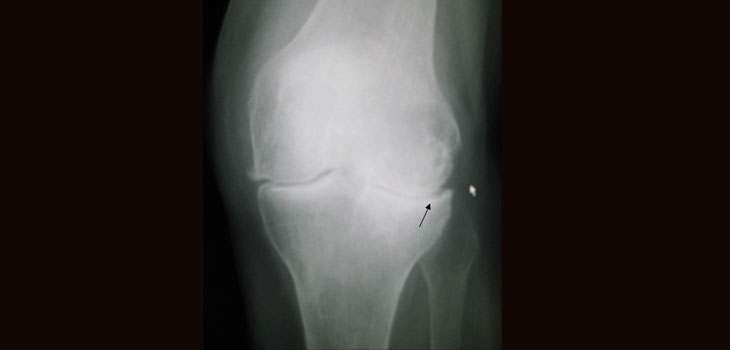
The new theory on OA, reported May 19 in Nature Medicine, suggests that initial harm to the cartilage causes the bone underneath it to behave improperly by building surplus bone. The extra bone stretches the cartilage above and speeds its decline.
“If there is something wrong with the leg of your chair and you try to fix it by replacing the cushion, you haven’t solved the problem, ” says Xu Cao, Ph.D., director of the Center for Musculoskeletal Research in the Department of Orthopaedic Surgery at the Johns Hopkins University School of Medicine, in the May 2, 2013 news release. “We think that the problem in OA is not just the cartilage ‘cushion, ’ but the bone underneath, ” he adds.
Dr. Cao says that the lack of effective drugs or a complete understanding of the underlying process that causes OA to progress led his group to search for a different underlying cause. “We began to think of cartilage and the bone underneath it, called subchondral bone, as functioning as a single unit, ” says Cao. “That helped us to see the ways in which the bone was responding to changes in the cartilage and exacerbating the problem.”
Using mice with ACL tears, the researchers found that, as soon as one week after the injury, pockets of subchondral bone had been “chewed” away by osteoclasts. This process activated high levels in the bone of a protein called TGF-beta1, which, in turn, recruited stem cells to the site so that they could create new bone to fill the holes. Dr. Cao calls these pockets of new bone formation “osteoid islets.”
But the bone building and the bone destruction processes were not coordinated in the mice, and the bone building prevailed. It is this extraneous bone formation that Dr. Cao and his colleagues believe to be at the heart of OA…as confirmed in a computer simulation of the human knee.
The team tried several methods to block the activity of TGF-beta1. When a TGF-beta1 inhibitor drug was given intravenously, the subchondral bone improved significantly, but the cartilage cap deteriorated further. However, when a different inhibitor of TGF-beta1, an antibody against it, was injected directly into the subchondral bone, the positive effects were seen in the bone without the negative effects on the cartilage. The same result was also seen when TGF-beta1 was genetically disrupted in the bone precursor cells alone.
Dr. Cao told OTW, “There are many ways to inhibit TGFb activity for the treatment: administration of TGFb antibody directly in the subchondral bone, inhibition of bone resorption or normalization of bone remodeling in the subchondral bone. In any of the treatments, we need get our IRB [institutional review board] approved first. Then we can start to recruit patients for the trial.”
React:
Discussion
This is a fascinating development. In my practice we've seen similar outcomes with the revised protocol. The key differentiator seems to be patient selection criteria. Has anyone else noticed the correlation with BMI thresholds?
Great point. I'd push back slightly on the conclusion, the sample size in the cited study is too small to draw population-level inferences. That said, the directional signal is compelling and worth a larger RCT.
We implemented a similar approach last year. Early results are promising but we're still gathering 12-month follow-up data. Happy to share our protocol if anyone is interested.
Join the conversation
Orthopedic professionals are discussing this. Sign in and upgrade to read every comment and add your voice.