
Bill Walter says, “There are many studies showing good results with different cementless designs.” Fares Haddad counters, “Not so fast. As of now, cemented total knee replacement is the one with established clinical results.”
Cementless Knee Fixation: Ready for Prime Time?
7 min read Premium comments
Great Debates
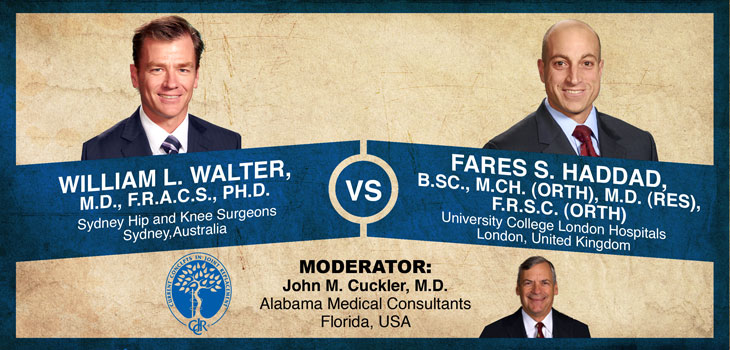
This week’s Orthopaedic Crossfire® debate is “Cementless Fixation: A Contemporary Durable Solution.” For the proposition is William L. Walter, M.D., F.R.A.C.S., Ph.D. of Sydney Hip and Knee Surgeons in Australia and against the proposition is Fares S. Haddad, B.Sc., M.Ch. (Orth), M.D. (Res), F.R.S.C. (Orth) from University College London Hospitals in the UK. Moderating is John M. Cuckler, M.D. from Alabama Medical Consultants in Florida.
Dr. Walter: “Total hips in the U.S. are 91% cementless and only 9% hybrid; total knees, however, are 91% cement and 9% hybrid or cementless. In the UK they cement a lot more of their total hips (38% cementless); total knees are 94% cement. In Australia we’re more enthusiastic about cementless knees, and roughly 45% of the knees in Australia have cementless fixation of either the femoral component, or both the femoral component and the tibial component.”
“Maybe there is a low usage of cementless knees in the U.S. because of poor experience with early designs. One company took a cemented design and simply added a porous coating and called it a cementless knee without modifying the design.”
“If we look at a micromotion study we have of the original LCS (low contact stress) with the POROCOAT, there is micromotion under the edge of the implant compared to when you put peripheral pegs which reduce the micromotion.”
“Cementless design works better if there is peripheral fixation on the tibial component with either screws or pegs. Also, the surgical technique must be fastidious. When we’re doing cementless surgery we make sure that with our bone cuts there’s no rocking of the tibial component. If you have high points that allow this rocking, they may lead to loosening. With cement that wouldn’t matter, but with the cementless design you have to be a better carpenter if you want to avoid the tibial component motion. With the femoral cuts you have to be more fastidious.”
“There are many studies showing good results with different cementless designs. And there’s a list of cases in the literature showing equivalent survivorship between cemented and cementless. As for the Australian National Joint Replacement Registry we have a high rate of cementless—about 22%—with 55% cemented and 22% hybrid. There is some higher risk of failure in the first few years—failure of fixation—but after that it is even. In our own hands we have published with cementless designs—95% at eight years. The failures were due to poor polyethylene not fixation failure.”
“So my conclusions are that cementless fixation requires stable initial fixation, which requires a good surface and good surgical technique. It also requires a good bearing surface. And for the same reasons that cementless fixation is philosophically appealing in hips, it’s also appealing in knees.”
Mr. Haddad: “I’m standing in for Robert Barrack, who has done all of the hard work for this presentation. We don’t believe cementless is a contemporary durable solution. Our indications—Robert’s and mine—for cementing a total knee—are based on age, gender, activity, and bone quality. If you’re old, middle aged, or young you get cement; if you’re male or female you get cement; if you’re active, moderately active, or inactive, you get cement; if you’re osteopenic, have average or high bone density, then you get cement.”
“Long-term data from Insall and his group: over 20 years, cemented total knee replacement has excellent clinical results with very low failures. It works, and it works in many hands. Rorabeck’s data comparing hybrid, cemented, and cementless: they came to a clear conclusion that there was an unequivocal advantage of cement as a preferred method of fixation for TKA [total knee arthroplasty].”
“Robert Barrack’s group examined retrieved components looking for ingrowth with early generation cementless implants, and got no bone ingrowth in over half of their cases. In many cases, the peripheral fixation didn’t ensure success because you still had increased uptake on bone scans and fibrous ingrowth rather than true bony ingrowth.”
“The mobile bearing failures were widely seen as cases where cementless fixation sadly failed. In a lot of cases, early tibial revision is required (8% in Robert Barrack’s series), with minimal bone ingrowth seen in those that had to be revised. The reality is that cement makes TKA much easier. It allows for good fixation, it lets you fill defects, and it allows you to make those final adjustments that the perfect carpenters amongst us cannot really do.”
“The key things are that you need an adequate surgical exposure, so beware of MIS [minimally invasive surgery] techniques. You need to be able to sublux the tibia, expose all the bony surfaces so that you can adequately prepare them. Everything needs to be cleaned with pulsatile lavage.”
“If there’s sclerotic or eburnated bone you need to drill it and make it a textured surface that will accept both micro and macro lock from cement. That’s easy to do if you have a good exposure.”
“Try to get the cement into the holes; then you compress the tibia and implant all the components at the same time so that you can compress everything together in full extension. With modular components you can then go ahead and remove the excess cement.”
“In Robert’s series there were 152 primary knees during his patella study; 10-15 year follow-up with no revisions for loosening. So there is a good case in Australia perhaps…perhaps with modern technology for looking at cementless TKA, but for the moment, cemented total knee replacement has established clinical results. It’s got a forgiving technique for the lower volume surgeon. All the previous cementless implants have had a poor track record, and although porous metals may have a future, we must be careful how we introduce innovation…wait for long-term data.”
Moderator Cuckler: “Bill you made the point that the design has to be specific to fixation. What problems does cementless fixation of the knee solve for us?”
Dr. Walter: “If you ask a surgeon the same question about hips—in America a lot of surgeons use cementless hips—and I think there is a belief that if you get cementless fixation once you have the bone growing into the metallic implant that it will be more durable in the longer term. I would apply the same philosophy to cementless knees.”
Moderator Cuckler: “I find the worst osteolysis with cementless, well fixed knees. Fares, do you buy into the theory that cement can act as barrier to the ingress of polyethylene wear debris?”
Mr. Haddad: “I’m not sure I buy into that per se. I think what we’ve got with cement is stable implants and hence potentially less wear and less osteolysis. With a lot of the cementless implants you had third bodies coming off the surfaces and instability at the interface, and that led to further problems.”
Moderator Cuckler: “Bill, should the surgeon doing 20-25 knee replacements per year try to do a cementless knee?”
Dr. Walter: “Probably not. I think it’s a more difficult technique. The point I was trying to make is that it can work if you use very good technique and the right implant.”
Moderator Cuckler: “So what’s worse? Bad cement technique and cemented fixation…what if you don’t know how to use cement in a total knee? Is that going to change the outcome?”
Mr. Haddad: “Although I think you should apply the principles and go for macrolock and microlock, it is perhaps less critical to get your cementing technique right in the knee than it is in the hip.”
Moderator Cuckler: “Bill, how does Australia handle the extra cost of the cementless implant? It’s been shown that the extra cost of this implant isn’t offset by the extra time it takes for cement or the extra time in the OR.”
Dr. Walter: “We pay too much for everything in Australia, so the companies just make less profit on the cementless implants.”
Mr. Haddad: “The uptake for cementless knees in the UK is very small so it’s not a significant issue. At the moment, for a total knee, I can’t see that the advantage justifies the extra cost.”
Moderator Cuckler: “Bill, how about the rehabilitation phase after a cementless knee? Do you have to alter weight bearing or activities?”
Dr. Walter: “We’ve had the same rehabilitation for cementless knees as we do for cemented. We don’t use CPM (continuous passive motion).”
Mr. Haddad: “Neither do we.”
Moderator Cuckler: “Some reports claim that there’s more blood loss with a cementless total knee. Has that affected your practice, Bill?”
Dr. Walter: “I don’t have any data to be able to answer that question, but when I do a knee replacement I leave the tourniquet down for the exposure. When I’m making the bone cuts I inflate the tourniquet.”
Moderator Cuckler: “Fares, do you put the tourniquet up for the entire procedure if you’re cementing or just for the cementing process?”
Mr. Haddad: “We only put the tourniquet up when we’re ready to cement.”
Moderator Cuckler: “Other than lavage and drying are you using anything else to dry the bone?”
Mr. Haddad: “The solutions we use for anesthesia include adrenaline and epinephrine. In the infected cases we also use hydrogen peroxide.”
Moderator Cuckler: “Bill, what are your contraindications for cementless fixation for a primary knee arthroplasty?”
Dr. Walter: “We use them in almost all bone; if you had very frail bone and an elderly patient with osteoporotic bone, that would be a contraindication. Also, complicated cases involving deformity where you may need a stem.”
Moderator Cuckler: “How about antibiotic containing bone cement in the immuno-compromised patient? Would that throw you over to the cemented side?”
Dr. Walter: “We routinely put antibiotics in our cement; we don’t come across those patients very often.”
Moderator Cuckler: “Thank you both.”
Please visit www.CCJR.com to register for the 2013 CCJR Winter Meeting, December 11–14 in Orlando, Florida.

“You may now view CCJR meeting content on your mobile device on the CCJR MobileTM App. Please scan the QR code to download from iTunes.”
React:
Discussion
This is a fascinating development. In my practice we've seen similar outcomes with the revised protocol. The key differentiator seems to be patient selection criteria. Has anyone else noticed the correlation with BMI thresholds?
Great point. I'd push back slightly on the conclusion, the sample size in the cited study is too small to draw population-level inferences. That said, the directional signal is compelling and worth a larger RCT.
We implemented a similar approach last year. Early results are promising but we're still gathering 12-month follow-up data. Happy to share our protocol if anyone is interested.
Join the conversation
Orthopedic professionals are discussing this. Sign in and upgrade to read every comment and add your voice.