
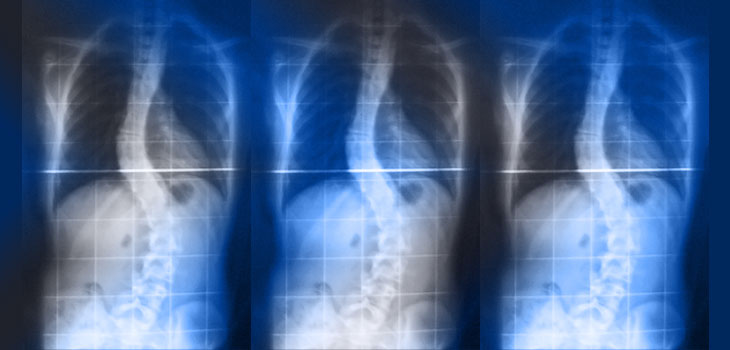
Big news from Japan…Researchers from the RIKEN Center for Integrative Medical Sciences have identified the first gene to be associated with adolescent idiopathic scoliosis (AIS) across Asian and Caucasian populations. The gene is involved in the growth and development of the spine during childhood. Dr. Ikuyo Kou and Dr. Shiro Ikegawa have just published their work in the journal Nature Genetics.
Adolescent Scoliosis: First Gene Discovered
1 min read Premium comments
Secondary
By studying the genome of 1, 819 Japanese individuals suffering from scoliosis and comparing it to 25, 939 Japanese individuals, the team identified a gene associated with a susceptibility to develop scoliosis on chromosome 6. The association was replicated in Han Chinese and Caucasian populations.
The researchers show that the susceptibility gene, GPR126, is highly expressed in cartilage and that suppression of this gene leads to delayed growth and bone tissue formation in the developing spine. GPR126 is also known to play a role in human height and trunk length.
“Our finding suggest the interesting possibility that GPR126 may affect both AIS susceptibility and height through abnormal spinal development and growth, ” explain the authors in the May 12, 2013 news release.
“Further functional studies are necessary to elucidate how alterations in GPR126 increase the risk of AIS in humans, ” they conclude.
React:
Discussion
This is a fascinating development. In my practice we've seen similar outcomes with the revised protocol. The key differentiator seems to be patient selection criteria. Has anyone else noticed the correlation with BMI thresholds?
Great point. I'd push back slightly on the conclusion, the sample size in the cited study is too small to draw population-level inferences. That said, the directional signal is compelling and worth a larger RCT.
We implemented a similar approach last year. Early results are promising but we're still gathering 12-month follow-up data. Happy to share our protocol if anyone is interested.
Join the conversation
Orthopedic professionals are discussing this. Sign in and upgrade to read every comment and add your voice.