
Two UK academics, Professor Adam Curtis and Dr. Matthew Dalby, at the University of Glasgow, and an astrophysicist, Dr. Stuart Reid, at the University of the West of Scotland, have grown new bone using high frequency vibrations. Their research has shown that it is possible to grow new bone by “nanokicking” mesenchymal stem cells 1, 000 times per second. They believe their research holds promise for fundamentally changing the way doctors grow bone.
Vibrating Mesenchymal Stem Cells Grow Bone
2 min read Premium comments
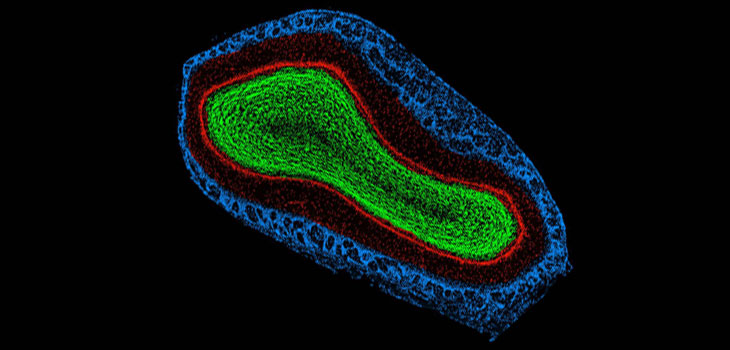
Secondary
Mesenchymal stem cells can be made to differentiate into specialized bone cell types. However, Dalby and Reid note that the present process is notoriously difficult and relies on highly engineered materials or a complex mixture of chemicals. The new technique makes use of the fact that, when individual bone cells stick together to form new bone tissue, the cell membranes of each cell vibrate as they adhere. It is thought that vibrating the stem cells at this frequency encourages ‘communication’ between the cells and promotes bone formation. Scientists can replicate this vibration by ‘kicking’ the stem cells in the lab around 5-30 nanometres in distance 1, 000 times a second. Dalby and Reid found that, at this vibration level, they could grow new bone.
With astrophysicist, Dr. Reid added to their team, the doctors were able to measure the strength and frequency of the kicks using an incredibly precise measuring technique called laser interferometry which is used to detect tiny ripples in space-time caused by gravitational waves. The team believes that this new technique is cheaper and easier to implement than current technologies and they hope that it will lead to new therapies for orthopedic conditions such as spinal traumas, osteoporosis and stress fractures.
Dalby said: “This new observation provides a simple method of converting adult stem cells from the bone marrow into bone-making cells on a large scale without the use of cocktails of chemicals or recourse to challenging and complex engineering, ” He added, “Multidisciplinary research is tricky as researchers need to learn new scientific languages. However, this collaboration between cell biologists and astrophysicists—an unlikely pairing—has yielded new insight as to how bone stem cells work.”
Reid said, “Linking stem cell research with expertise from the field of gravitational wave astronomy, where we have developed instrumentation that can measure length changes almost a million times smaller than the diameter of a proton, has enabled this unique research field to emerge.”
Dr. Sylvie Coupaud, from the Department of Biomedical Engineering at the University of Strathclyde, commented on the implications of the researchers’ work. “Vibration therapy could be applied to stimulate bone formation and maintain bone health as an alternative to traditional exercise. In the next phase of this bench-to-bedside research, parameters of vibration that have been shown by Dalby and Reid to successfully stimulate the development of bone cells in the lab can be scaled up for testing in patients to quantify their bone-stimulating effects in whole bones.”
Author
React:
Discussion
This is a fascinating development. In my practice we've seen similar outcomes with the revised protocol. The key differentiator seems to be patient selection criteria. Has anyone else noticed the correlation with BMI thresholds?
Great point. I'd push back slightly on the conclusion, the sample size in the cited study is too small to draw population-level inferences. That said, the directional signal is compelling and worth a larger RCT.
We implemented a similar approach last year. Early results are promising but we're still gathering 12-month follow-up data. Happy to share our protocol if anyone is interested.
Join the conversation
Orthopedic professionals are discussing this. Sign in and upgrade to read every comment and add your voice.