
“Hip replacement involves inevitable wear and osteolysis, ” says Edwin Su. “We need another option. “The data is on my side, ” counters Adolph Lombardi. “I’m finding no added advantage of resurfacing.”
Total Hip Replacement or Resurfacing?: Su v. Lombardi
7 min read Premium comments
Great Debates
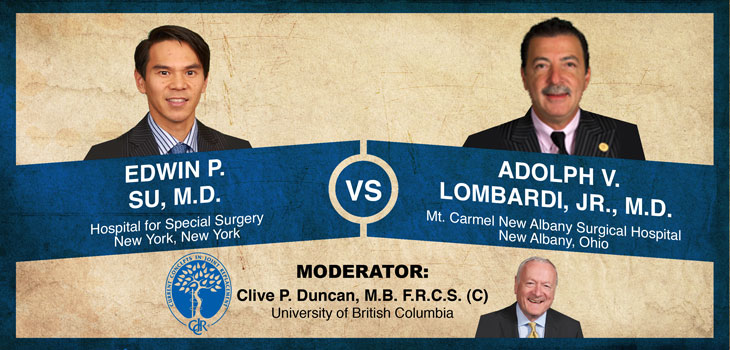
This week’s Orthopaedic Crossfire® debate is “Surface Replacement Arthroplasty: A Viable Option.” For the proposition is Edwin P. Su, M.D. from the Hospital for Special Surgery in New York. Against the proposition is Adolph V. Lombardi, Jr., M.D. of Mt. Carmel New Albany Surgical Hospital in Ohio. Moderating is Clive P. Duncan, M.B., F.R.C.S.(C) from the University of British Columbia.
Dr. Su: “My job is to convince you that we need an alternative to total hip replacement (THR). The problem with hip replacement is that there is inevitable wear and osteolysis. We also know there is dislocation…and dislocation as a reason for revision is increasing. I believe this is because our patients are more active and younger. The Swedish hip registry also demonstrates that in younger patients hip replacement does not work as well. In patients younger than 50 years old they have almost a 40% revision rate when they get to 20 years.”
“The challenge is performing THR in these young patients. They pose the greatest challenge to implant longevity and their increased activity may lead to an earlier need for revision surgery.”
“The benefits of resurfacing are bone preservation, joint stability, better reproduction of offset, it loads the bone more physiologically, and I believe it gives them a greater activity level. It preserves the femoral bone, it can reproduce the natural anatomy, and it avoids stress shielding, gives greater stability, and is an easier revision surgery.”
“We looked at this in a cadaveric study where we examined and weighed the reamings and removed bone. At the acetabular bone we had no difference, and in the femoral bone there’s clearly a difference. So overall there was a net saving of bone with the resurfacing operation. It definitely gives you a more stable joint. The large diameter metal-on-metal hip replacement is no longer being used, so how can you achieve stability in a patient who needs it?”
“There is a more physiologic loading of the bone. A THR receives load from the top, converts it into intramedullary hoop stresses, and this is not the normal way your bone is loaded. With a resurfacing the bone is loaded from the top and it transmits through the femoral neck…loading that bone and preserving it. So what will happen if you continue to load an implant? In a THR it may break.”
“With resurfacing there is better recreation of normal hip mechanics in matching length and offset. There’s also believed to be a higher level of activity. This has been controversial, but there were two recent presentations which demonstrated ten-year follow-up of a resurfacing versus total hip replacement. They found a significantly higher function score in the hip resurfacing group. In a similar study, researchers surveyed patients with a large diameter total hip replacement and hip resurfacing. They found that 80% of hip resurfacing patients—as opposed to 45% of total hip replacement patients considered themselves very active. Also, fewer hip resurfacing patients reported limitations in their activities.”
“Hip resurfacings in certain subgroups are also performing well in national joint registries. The latest data from the Australian registry—2011—there is a difference in gender. Females have a higher revision rate (over all years) than men. But if we look at this by age we see that men under 55, and 55-64, have about a 4.2% revision rate at seven years. If we compare that to a THR in the same age group at seven years we find that there revision rate for THR is actually higher. At seven years the revision rate for hip resurfacing in men under the age of 65 is lower than that of a hip replacement. This data can help us select the patients who will have the greatest success with resurfacing: men under the age of 65 with osteoarthritis and with a large femoral head size.”
Dr. Lombardi: “So we heard the pros of resurfacing. I’m going to use the literature and the registry data to show you that these aren’t true. It’s true that you preserve femoral bone stock. But do you preserve acetabular bone stock? His article says ‘yes, ’ but you can find whatever you want in the literature. In one paper by Longhead et al. (JBJS-Br, 2006) they had significantly higher volume of normal bone reamed in the acetabulum. And there was 311% more bone removed with resurfacing versus total hip. In a paper by Brennan et al. (JOS Hong Kong, 2009) there was no significant difference, so we have some people who do support the data that we just heard from Professor Su that there’s no difference in acetabular bone removed.”
“Range of motion (ROM): There seems to be an unfavorable head-neck ratio in resurfacing, and no resurfacing allowed for greater than 90 degrees without impingement in a study of eight designs and resurfacings (Kluess et al., Acta Orthop, 2008). In another study (Bengs et al., Acta Orthop, 2008) they tested eight hip replacements, three resurfacings and five total hips. There was statistically greater ROM with THR. Impingement occurred in 29/30 motions in resurfacing and 41/100 motions in total hip.”
“A cadaveric study by Incavo et al. (J Arthroplasty, 2010) with eight cadavers showed that a ROM of the total hip was comparable to the normal hip, but there was some restriction of flexion with resurfacing (as opposed to the normal hip).”
“Gait analysis: In a comparison of THA and resurfacing Peterson et al. (Int Orthop, 2010) found similar improvements in the mechanics of gait. Speed increased significantly, but with no difference between groups. So I’m finding no added advantage of resurfacing.”
“Looking at the functional outcomes of hip resurfacing versus large head THR, Lavigne et al. (CORR, 2009) found no difference. The operative groups reached the controls by three months. Killampalli et al. (Hip Int, 2009) found that in young patients at four-seven years there were no differences in levels of function or activity pursued.”
“Return to function: In a paper looking at resurfacing versus standard heads the authors found no differences in the various scores used, but found a statistically greater improved ROM score in THR—not resurfacing. (Stulberg et al., J Arthroplasty, 2009). As for outcomes, in a study by Lingard et al. (JBJS-Br, 2009) resurfacings had better one-year pain scores. At two-five years the clinical results were comparable between THR and resurfacings (Mont et al., CORR, 2009).”
“In a meta analysis of resurfacing versus cementless THR, we see that the rate of revision for mechanical failure is 1.3% for THR and 2.6% for resurfacing (Springer et al., J Arthroplasty, 2009). Vendittoli et al. (Hip Int, 2010) found clinical results at three-six years—resurfacings versus 28mm metal-metal THR—the revision rate was 4/109 for resurfacings and 2/100 for THR. Early results from Sandiford et al. (JORS, 2010) show that functional outcome of hip resurfacing is not superior to THR.”
“Turning to the registry data, we see an increased failure rate compared with THR, except in males younger than 65 and a diagnosis of primary osteoarthritis, those with a head diameter greater than 50 (Corten et al., CORR, 2010). But the results are inferior. From the Nordic Registry (1995-2007) we see that there is a risk of aseptic revision by two years in resurfacing (2.4%) and THR (1.1%).”
“The Australian registry showed eight year cumulative revision rates (5.3% for resurfacing and 4% for THR). The Finnish registry found no difference in the risk, but a higher rate of resurfacing revision if you are female, have an ASR implant, or if the surgery is done in a hospital with a low procedure volume.”
“I picked the most extreme article on metal-metal complications…the cobaltism that gives you deafness, blindness, headaches, etc. The one perhaps positive thing is that it seems that there is a higher metal ion in the large head metal-metals versus the resurfacings (Vendittoli et al., J Arthroplasty, 2010). So why are cobalt ion levels higher in patients with metal-metal THR? Because we are now aware of the fretting and crevice corrosion that occurs at the head-neck junctions.”
“So it’s an evolving science.”
Moderator Duncan: “Edwin, you stated that there’s evidence that these patients do better from a functional standpoint. Adolph, respond to the evidence discussed.”
Dr. Lombardi: “I think it depends on whether you do this in the lab and look at the ROM obtained versus doing it in the patient. For functional outcome perhaps the ROM is the same…but not better.”
Moderator Duncan: “Edwin?”
Dr. Su: “I presented recent data from ISTA which isn’t yet in the literature. It shows at ten years the functional results were superior. But I agree with Dr. Lombardi that in the literature it’s very controversial as to whether the function is better.”
Moderator Duncan: “Edwin, would you agree that in the papers by Haddad and Noble they were not prospective randomized studies, and the patients may have been functioning a lot better before surgery?”
Dr. Su: “That is true for the Noble study. Fares Haddad‘s study was a prospective randomized trial.”
Moderator Duncan: “Annual surveillance…what should your colleagues do if they inherit a patient with a metal-metal arthroplasty.”
Dr. Lombardi: “You must follow the patient on a yearly basis, scrutinizing not only for symptoms, but looking at function because sometimes they tell you they’re not having pain, but they’re having difficulty getting in and out of the car…some subtle thing. I would do metal ions and cross sectional imaging.”
Moderator Duncan: “Edwin, why did you do the metal ions? They’re not paid for by many ministries of health. And what about the 7 parts per billion?”
Dr. Su: “The 7 parts per billion has been somewhat arbitrary. I use metal ions regularly in my practice because it helps me gauge how wear is occurring in the joint, which we can’t measure on X-ray.”
Moderator Duncan: “Thank you both.”
Please visit www.CCJR.com to register for the 2013 CCJR Spring Meeting, May 19 – 22 in Las Vegas, Nevada.

“You may now view CCJR meeting content on your mobile device on the CCJR MobileTM App. Please scan the QR code to download from iTunes.”
React:
Discussion
This is a fascinating development. In my practice we've seen similar outcomes with the revised protocol. The key differentiator seems to be patient selection criteria. Has anyone else noticed the correlation with BMI thresholds?
Great point. I'd push back slightly on the conclusion, the sample size in the cited study is too small to draw population-level inferences. That said, the directional signal is compelling and worth a larger RCT.
We implemented a similar approach last year. Early results are promising but we're still gathering 12-month follow-up data. Happy to share our protocol if anyone is interested.
Join the conversation
Orthopedic professionals are discussing this. Sign in and upgrade to read every comment and add your voice.