
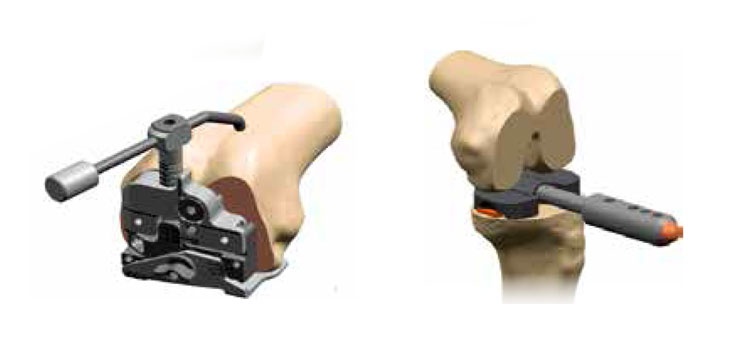
Smith & Nephew, plc recently put its best knee forward, taking the opportunity to showcase its JOURNEY II Bi-Cruciate Stabilized (BCS) knee replacement at the American Academy of Orthopaedic Surgeons (AAOS) meeting in Chicago. The company’s new PHYSIOLOGICAL MATCHING Technology takes advantage of its LifeMOD human simulation software.
Smith & Nephew Showcases Knee, Technology
2 min read Premium comments
Secondary
Smith & Nephew engineers were able to conduct proprietary analysis of the bone, ligament and muscle forces that impact the knee, and then account for those forces within the design of an implant that restores anatomic shapes and normal motion.
“Unlike implants that create unnatural motion with a symmetric, circular design, or with a rotating platform, the JOURNEY II BCS knee accommodates the swing-and-rotate of the knee with the same engineering principles the body naturally uses, ” explains Steven Haas, M.D., Chief of the Knee Service at Hospital for Special Surgery in New York City, in the March 19, 2013 news release. “As a result, the muscles and ligaments around the new joint don’t have to work harder because the implant’s natural shape and resulting motion allow these soft tissues to move in familiar ways. This leads to higher patient satisfaction scores, more mechanical efficiency of the muscle, and a more natural feeling while walking or bending in the months after their procedure.”
The JOURNEY II BCS knee is made from Smith & Nephew’s VERILAST Technology. The combination of two wear-reducing materials—proprietary OXINIUM alloy and a highly cross-linked plastic liner—VERILAST Technology generates a significant reduction in implant wear compared to traditional bearing couples on the market.
Scott Elliott, senior vice president, Smith & Nephew told OTW, “Our biggest challenge during the development of the JOURNEY II Knee is the same challenge every orthopedic company faces—creating a knee replacement that provides accurate and reproducible results for patients, and a simple, intuitive technique for surgeons. We stretched this challenge to include an implant which is designed to restore the kinematic patterns of the normal knee in an attempt to gain the physiologic advantages inherent in that motion.”
“Patient satisfaction scores for total knee replacement indicate they don’t always have confidence in their physical movement as a result of their traditional, non-anatomically shaped device. Our challenge was to give them back this confidence. And we believe we have in ways that no other knee replacement is capable of doing.”
“Without the current version of our proprietary LifeMod software, we would not have been able to perform more than 100, 000 virtual surgeries where we reestablished that implant ‘fit’ is subordinate to implant ‘shape’. Beyond simple bone coverage, an implant must fit and move correctly within the soft tissue envelope and reproduce the original anatomic shapes that guide the knee and soft tissues through normal motion.”
“These virtual surgeries, and the 4, 500 actual surgeries performed during the knee’s limited market release, breathed life into our trademarked design concept called PHYSIOLOGICAL MATCHING. In other words, the implant’s design has to match normal anatomical features in order to replicate the traits of normal physiological performance, such as function, motion and durability. The JOURNEY II Knee, coupled with our low-wear VERILAST material technology, uniquely achieves this.”
React:
Discussion
This is a fascinating development. In my practice we've seen similar outcomes with the revised protocol. The key differentiator seems to be patient selection criteria. Has anyone else noticed the correlation with BMI thresholds?
Great point. I'd push back slightly on the conclusion, the sample size in the cited study is too small to draw population-level inferences. That said, the directional signal is compelling and worth a larger RCT.
We implemented a similar approach last year. Early results are promising but we're still gathering 12-month follow-up data. Happy to share our protocol if anyone is interested.
Join the conversation
Orthopedic professionals are discussing this. Sign in and upgrade to read every comment and add your voice.