
Are surgeons’ techniques a partial cause of the failure of implanted knees? William Schroer, M.D. of the St. Louis Joint Replacement Institute in St. Louis, Missouri, believes that they are.
New Study Tackles Surgeon Technique and Implant Failure
2 min read Premium comments
Secondary
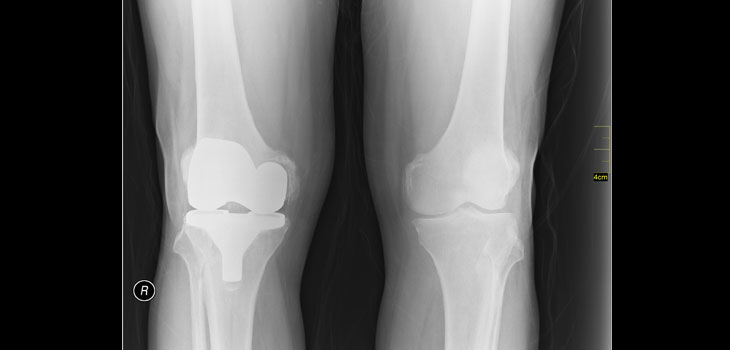
As reported March 24 by Nancy Walsh, staff writer for MedPage Today, Schroer’s group collected data from six centers between January 2010 and December 2011 and conducted a retrospective review, looking to discover why primary knee implants failed in almost 700 cases. They also looked at the time frames in which the failures took place.
During the first two years, surgeons at the six centers performed 243 knee revisions. Between years two and five, they performed an additional 172 while between years 5 and 15 they performed 199. They performed a total of 67 after 15 years.
In 85% of the cases Schroer and his team were able to determine whether the implant was initially successful or was never successful. He and his fellow researchers found that aseptic loosening, responsible for 31% of surgical revisions, was the most common cause of joint replacement failure. Walsh reported that 60% of the revisions for aseptic loosening were done within the first five years of the initial implantation surgery.
After aseptic loosening, the most frequent reasons for failure were instability (21%), infection (13%), polyethylene wear (11%) and arthrofibrosis (9%). Significantly, aseptic loosening was the only cause of failure that occurred consistently over time.
Walsh quoted Schroer as saying, “This is often a catch-all diagnosis, including multiple different implants and techniques. It sometimes results from an initial failure of fixation, when the implant was never secure, and sometimes happens later after the initially secured implant loosens.” He added that instability leading to revision most often occurred during the first two years after implantation. “In this study, two-thirds of the instability failures were classified as never having been successful, ” he said.
Schroer’s study concluded that surgeons can influence the infection rate through patient selection and an emphasis on quality control and operating room protocols. When the reason for failure was arthrofibrosis, surgical factors such as component malpositioning or poor ligament balancing often contributed.
Schroer reminded attendees at the March 2013 American Academy of Orthopaedic Surgeons (AAOS) convention where he presented the results of his study that, “Polyethylene wear used to be the main cause of primary knee arthroplasty failure, but poly is now made and sterilized better, with improved articulation and locking mechanisms., ” He lamented the fact that researchers are still using data from 2001 that implicates polyethylene wear as the primary cause of failure in total knee arthroplasty.
Author
React:
Discussion
This is a fascinating development. In my practice we've seen similar outcomes with the revised protocol. The key differentiator seems to be patient selection criteria. Has anyone else noticed the correlation with BMI thresholds?
Great point. I'd push back slightly on the conclusion, the sample size in the cited study is too small to draw population-level inferences. That said, the directional signal is compelling and worth a larger RCT.
We implemented a similar approach last year. Early results are promising but we're still gathering 12-month follow-up data. Happy to share our protocol if anyone is interested.
Join the conversation
Orthopedic professionals are discussing this. Sign in and upgrade to read every comment and add your voice.