
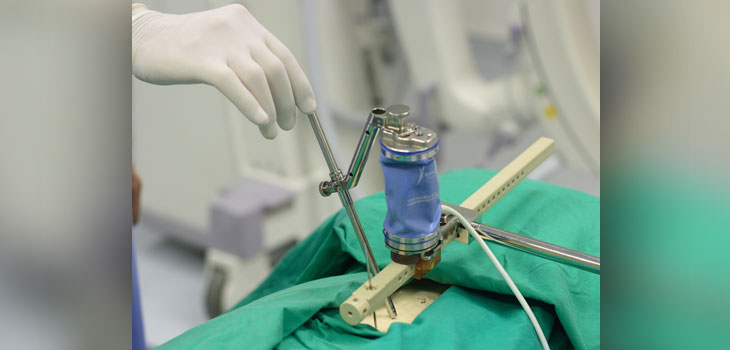
Only three surgeons in the Tampa Bay area of Florida are performing robotic spine surgery…and they’re all at the Florida Orthopaedic Institute (FOI). The surgeons are using technology from Mazor Robotics Ltd, and are seeing lower radiation exposure and higher accuracy among implant cases.
FOI Pioneers Robotic Spine Surgery
2 min read Premium comments
Secondary
Asked what led to the decision to move toward this surgery, Roy Sanders, M.D., president and chief medical officer of FOI told OTW, “As leaders in orthopedic care and technology, we want to provide patients with cutting-edge procedures and devices. Through Mazor Robotics, we’re able to offer patients suffering from spinal deformities a minimally invasive surgery with lower levels of radiation.”
As for the costs involved, Dr. Sanders noted, “We don’t divulge numbers, but the decision to work with Florida Hospital Carrollwood and introduce Mazor Robotics into the Tampa Bay area was made in the best interest of our patients, and we believe it’s a sound financial decision.”
Antonio Castellvi, M.D. of FOI was asked about the surgical experience. He told OTW, “It’s simpler, safer and offers tremendous patient benefits. The system enhances safety by reducing a patient’s exposure to radiation and guides my tools according to the predetermined blueprint and with the highest level of accuracy. Our spine team has performed 40 spine surgeries with the use of Mazor Robotics, and we’ve seen a 98% accuracy rate. The robot is designed to be superior to the human ability and it does so by using a surgical guidance system, which replaces a surgeon’s need for direct field-of-view.”
Clifton Strickland recently underwent this surgery at Florida Orthopaedic Institute. He commented to OTW, “Prior to my surgery, I couldn’t do the things I love like shooting photography and playing sports with my son. I had been living with the pain for 47 years, and even though it was incredibly painful, I thought I had to live with it. My son, who is also a patient of Dr. Castellvi, told me that after all these years I had to do something about it. Now, I’m ready to start walking, doing my physical therapy exercises and living a pain-free lifestyle.”
Asked what he would say to other patients considering this procedure, Strickland noted, “I would tell patients what I wish I knew earlier, and that’s not to put it off. There’s no sense in living with all that pain.”
React:
Discussion
This is a fascinating development. In my practice we've seen similar outcomes with the revised protocol. The key differentiator seems to be patient selection criteria. Has anyone else noticed the correlation with BMI thresholds?
Great point. I'd push back slightly on the conclusion, the sample size in the cited study is too small to draw population-level inferences. That said, the directional signal is compelling and worth a larger RCT.
We implemented a similar approach last year. Early results are promising but we're still gathering 12-month follow-up data. Happy to share our protocol if anyone is interested.
Join the conversation
Orthopedic professionals are discussing this. Sign in and upgrade to read every comment and add your voice.