
Is the PILD procedure for LSS (percutaneous image-guided lumbar decompression for lumbar spinal stenosis) reasonable and necessary? The Centers for Medicare and Medicaid Services (CMS) want you to tell them.
CMS Opens PILD Coverage Analysis
2 min read Premium comments
Secondary
The agency initiated a national coverage analysis (NCA) of PILD for LSS on April 5, 2013. There is a 30-day public comment period.
CMS is requesting public comment on the clinical evidence of health benefit outcomes, short term and long term, provided by this procedure in the Medicare population.
Reasonable and Necessary?
PILD describes a minimally invasive laminotomy/laminectomy procedure (interlaminar approach) for decompression of the lumbar spine for a primary diagnosis of LSS under indirect image guidance (e.g.. fluoroscopic, CT) with or without the use of an endoscope. This procedure is proposed as a treatment for symptomatic LSS that is unresponsive to conservative therapy.
As we reported last October, this procedure is not without controversy over a disagreement between researcher Daryl Fourney, M.D. and Vertos Medical, Inc. over the publication of a case study of patients undergoing Vertos’ “mild” procedure. Looks like CMS wants to see the evidence.
The agency says it is opening this NCA to complete a thorough review of the evidence to determine if the procedure is reasonable and necessary for coverage under the Medicare program. The scope of the review is inclusive of percutaneous lumbar laminotomy/laminectomy (interlaminar approach) for the decompression of neural elements (spinal cord, nerve roots), under indirect image guidance (e.g., fluoroscopic, CT), with or without the use of an endoscope. The announcement notes that endoscopically assisted laminotomy/laminectomy, which requires open and direct visualization, as well as other open lumbar decompression procedures for LSS are not within the scope of this NCA.
Safe and Effective?
Frank Phillips, M.D., Professor, Orthopaedic Surgery Spine Fellowship Co-Director at the Rush University Medical Center in Chicago told OTW that in his experience, the older patients that typically require surgery for spinal stenosis have neural compression caused by hypertrophied bone as well as ligamentum flavum.
“Numerous studies have shown that decompression of the neural elements under visualization is effective in improving claudication symptoms in appropriately selected patients. Under direct visualization, removing the offending pathology, while protecting the neural elements, is technically demanding.”
“Any procedure that aims to achieve decompression of the neural elements by percutaneous ‘decompression’ techniques must be required to show efficacy and safety in patients that are considered surgical candidates, ” said Dr. Phillips.
Comment Instructions
The expected NCA completion date is January 3, 2014. The public comment period ends May 5, 2013. The agency hopes to issue a proposed decision memo this October.
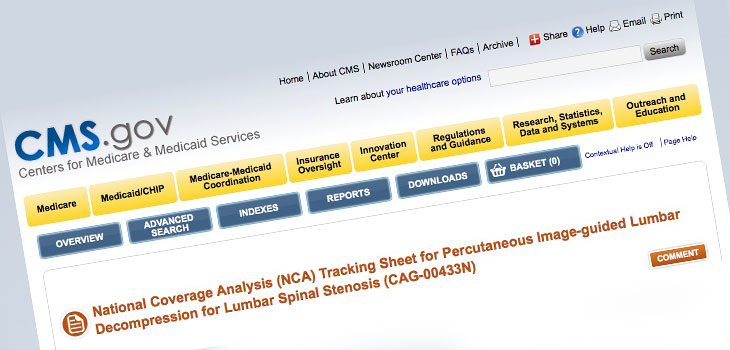
You can comment by clicking on the “Comment” button at this site.
Author
React:
Discussion
This is a fascinating development. In my practice we've seen similar outcomes with the revised protocol. The key differentiator seems to be patient selection criteria. Has anyone else noticed the correlation with BMI thresholds?
Great point. I'd push back slightly on the conclusion, the sample size in the cited study is too small to draw population-level inferences. That said, the directional signal is compelling and worth a larger RCT.
We implemented a similar approach last year. Early results are promising but we're still gathering 12-month follow-up data. Happy to share our protocol if anyone is interested.
Join the conversation
Orthopedic professionals are discussing this. Sign in and upgrade to read every comment and add your voice.