
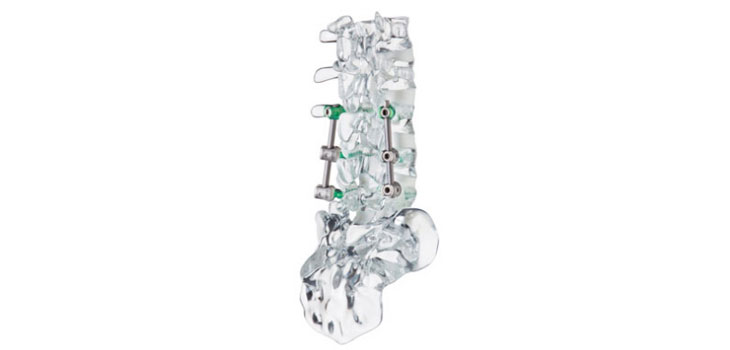
ulrich medical USA, Inc. is releasing a new spinal implant, called the flamenco Thoracolumbar Rod-Screw System, into the U.S. market. The system is designed to enhance decompression and stabilization of the thoracic and lumbosacral spine when used for fusion surgeries.
ulrich medical Offers New Spinal Implant
1 min read Premium comments
Secondary
“This product provides simple, straight-forward instrumentation and maximized tray layout, which helps decrease critical operating room time for the patient and surgical team, ” said Tom Carter, senior marketing manager, ulrich medical USA. “It provides surgeons with a standard 5.5 mm rod and tulip head design similar to the most popular pedicle screw systems currently available in the United States.”
“The release of the flamenco system enhances ulrich’s market leadership position in expandable corpectomy cage technologies, ” said Erika Laskey, company vice president of sales and marketing. “It offers surgeons German-engineered supplemental fixation solutions for use with our five expandable vertebral body replacement (VBR) product lines for complex trauma and tumor applications.”
Heinrich C. Ulrich founded ulrich medical® in Ulm, Germany, in 1912 to develop high quality, precision surgical instruments. The company’s products are used in medical applications ranging from spine surgery to diagnostic imaging. The U.S. division, ulrich medical USA, Inc., is located in St. Louis, Missouri.
Author
React:
Discussion
This is a fascinating development. In my practice we've seen similar outcomes with the revised protocol. The key differentiator seems to be patient selection criteria. Has anyone else noticed the correlation with BMI thresholds?
Great point. I'd push back slightly on the conclusion, the sample size in the cited study is too small to draw population-level inferences. That said, the directional signal is compelling and worth a larger RCT.
We implemented a similar approach last year. Early results are promising but we're still gathering 12-month follow-up data. Happy to share our protocol if anyone is interested.
Join the conversation
Orthopedic professionals are discussing this. Sign in and upgrade to read every comment and add your voice.