
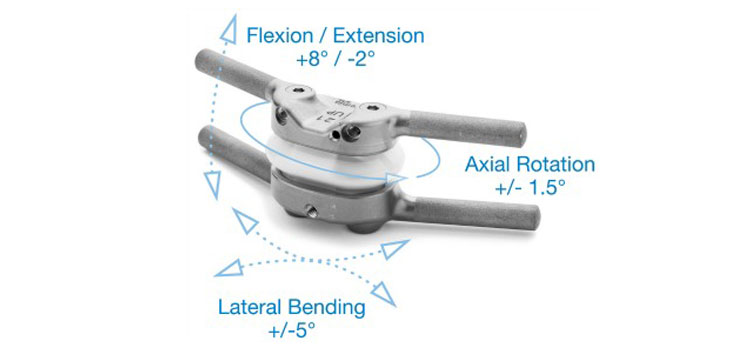
Premia Spine, Ltd, a medical device company headquartered in Tel Aviv, is launching the TOPS spinal implant—which had been under development for years with another Israeli firm, Impliant, Ltd. TOPS is an acronym for Total Posterior Spine System and it differs from other spinal implants in several ways but most pronounced is that it has a central polyurethane unit that moves, recreating motion in all directions.
The Return of TOPS Spinal Implant
1 min read Premium comments
Secondary
According to Tova Cohen, writing for Reuters, the device is an alternative to fusion surgeries, and facilitates a quicker recovery for the patient as well as a reduced risk of reoperation.”With the TOPS System, instead of immobilizing we replace the diseased segment with an artificial joint, ” said Premia Spine CEO Ron Sacher. He compared the procedure to hip and knee replacements that patients now undergo.
Sacher noted that fusion surgery in the lower back eliminates one of the three key motion segments, making the other two segments work much harder. Within a few years, he said, patients often require more surgery.
According to a study of lumbar spinal fusions in the United States, presented at a symposium in Barcelona last year, one in four elderly fusion patients being treated for spondylolisthesis had to have a second operation on the spine within two years of surgery. Nearly one in two elderly patients who underwent fusion surgery had to be readmitted to the hospital suffering from complications.
After completing five-year follow-ups on patients from trials in Belgium and Israel, Premia Spine believes its results are significantly better than those achieved by fusion. Patients who’d been treated with the TOPS System’s experienced overall reoperation rate of less than 5%, Sacher told Reuters.
The TOPs System is not yet available in the United States but is being offered in Germany. The company expects to be profitable by the end of 2014.
Author
React:
Discussion
This is a fascinating development. In my practice we've seen similar outcomes with the revised protocol. The key differentiator seems to be patient selection criteria. Has anyone else noticed the correlation with BMI thresholds?
Great point. I'd push back slightly on the conclusion, the sample size in the cited study is too small to draw population-level inferences. That said, the directional signal is compelling and worth a larger RCT.
We implemented a similar approach last year. Early results are promising but we're still gathering 12-month follow-up data. Happy to share our protocol if anyone is interested.
Join the conversation
Orthopedic professionals are discussing this. Sign in and upgrade to read every comment and add your voice.