
“Why the robot? It’s all about headache management, ” says Doug Padgett. “Hold up, ” says Mike Berend. “There are a number of unanswered questions here. Does it solve real problems in total hips? Can all surgeons use it?”
Robots for THR: Making Men Out of Boys?
7 min read Premium comments
Great Debates
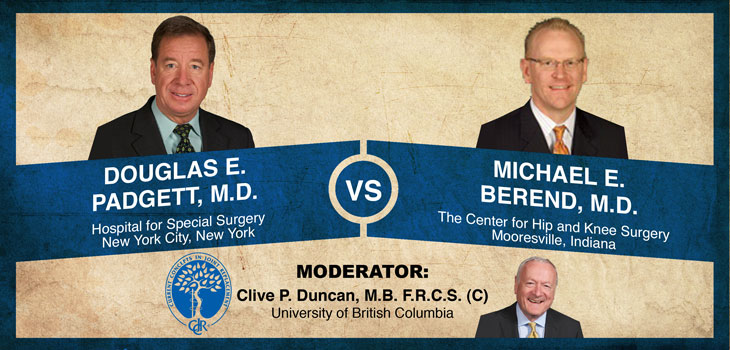
This week’s Orthopaedic Crossfire® debate is “Robotic Arm Guided THA: Makin’ Men Out of Boys!” For the proposition is Douglas E. Padgett, M.D. from Hospital for Special Surgery in New York City. Against the proposition is Michael E. Berend, M.D. of The Center for Hip and Knee Surgery in Mooresville, Indiana. Moderating is Clive P. Duncan, M.B. F.R.C.S. (C) from the University of British Columbia.
Dr. Padgett: “Today I will be challenged by Mike Berend, who was a little late today because he was looking for money to find a payphone because he doesn’t believe in cell phone technology. Why the robot? It’s all about headache management. The changing face of robotics has been outlined, including work by Kevin Bozic and our internal data at Hospital for Special Surgery looking at instability and lysis and the number one reasons for revision in the new millennium.”
“As for the etiology of instability, we know there are patient factors like cognition and compliance, and surgical factors such as approach. But most importantly there is component position. We learned this from Lewinnick in 1978: the ideal position is 40 degrees of abduction and 15-25 degrees of anteversion. The second issue in terms of headaches in joint replacement is limb lengthening and offset. It’s been estimated that approximately 20% of all of our hips have some discrepancy. In my state of New York this is the number one reason for litigation following total hip arthroplasty [THA/THR].”
“As for long-term headaches we’re concerned about the bearing surface, which is the particle generator. But the effect of implant orientation on hard bearings in work by John Fisher, as well as traditional bearings, has been borne out. We’re going to make an assumption that implant position is important. The femur is dictated by the femoral anatomy when using uncemented techniques, so the socket is the wild card. Anatomic landmarks have been used, as well as external positioning guides. In a study that we published in 2005 the external alignment guide got a mean of 40 degrees; however the range of the outliers was 22-57 degrees.”
“Is there a role for guidance? A quote I love: The problem with navigation is that those that need it can’t afford it, and those that can afford it (academic centers) probably don’t need it. Thank you Harry Rubash. The study that won the John Charnley Award involved 2, 000 total hips at Massachusetts General Hospital, arguably by expert surgeons and only 50% of their cups within the range for both version and abduction. Clearly, this technology is sensitive to implant precision and accuracy.”
“How we do total hip replacement: We measure it with a micrometer, we draw it with a ruler, and we cut it with an ax. Would this work in any other industry? I would submit to my opponent that he fly without the aid of modern day avionics as he did last night when he arrived. Robotics combines the visual guidance afforded by navigation with the tactile feedback of robotics; it’s a semi-passive (haptic) technology relying on touch.”
“The ideal features include enhanced preoperative planning, exacting bone preparation, consistent implant delivery, and the reproducibility of implant position, leg length, and offset. This is a CT-based protocol; we can determine our femoral version, socket version, and socket abduction. We can then look at the net change in COR (Center of Rotation), examining the medial lateral offset and cranio-caudad position, which affects hip length.”
“In a study we just completed we were able to demonstrate that the robotic assisted cups were more closely aligned with the preoperative plan than the manually assisted cups; there was also more consistency in socket sphericity. After registering the bone using the robot we can accurately prepare and shape the acetabular vault. Then, in the socket implantation, the haptics are engaged, and despite beating on it with a 20 pound mallet, we have consistent orientation in both abduction and version. The final product: we look at hip length and offset and we know exactly where this hip is going to wind up.”
“Robotic assisted total hip replacement…logic dictates it.”
Dr. Berend: “There is a great appeal to using the robot, but there are a number of unanswered questions. Does it solve real problems in total hips (the outcome of THA has never been better)? Is it worth the time and cost? Who pays? Is it transferable (can all surgeons use it)? What are the risks? Is the future now?”
“The problems after THA are multifactorial and involve the patients and us: infection, venous thromboembolism (VTE), fracture, leg length discrepancy, loosening, heterotopic ossification, impingement, and dislocation. So it’s much more than cup position.”
“Case in point: At two years postop the leg feels somewhat long and the cup is in the ‘safe zone’. Unfortunately after nine dislocations the case is posted for revision. Our data show—with the anteriolateral approach—800 hips and only three dislocations; in the posterior approach cohort with the use of large heads, only two patients had dislocations. So out of the last 1, 000 hips, five patients may have benefitted from robotics. I don’t know that impingement, or being able to establish the kinematics between the femur and the acetabulum has been figured out yet by the robot.”
“We’ve learned a lot from Dr. Padgett and his retrieval studies looking at well aligned components that involved significant poly wear and impingement. Perhaps highly cross-linked polyethylene or vitamin E bearings will improve.”
“The logic I’ve heard is: ‘We have to get a robot because they have a robot.’ That’s not the best way to approach it, especially given the capital investment approaching $1, 000, 000. It’s $1, 000 for the CT scan and the interpretation, $1, 000 for disposables, time required for scheduling, etc. And how much time does it take from our system? This is unknown. As for the value of the surgeon, it’s important to remember that we are performing the procedure, not the robot. If you’re using any of these technologies—and one out of five needs to be aborted—then we still need to know how to do the operation very well.”
“We should be careful with the claims of this new technology, especially saying robots ‘allow breakthrough options for early to mid stage OA [osteoarthritis].’ And we have to be wary of the media coverage. There was a video on ABC News showing that with traditional procedures you’re in the hospital 3-5 days, whereas it’s 1 day when robots are involved…and at 1 week this person is walking along the boardwalk without a problem. But is this really related to the robot or is it patient selection?”
“The clinical evidence is lacking. In a 2010 study by Nakamura they found statistically significant improvements with the use of a robot, but I believe it is clinically irrelevant. So are we ‘lost in space?’ Danger, Doug Padgett! Leg length can be easily assessed intraoperatively; with robotics there are reports of surgery being an hour longer with more blood loss, higher heterotopic ossification. We need to be very cautious.”
Moderator Duncan: “Doug, do you want to respond to the costs that Michael outlined?”
Dr. Padgett: “It’s important, but I would put it down on the list. If we’re going to solve the issue of the 30/50 year hip replacement we can see how modern day bearings—or what we thought were going to be modern day hard-on-hard bearings—were exquisitely sensitive to positioning. The question is, ‘Can this enhanced technology help with the execution and delivery?’ If so, then it may be worth the capital expense.”
Moderator Duncan: “Is that applicable to the socket only?”
Dr. Padgett: “I think it’s applicable to all adult reconstruction. This particular product has both hip and knee applications.”
Moderator Duncan: “I didn’t understand why you need it for preparation of the acetabulum.”
Dr. Padgett: “When people are measuring their postoperative socket the question is, ‘Is there a disconnect in terms of how the socket is being independently prepared?’ Then the final delivery of the product, i.e., the socket being put in…is that what’s leading to the discrepancy? You’re using navigation and the socket is supposed to go in at 20-25 degrees of version. Then when the CT scans are done postoperatively, the version has an extreme range that isn’t consistent with the numbers at the time of surgery.”
Moderator Duncan: “A question from the floor…the potential role of robotics in getting the stem right.”
Dr. Padgett: “I’m not using it in terms of the preparation, but in terms of doing the final reduction we do digitize the upper part of the femur, it is acquired, and then our post reduction aggregate limb length, offset and all of those parameters are affected by what happens on the femoral side.”
Moderator Duncan: “Michael, here is an audience question: With regards to robotic surgery, given the advances in technology, is there any risk that they will eventually pose a threat to mankind?”
Dr. Berend: “There are no robots in the audience and no robots participating in the debate. On the economics, if I had a million dollars to invest, and four million dollars over five years for use of a technology, I’d hope that it would help clinically more than the five patients that had a dislocation in our series.”
Dr. Padgett: “Mike, that’s one facet of it, but I don’t think that the final outcome measure of the success of whatever technology it’s going to be, is, for example, that is will cut down on your dislocation rate. We’ve seen perfectly placed total hip replacements where every metric by which we realize what we think is appropriate has been met, the patient still dislocates.”
Moderator Duncan: “If the robot in each of your hospitals has broken down that day, what do you think about using the transverse acetabular ligament?”
Dr. Berend: “If the socket is of normal morphology I think it’s very useful.”
Moderator Duncan: “Doug, do you use it?”
Dr. Padgett: “Rarely. The most important aspect to remember is that this is a combined articulation where you’re taking a femur and putting it inside a socket. You must look at the relative relationship between the two.”
Moderator Duncan: “Thank you both.”
Please visit www.CCJR.com to register for the 2013 CCJR Spring Meeting, May 19 – 22 in Las Vegas, Nevada.

“You may now view CCJR meeting content on your mobile device on the CCJR MobileTM App. Please scan the QR code to download from iTunes.”
React:
Discussion
This is a fascinating development. In my practice we've seen similar outcomes with the revised protocol. The key differentiator seems to be patient selection criteria. Has anyone else noticed the correlation with BMI thresholds?
Great point. I'd push back slightly on the conclusion, the sample size in the cited study is too small to draw population-level inferences. That said, the directional signal is compelling and worth a larger RCT.
We implemented a similar approach last year. Early results are promising but we're still gathering 12-month follow-up data. Happy to share our protocol if anyone is interested.
Join the conversation
Orthopedic professionals are discussing this. Sign in and upgrade to read every comment and add your voice.