
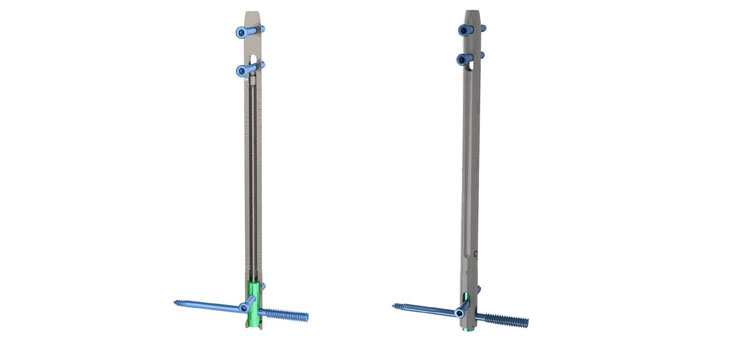
MedShape has announced a 10mm version of its DynaNail Ankle Arthrodesis Nail. This smaller DynaNail expands the use of the intramedullary (IM) nail to patients with narrow bone anatomies that require smaller fusion devices. MedShape is showing samples of its 10mm and 12mm DynaNail devices at the American Academy of Orthopedic Surgeons (AAOS) Annual Meeting, March 20-23, 2013 in Chicago.
MedShape Launches 10mm DynaNail!
2 min read Premium comments
Secondary
DynaNail is an effective alternative to external fixators for performing tibiotalocalcaneal (TTC) arthrodesis procedures. Leveraging the shape memory properties of nickel titanium (NiTiNOL), the nail sustains compression across the joint on the level of an external fixator. Compression across the joint is important for ensuring the joint bones remain in close apposition and in promoting healing. Eliminating external fixators reduces surgery time and minimizes the need for follow-up procedures. Because it is inserted like traditional IM nails, DynaNail also significantly reduces physician training time.
“Surgeons have a number of product options when considering intramedullary rod fixation for treating complex ankle and rear foot fusions. Of the many products I have utilized for my patients, I have found, without question, that MedShape’s DynaNail system is superior to all other systems, ” said Dr. Randall Brower, DPM of Desert Canyon Foot & Ankle in Phoenix, Arizona, in the March 12, 2013 news release. “The DynaNail is the only ‘fourth generation’ rod to utilize new pseudoelastic nickel titanium technology. This has been a game changer with 100% fusion in all cases I’ve used it in to date.”
Introduced late last year, the original DynaNail is 12mm in diameter. The new 10mm size offering will expand the use of DynaNail to patients with narrow bone anatomies. In the procedure, surgeons work to increase the size of the implant tunnel across the TTC joint until they get “chatter” from the drill. Once the surgeon completes the tunnel drilling, they now have two implants to choose from based on the tunnel size. The 10mm DynaNail serves as a less invasive treatment option while still retaining the unique sustained compressive power garnered from the internal NiTiNOL element.
“As a leader in shape memory devices, we are proud to respond to physician demand with the 10mm offering and are enthusiastic about its efficacy in orthopedic surgery, ” said Jeremy Blair, team leader for DynaNail. “DynaNail’s successful use is a clear indicator of the exciting future it holds for podiatrists and orthopedic surgeons everywhere.”
Kurt Jacobus, Ph.D., CEO of MedShape told OTW, “Major milestones included developing a method to machine NiTiNOL by leveraging some of its unique thermodynamic properties, and then developing an approach to activate NiTiNOL inside the body. MedShape holds patents on both of these processes. MedShape also identified a way to combine NiTiNOL with titanium by housing a NiTiNOL element inside a titanium outer body such that the pseudoelastic properties of the NiTiNOL could be garnered while retaining the titanium’s rigidity and strength. These milestones will pave the way for smaller nails to be used in foot and ankle applications as well as other applications throughout the body.”
React:
Discussion
This is a fascinating development. In my practice we've seen similar outcomes with the revised protocol. The key differentiator seems to be patient selection criteria. Has anyone else noticed the correlation with BMI thresholds?
Great point. I'd push back slightly on the conclusion, the sample size in the cited study is too small to draw population-level inferences. That said, the directional signal is compelling and worth a larger RCT.
We implemented a similar approach last year. Early results are promising but we're still gathering 12-month follow-up data. Happy to share our protocol if anyone is interested.
Join the conversation
Orthopedic professionals are discussing this. Sign in and upgrade to read every comment and add your voice.