
“There is no data to support the use of anything else but chemprophylaxis, ” argues Jay Lieberman. “In balancing the risk between chemoprophylaxis and compression, clearly things are in favor of mechanical compression with or without aspirin, ” counters Doug Padgett.
DVT Anticoagulants: Lieberman Goes Up Against Padgett
7 min read Premium comments
Great Debates
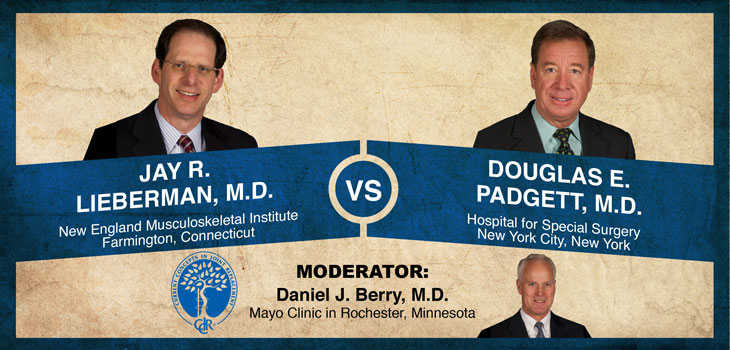
This week’s Orthopaedic Crossfire® debate is “DVT Anticoagulants: Contemporary Standard of Care.” For the proposition is Jay R. Lieberman, M.D. from New England Musculoskeletal Institute in Farmington, Connecticut. Against the proposition is Douglas E. Padgett, M.D. of The Hospital for Special Surgery in New York City. Moderating is Daniel J. Berry, M.D. from Mayo Clinic in Rochester, Minnesota.
Dr. Lieberman: “The selection of a prophylaxis is a balance between efficacy and bleeding. As orthopedic surgeons we want to prevent fatal pulmonary embolism (PE), symptomatic PE and deep vein thrombosis (DVT), bleeding (particularly hematoma in the joint), and persistent drainage.”
“Today we have low molecular weight heparin (LMWH), Warfarin, Fondaparinux, and aspirin; Rivaroxavan and Dabigatran are available in Europe and Canada, but not in the U.S. We have mechanical devices and new portable compression, and then a combination of these.”
“The American Association of Hip and Knee Surgeons (AAHKS) did a survey and found that 99% of respondents routinely use chemoprophylaxis following THA [total hip arthroplasty], 90% routinely use mechanical prophylaxis after THA, and 94% routinely use chemoprophylaxis after discharge following THA.”
“The most popular guidelines are from the American College of Chest Physicians (ACCP) and the AAOS [American Academy of Orthopaedic Surgeons] guidelines. I have issues with the CHEST guidelines. They use a surrogate outcome—asymptomatic clots picked up on a venagram—and we’re not sure of the clinical relevance of that. Also, they don’t pay enough attention to bleeding or to the effect of wound drainage on final outcomes. This Warfarin level they recommend of between two and three is too high. In addition, I oppose the Grade 1 recommendation against aspirin because it does reduce symptomatic PE. And though it’s less potent than other anticoagulants, it probably has less bleeding.”
“AAOS has its own strategy. The difference is that they assess PE risk and bleeding risk, and categorize the patients accordingly. If you have a standard risk of PE and major bleeding then all the chemoprophylaxis agents are appropriate; if you have an elevated risk of PE then aspirin drops out because it’s not as effective. If you have an elevated risk of major bleeding the LMWH drops out.”
“These guidelines put the focus on symptomatic events rather than asymptomatic events. Its strength is that it recognizes that surgeons are interested in symptomatic events, and recognizes the potential importance of bleeding. However, it doesn’t recognize differences between hips and knees, and it’s difficult to assess DVT risk and bleeding risk in these patients.”
“The Surgical Care Improvement Project (SCIP) guidelines recommend LMWH, Warfarin, and Fondaparinux. The combination of aspirin and mechanical compression is acceptable if you note in the chart that you chose it because you have concerns about bleeding.”
“Mechanical devices…only three randomized trials comparing these devices to Warfarin and they showed questionable efficacy against proximal clots. One study showed that it was as good as LMWH; a recent portable compression study by Colwell and Padgett is an interesting concept. But right now it remains an adjunctive agent to total hip replacement.”
“They used the Enoxaparin against these portable compression devices that patients go home with. In 10 days you must do duplex ultrasounds. They had very low DVT and PE rates and more bleeding with LMWH; 61% of the patients also received aspirin, so it wasn’t mobile compression alone.”
“LMWH works, but there are concerns about bleeding and drainage. Warfarin and Fondaparinux have also proven effective. The reason these agents have bleeding concerns is that they’re anticoagulants. For patients where you’re concerned about bleeding you might use aspirin and mechanical compression. Thanks.”
Dr. Padgett: “I vehemently oppose this. Looking at Virchow’s Triad you have hypercoagulation at the top, with stasis and endothelial damage on the bottom. The thesis of my opponent is that the optimal way to prevent VTE and its complications is to use anticoagulants addressing the hypercoaguable aspect of the triad. I will use logic and data to show that there are better and safer alternatives for DVT prevention.”
“Currently, the strategies are toward chemoprophylaxis based on the ACCP. The problems with these studies and guidelines are that they are largely sponsored by big pharma. The investigators are consultants for the companies and they downplay the risks of the anticoagulants.”
“There are two studies of note. First, there is a meta-analysis of potent anticoagulants…an all cause mortality study done at our institution. We looked at 28, 000 patients that were grouped into those receiving LMWH, Warfarin, and the HSS protocol (a combination of multimodal prophylaxis). The data showed that the greatest all cause mortality were in the groups that were receiving the potent anticoagulants; the lowest risk groups were the multimodal prophylaxis groups.”
“The second study is, ‘The Failure of the American College of Chest Physicians 1-A Protocol for Lovenox in Clinical Outcomes for Thromboembolic Prophylaxis’ by Robert Barrack and his associates. The authors switched from their Coumadin protocol to LMWH due to difficulty adjusting the INR (International Normalized Ratio). Their intention was to enroll 1, 500 patients. After less than 300 patients they had a 9% major complication rate, almost a 5% readmission rate, and a 3.4% reoperation rate for wound drainage. The study was terminated.”
“Back to basics. If limb torsion leads to restriction in venous outflow, and decreased flow leads to stasis and stasis leads to thrombosis, then why not consider mechanical compression? It’s been studied in hips and knees, it increases venous flow and emptying, and it releases endothelial derived relaxing factors and urokinase. There is some systemic fibrinolytic effect, and we know that it works.”
“The advantages of mechanical compression devices are that it’s complication free, it’s safe, and time worn equals effectiveness. The disadvantages are that they are applied after surgery, are worn only in the hospital, and there are compliance issues.”
“The new technology is ActiveCare Continuous Enhanced Circulation Therapy (CECT). It’s miniature, portable, battery powered, can be worn in and out of bed, and is applied at the time of surgery. In our 2010 study we looked at efficacy and safety of the device versus Enoxaparin. In the CECT arm the device was applied in the operating room and over half of the group received a buffered aspirin a day; there were skin checks and follow-up at 14 days with duplex ultrasound and a clinical follow-up at three months.”
“In the Lovenox arm there was no pneumatic compression. We evaluated the patients with bilateral, duplex ultrasounds and three month clinical follow-up. We found no difference in age, body mass index, sex distribution, time of surgery or length of surgery.”
“There was no difference in the incidence of DVT or PE between the groups. In terms of bleeding indices, there was a trend towards significance in the Lovenox group, meaning more bleeding…however, this was largely borne out by the major bleeding events. In the compression device group bleeding events were 0; major bleeds in the Lovenox group were 5.8% and minor bleeds were 31.2%. Mean use was 11 days in the CECT group—and patients were using the device for almost 20 hours/day. In this study we demonstrated the indisputable safety of this device in regards to decreasing the risk of VTE, as well as reducing the risk of postoperative bleeding.”
Moderator Berry: “Jay, a minute to rebut.”
Dr. Lieberman: “There’s just no data to support the use of anything else. We’d all love mechanical compression to work, but I could find only one multicenter randomized trial that looks at the effect of mechanical compression. And it wasn’t powered for efficacy, but for safety. Also, they used a duplex ultrasound, which is not accepted by the FDA when you put a drug on the market.”
Moderator Berry: “Doug?”
Dr. Padgett: “That 5-7% major bleeding rate is real; we know the outcomes of that data are awful. The issues related to taking patients back for washouts and subsequent infections are real. In balancing the risk between the two, clearly it’s in favor of mechanical compression with or without aspirin.”
Dr. Lieberman: “I don’t have a problem if you want to put aspirin in it. Individual orthopedic surgeons must decide what the balance is going to be and what your treatment will be for which anticoagulant agent. Even in that study you quoted, 61% received aspirin, and it was up to the investigators to decide whether they used it or not. So aspirin is chemoprophylaxis.”
Moderator Berry: “Is there any drawback to using mechanical measures and should it at least be part of your regimen while the patient is in the hospital?”
Dr. Lieberman: “Every patient should get mechanical prophylaxis for both hips and knees.”
Moderator Berry: “So there’s no reason not to other than the cost?”
Dr. Lieberman: “Yes”
Moderator Berry: “Doug, you agree?”
Dr. Padgett: “100%”
Moderator Berry: “What about someone at high risk, say a patient with a prior history of venous thromboembolic disease? Would you agree that this patient needs something more than just mechanical compression and aspirin?”
Dr. Padgett: “Yes. These are people at risk for primary embolic phenomena. Those are the people who, preoperatively, need to see either your internist or hematologist to determine the postop DVT protocol.”
Moderator Berry: “What would that be in your institution, Doug?”
Dr. Padgett: “Most likely postop Warfarin.”
Moderator Berry: “Would they be bridged…might get LMWH for a couple of days?”
Dr. Padgett: “Right.”
Dr. Lieberman: “For the high risk patient…look at the AAOS guidelines…they drop out aspirin because it’s not as effective. What we’d really love to do is risk stratify. If only we had a blood test that would tell a patient, ‘You’re low risk so you get mechanical compression and aspirin, ’ or ‘You have a higher risk so you need LMWH and Warfarin, ’ etc. But that kind of testing is not available now.”
Moderator Berry: “We need new studies. Even a study 10 years ago probably doesn’t really reflect the current risk of DVT. Thank you both.”
Please visit www.CCJR.com to register for the 2013 CCJR Spring Meeting, May 19 – 22 in Las Vegas, Nevada.

“You may now view CCJR meeting content on your mobile device on the CCJR MobileTM App. Please scan the QR code to download from iTunes.”
React:
Discussion
This is a fascinating development. In my practice we've seen similar outcomes with the revised protocol. The key differentiator seems to be patient selection criteria. Has anyone else noticed the correlation with BMI thresholds?
Great point. I'd push back slightly on the conclusion, the sample size in the cited study is too small to draw population-level inferences. That said, the directional signal is compelling and worth a larger RCT.
We implemented a similar approach last year. Early results are promising but we're still gathering 12-month follow-up data. Happy to share our protocol if anyone is interested.
Join the conversation
Orthopedic professionals are discussing this. Sign in and upgrade to read every comment and add your voice.