
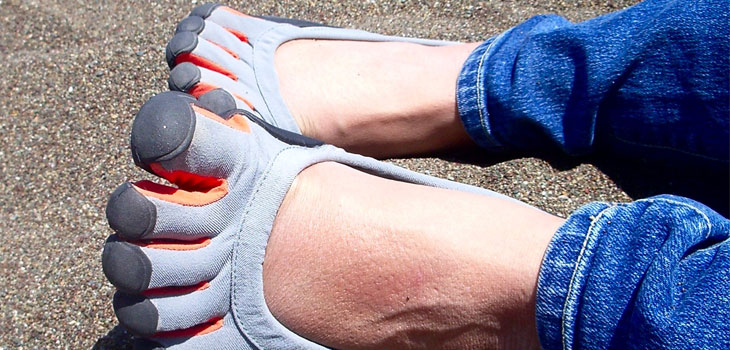
The jury is still out on barefoot or near-barefoot running. In a 10-week study, 10 of 19 runners who began doing some of their mileage in Vibram FiveFingers (a kind of runner’s slipper with toes) showed signs of foot bone injury at the end of the study when compared to one of 17 runners who continued to do all of their running in conventional shoes, according to Scott Douglas, who reported on the study for Runners World Newswire.
Bone Injury Followed Near-Barefoot Running
2 min read Premium comments
Secondary
Researchers in Utah divided the runners into two groups. All were recreational runners with an average age of 26 who were running a weekly mileage of from 15 to 30 miles. One group was told to continue its normal training in its conventional running shoes. The other group also continued its normal training, except that the runners did some of their running in Vibram FiveFingers. None of the study participants had previously run in FiveFingers, and none had been prevented by a lower-leg injury from running at least three days a week in the six months prior to the study.
Douglas reports that the FiveFingers group followed a conservative transition plan based on one offered at the time of the study on Vibram’s website. In the first week, they did one run of one to two miles in Vibrams. During the next two weeks, they added another short run in Vibrams each week. By the third week the runners were to do three runs of at least 1 mile in Vibrams. After the third week, they were told to increase the amount they ran in Vibrams as felt comfortable, with the goal of replacing one short run a week in conventional shoes for a short run in Vibrams.
At the start of the study, the researchers took MRIs of the runners’ feet and repeated them at the end of the study. They found no differences post-study between the groups in what the MRIs showed about the runners’ soft tissues. However, bone readings were quite different.
The MRIs measured bone marrow edema (excess fluid) in bone marrow in several locations on the runners’ feet. Douglas explains that assessing bone marrow edema is a common way of looking for bone injury, as the swelling in the bone marrow can indicate a protective response to injury. The researchers used a scale of 0 to 4 to rate bone marrow edema, with 0 indicating normal bone health and 4 indicating a stress fracture. Edema in 25% to 50% of bone was considered a stress reaction, and corresponded to a score of 2. The researchers considered a reading of 2 or higher to mean that the runner was injured.
Using that rating, 10 of the 19 runners in the Vibrams group had a foot bone injury at the end of the study, compared to one of the 17 runners in the conventional-shoes group. Two of the 10 injured Vibrams runners developed full-blown stress fractures—one in the heel and one in the second metatarsal. .
According to Douglas, the researchers concluded that, to reduce risk of foot bone injury, runners transitioning to Vibram FiveFingers should take even longer than the 10-week plan used in this study. They also advised doing all introductory runs at low intensity, thus reducing impact forces. Douglas also noted that in their peak mileage week during the 10-week study, the conventional-shoe runners reported more average mileage (30 miles) than either the Vibrams runners who did not get injured (about 18 miles) or the Vibrams runners who were injured (about 15 miles).
Author
React:
Discussion
This is a fascinating development. In my practice we've seen similar outcomes with the revised protocol. The key differentiator seems to be patient selection criteria. Has anyone else noticed the correlation with BMI thresholds?
Great point. I'd push back slightly on the conclusion, the sample size in the cited study is too small to draw population-level inferences. That said, the directional signal is compelling and worth a larger RCT.
We implemented a similar approach last year. Early results are promising but we're still gathering 12-month follow-up data. Happy to share our protocol if anyone is interested.
Join the conversation
Orthopedic professionals are discussing this. Sign in and upgrade to read every comment and add your voice.