
For patients suffering with vertebral compression fractures (VCFs) which treatment is superior —balloon kyphoplasty or the Kiva VCF Treatment System by Benvenue Medical, Inc.? An independent, peer-reviewed study published online and in the February 15 edition of Spine, found that the Kiva system significantly restored vertebral body wedge deformity and resulted in lower rates of extravasation and cement volume than balloon kyphoplasty.
Balloons Out – KIVA In – For VCFs
2 min read Premium comments
Secondary
PR Newswire quoted Panagiotis Korovessis, M.D., Ph.D., chief of the Department of Orthopaedic Surgery at General Hospital “Agios Andreas” in Patras, Greece, and author of the study as saying: “This study revealed statistically significant advantages of Kiva over balloon kyphoplasty. The study results also indicate that using Kiva to treat painful VCFs may positively influence the medium- and long-term results. Patients may experience less back pain and fewer frequent adjacent fractures.”
For the study doctors examined 168 patients who had 255 osteoporotic fractures less than three months old with an average 14-month post-operative follow-up. The study researchers measured the patients’ vertebral body height, segmental kyphotic angle, extravasation rates, pain, function, and determined their quality of life. The study concluded with several statistically significant outcomes in favor of Kiva over balloon kyphoplasty, the current gold standard of care and most common vertebral augmentation treatment in the United States.
“This study suggests that the Kiva system may restore vertebral body height, but more significantly, restore normal mechanics and spine alignment in patients with VCFs. This has important implications for body mechanics and future fractures. It would appear that the system allows the use of less cement which translated into less leakage, ” said Sean M. Tutton, M.D., FSIR, professor of Radiology and Surgery at the Medical College of Wisconsin in Milwaukee.
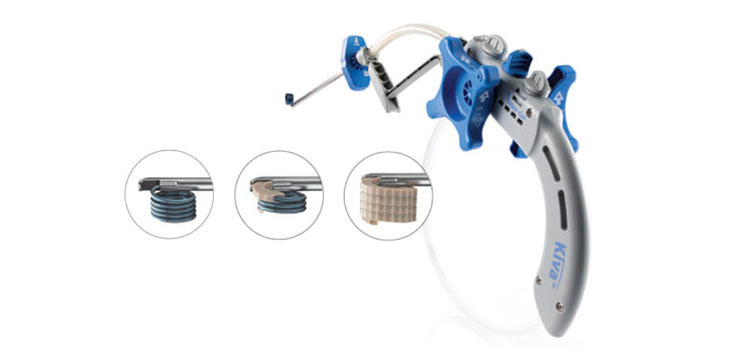
The National Osteoporosis Foundation estimates that there are 700, 000 osteoporosis-related vertebral compression fractures annually in the U.S. alone, yet only 200, 000 kyphoplasty procedures are done globally. As explained by PR Newswire, the Kiva VCF Treatment System features a proprietary flexible implant made from PEEK-OPTIMA , a biocompatible polymer that is widely used as a spinal implant. The Kiva implant is designed to function as a mechanical support structure and a reservoir for bone cement.
Physicians deliver the implant percutaneously in a continuous loop into the vertebral body through a small diameter, single incision. The amount of the Kiva implant delivered can be physician-customized during the procedure to adjust to various fracture types. Delivered over a removable guide wire, the implant provides structural support to the vertebral body and directionally controls and contains bone cement.
The Kiva VCF Treatment System is commercially available only in Europe. Kiva is investigational in the United States and is currently the subject of an approved IDE (investigational device exemption) study.
“Publication of these study results in a peer-reviewed journal further validates the benefits the spine community reports with Kiva. We continue to work very closely with the FDA on our IDE study and we’re pleased with the significant progress we’re making toward bringing this system to the U.S. market, ” said Robert K. Weigle, CEO of Benvenue Medical, Inc.
Author
React:
Discussion
This is a fascinating development. In my practice we've seen similar outcomes with the revised protocol. The key differentiator seems to be patient selection criteria. Has anyone else noticed the correlation with BMI thresholds?
Great point. I'd push back slightly on the conclusion, the sample size in the cited study is too small to draw population-level inferences. That said, the directional signal is compelling and worth a larger RCT.
We implemented a similar approach last year. Early results are promising but we're still gathering 12-month follow-up data. Happy to share our protocol if anyone is interested.
Join the conversation
Orthopedic professionals are discussing this. Sign in and upgrade to read every comment and add your voice.