
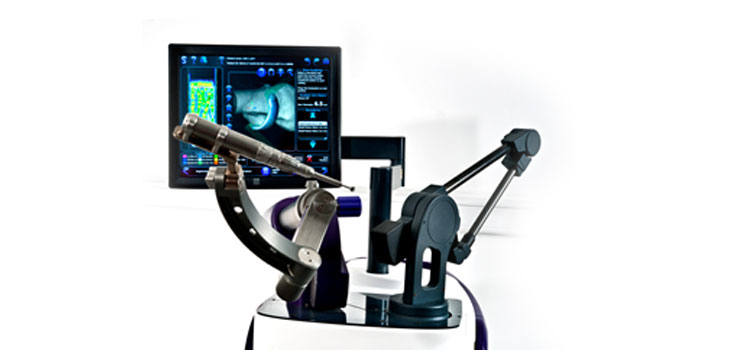
Stanmore Implants, a London firm specializing in the design and manufacture of patient-specific orthopedic implants, has received 510(k) clearance from the FDA to market its Sculptor Robotic Guidance Arm in the United States. The device is used for precision implant placement in unicompartmental knee surgery—also referred to as partial knee resurfacing.
Surgical Robot Clears FDA
1 min read Premium comments
Secondary
Partial knee resurfacing only replaces the parts of the knee that are worn out and painful rather than cutting away the entire joint. This preservation technique, according to the company, retains the natural ligaments around the knee, reduces surgical damage to tissue and is less invasive compared to total knee replacement. Stanmore officials explain that Sculptor RGA utilizes a robotic guidance arm to assist the surgeon’s operation of a cutting tool, limiting the removal of bone to a pre-defined safe area. From proprietary planning software, personalized implants are designed in-house, then manufactured and placed precisely using Stanmore’s ‘Active Constraint technology.
During surgery, bone is removed corresponding to the implant shape while a tracking arm determines and monitors the location of the patient ensuring that the surgeon accurately prepares the bone surface to precisely match the implant. According to the release, the company plans a limited distribution of the Sculptor RGA in the United States for unicompartmental knee surgery to a select group of surgeons beginning around mid-2013.
Brian Steer, Executive Chairman of Stanmore, said, “Following this FDA clearance for Sculptor RGA we are excited by the opportunity to bring our personalized approach to knee surgery to patients in the United States. Robotic technology represents a major advance in orthopaedics, providing accurate placement that is critical to implant longevity and reproducibility along with tangible cost benefits, making access to robotic surgery more widely available to patients. Stanmore is now looking forward to working further with surgeons to continue to develop innovative solutions for the global orthopaedic market.”
Industry analysts have estimated that the global market for unicompartmental knee replacements is about 150, 000 procedures per year with a market value of approximately $450 million.
Author
React:
Discussion
This is a fascinating development. In my practice we've seen similar outcomes with the revised protocol. The key differentiator seems to be patient selection criteria. Has anyone else noticed the correlation with BMI thresholds?
Great point. I'd push back slightly on the conclusion, the sample size in the cited study is too small to draw population-level inferences. That said, the directional signal is compelling and worth a larger RCT.
We implemented a similar approach last year. Early results are promising but we're still gathering 12-month follow-up data. Happy to share our protocol if anyone is interested.
Join the conversation
Orthopedic professionals are discussing this. Sign in and upgrade to read every comment and add your voice.