
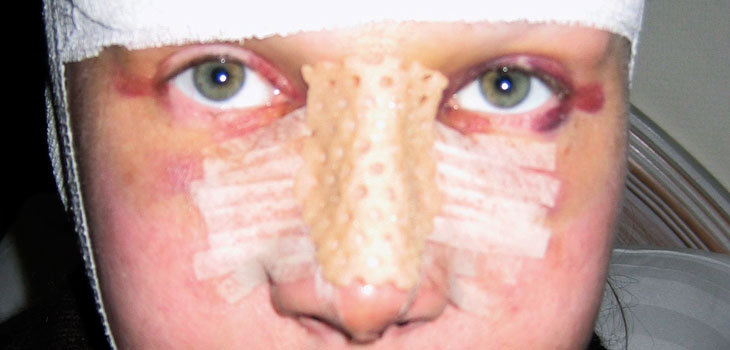
The British are at it again—first a trachea and now a nose. The BBC Focus magazine recently profiled the work of Professor Alex Seifalian, of University College, London, who is leading a team to create a new nose for a London businessman who lost his original nose to cancer. The trial, if successful, will be the first time a full nose will have been grown from stem cells.
Stem Cells Grow New Nose
1 min read Premium comments
Secondary
Seifalian first created a glass model of the man’s nose and spayed it with honey-comb shaped material to form a biological scaffold for new cells to attach to. Once the scaffold had been created the researchers removed the glass mould and coated the biological frame with millions of stem cells. While the scaffold was being built, the researchers inserted a small balloon beneath the surface of the man’s arm and gradually inflated it to stretch the skin, making it loose enough to accommodate the new nose.
Two months ago, doctor’s removed the balloon from under the skin and in its place inserted the nose framework where it now resides in the man’s arm growing new networks of nerves, blood vessels and skin. Researchers believe that, if all goes well, after three months beneath the skin on his arm, the nose will be ready to be removed. Once it has been removed doctors will surgically reattach the nose to the man’s face. They will also sew up his arm and it should return to normal.
Seifalian said the man’s nose has been designed to look exactly like the original—slightly crooked. He told BBC Focus magazine: “His nose was a little bit bent to the left and we asked if he wanted it straight but he said no, he wanted it exactly the same.”
Author
React:
Discussion
This is a fascinating development. In my practice we've seen similar outcomes with the revised protocol. The key differentiator seems to be patient selection criteria. Has anyone else noticed the correlation with BMI thresholds?
Great point. I'd push back slightly on the conclusion, the sample size in the cited study is too small to draw population-level inferences. That said, the directional signal is compelling and worth a larger RCT.
We implemented a similar approach last year. Early results are promising but we're still gathering 12-month follow-up data. Happy to share our protocol if anyone is interested.
Join the conversation
Orthopedic professionals are discussing this. Sign in and upgrade to read every comment and add your voice.