
“I’m no fan of modularity, but dislocation is the number one cause of revisions. So that’s the only reason I’m using it, ” states Wayne Paprosky. Mike Berend argues against the proposition saying: “One piece implants are appropriate for the vast majority of stem revisions. It’s significantly quicker and easier, involves fewer trays, and is proven out into the second decade.”
Paprosky Takes on Berend Over Stem Modularity
8 min read Premium comments
Great Debates
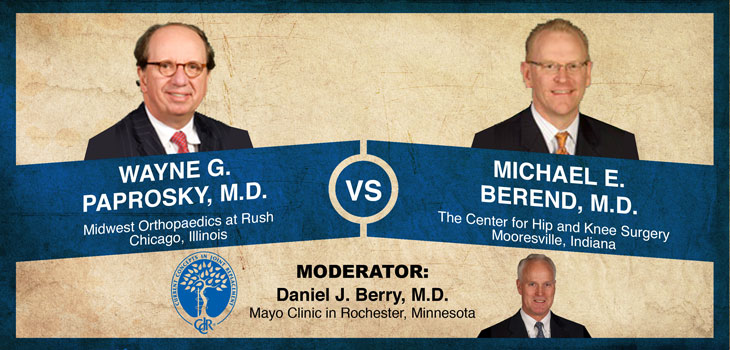
This week’s Orthopaedic Crossfire® debate is “Femoral Stem Modularity in Revision THA [total hip arthroplasty]: The Solution for all Seasons.” For the proposition was Wayne G. Paprosky, M.D. from Midwest Orthopaedics at Rush in Chicago. Against the proposition was Michael E. Berend, M.D. of The Center for Hip and Knee Surgery in Mooresville, Indiana. Moderating was Daniel J. Berry, M.D. from Mayo Clinic in Rochester, Minnesota.
Dr. Paprosky: “Modularity is unnecessary in Type 1 and Type 2 femurs. The metaphyseal anatomy is relatively unaltered, monoblock stems are easily rotated into correct version, and in these cases there is no modularity advantage whatsoever. This is my perspective after having done revisions for 25 years.”
“You’re able to turn the implant in whatever version position you want. Even if you have a little bit of varus remodeling, you still are able to do this provided you keep the stem short (under eight inches). Breakage does occur in monoblock stems. The big concern with modular stems is breakage; there are reports of fractures of monoblock stems.”
“In a study we did several years ago there were 18 stem fractures in 17 patients; the majority of the cases were in smaller diameter stems, but they can occur in larger diameter stems. When it does, it usually occurs when there’s no proximal support. When we start to get into trouble is when the femurs get more deformed.”
“About 10 years ago we found that porous coated stems didn’t work in these types of cases, so we began advocating the use of tapered stems since we’re able to get fixation over two centimeters when there was less than four centimeters of isthmus available. We got great rotational stability, and we were able to independently adjust the anteversion. Monoblock fluted tapered stems have shown a higher dislocation rate…and there has been some subsidence early on. But I think as your learning curve improves subsidence will probably go down.”
“As we get further down the femur and there’s more damage, the femur starts to deform. The varus remodeling gets more severe; we go with longer stems and have to use curved stems. It’s near impossible to adjust the anteversion in a curved stem. So what we find in Type 3 femoral defects is the more bone damage, the greater the torsional remodeling, the greater the difficulty with anterior mismatch. And without proximal landmarks it’s difficult to adjust the height. With torsional remodeling you really don’t have a good sense of what the anteversion of your stem should be.”
“So the absolute indications for modularity are: when you have severe proximal torsional remodeling, altered anatomy of the lesser trochanter, severe proximal bone loss, and the lesser trochanteric landmark is gone (to determine version). And in cases with severe bone loss where curved stems are required, you can’t adjust the anteversion.”
“Anteversion optimization: why not use modularity…because there are reports of breakage and corrosion. The newer designs are stronger and there’s no reported breakage yet. From 2000-2003 we looked at all patients undergoing femoral revision at Central DuPage Hospital using two different devices (modular devices with tapered stems). We had a minimum of eight year follow up, there was no proximal femoral support, and we had only one loosening and no dislocations.”
“And there was the 2003 study by Louis Kwong that was similar to ours and was very successful. They had 143 patients, a 97% rate of component survival, and average subsidence of 2.1 millimeters.”
“The dislocation rate that we’ve found overall is only 3% in modular stems; the dislocation rate with monoblock, including my series, was 8-14%. So dislocation rates can be reduced in femoral revision by using large diameter heads in conjunction with adjusting anteversion.”
Dr. Berend: “I’d like to bring a Midwestern, simple country surgeon approach. We haven’t gotten on the bandwagon for modular implants; we’ve used the same implant for all comers. Looking at a case of a Type 2 femur…a cemented implant removed with a femoral osteotomy where there was a fracture of the stem. I’m sure design improvements have helped reduce this; it’s interesting that the final solution for this problem was to go with a non modular implant. Perhaps we can skip the interval step of modularity and go straight to one piece implants.”
“We have lots of things to choose from: fully coated, proximally coated (which is what we’ve most often used), one piece implants, and modular stems. It’s a difficult inventory problem…how do you know when you’re going to need it?”
“Wayne’s work from 1999 had 170 hips and pretty good follow-up with excellent stem survivorship (95%). Six stems were revised to larger stems, and they observed stress shielding in larger bone diameters, so that’s one case where we’d agree on modularity.”
“Look at two quotes from this study: ‘On the basis of the radiographic and clinical results at a mean follow-up of 14.2 years, we recommend the use of extensively coated femoral stems in revision hip arthroplasty…’ and ‘Proximally coated implants are not well suited to achieving these goals…’”
“We asked, ‘Does defect determine the stem survivorship?’ We have used the same stem since 1987; one of the designers reported 99.2% clinical survivorship after 14 years. It is coated only on the proximal one third, and is available in many lengths. The critiques are that it’s not fully coated, it’s non modular, and it doesn’t achieve torsional stability…is a bowed implant after you reach the 220mm length. We’ve been able to use that in the vast majority of revisions.”
“Our series is 461 hips with follow-up out to 21 years; overall survivorship for all revisions is 96.3%. If you look at femoral aseptic loosening it’s 99%. There were no stem fractures in this cohort. Interestingly, stem survivorship on the femoral side was not correlated with femoral deformity, but overall complications of all reasons were correlated with deformity.”
“From my work using the Paprosky Classification System: The majority of aseptic femoral re-revisions were Type 3 and higher; there were five femoral revisions (two for instability, one for periprosthetic fracture, one was not placed inside the femur at the index operation, and one patient returned for a follow-up at one year with a loose femoral component (and wearing an orange jumpsuit).”
“If you look at the overall complication rate, the dislocation was 6.7%, and a host of other problems that you see in all revision surgery about the hip. I do think that large head femoral diameters—which were not used in the majority of these cases—can reduce the dislocation rate.”
“There’s been critique of using a one piece proximally coated stem with an extended trochanteric osteotomy. We looked at our early experience in 45 hips; we had 98% union rate at the trochanter, 100% stem survival, excellent ingrowth of the implant. And, as Wayne pointed out, there was an 18% intraoperative fracture rate. In shorter femurs where there is a mismatch between the bow of the femoral implant and the bow of the femur, these folks may benefit from a modular implant.”
“We’re seeing increasing complexity, and the types of cases where you only have the distal femur I think a modular fluted stem is an excellent solution. So the goal here is torsional implant stability, and I think one piece implants are appropriate for the vast majority of stem revisions. It’s significantly quicker and easier, involves fewer trays, and is proven out into the second decade. I would like to see long term data on modular stems, and I would encourage all of us to use large heads in these populations.”
Moderator Berry: “Wayne, rebuttal?”
Dr. Paprosky: “There’s probably crossover of almost 90%. I looked at our data and the dislocation rate is higher as the defect gets more severe and there’s more proximal remodeling. And without the landmarks—for someone who’s not doing them all the time—you’d think that might be a reason, but for someone like me who’s been doing this for 25 years, there is a difference and I’m able to fine tune the anteversion. When you don’t have the proximal anatomy it’s easier to think of doing two things separately…putting the stem in first and getting it solidly fixed, and then fine tuning the anteversion. But we’re talking maybe 10% of cases. I’m not a fan of modularity because you have to put them together, there’s a potential for particulates, etc. But dislocation is the number one cause of revision of revisions. So that’s the only reason I’m using it.”
Moderator Berry: “So you like the advantages of modularity, but don’t like the biomechanical problems of modularity?”
Dr. Paprosky: “Absolutely.”
Moderator Berry: “Mike?”
Dr. Berend: “Sometimes it’s hard to decide offset, leg length, stability in these disaster type cases. We’ve chosen to do that with a one piece stem; we feel like we can adjust the anteversion even easier if the proximal femur is missing.”
Moderator Berry: “Mike, is the reason you can deal with the anteversion more easily with a specific system you used because it’s a calcar replacing one so you can rotate it a bit more easily than a monoblock?”
Dr. Berend: “Excellent point. When the bone is absent down to the level of the lesser trochanter you can pick your anteversion before you impact the final stem.”
Moderator Berry: “Wayne, you said that you could handle 80% of revisions with a monoblock stem, but what do you actually do now?”
Dr. Paprosky: “Unfortunately I’m at the bottom of this sewer drain…so I’d love to be able to say that it is 85% because that’s generally the breakdown in the literature of Type 1s and Type 2s versus 3s. But my practice is probably closer to two-thirds 3Bs and 4s. And in the 3As if I can get away with it I will use monoblock stems.”
Moderator Berry: “Mike, you’ve made the argument for monoblock, but in a practice where you’re seeing tough cases, how often do you actually go to modularity?”
Dr. Berend: “It’s less than 2%; I think any time you’re doing a femoral osteotomy transversely we’ll use it for the splined element distally. Other than that, the case I showed is the only one we’ve done in 20 years.”
Moderator Berry: “If you’re going to make an argument about why you’d want to avoid it, you might say ‘cost.’ Also, there is the concern about how the modular junctions will hold up long term. Wayne, what do we know about how the modern tapers are holding up?”
Dr. Paprosky: “In every case where I use a modular stem there is no support. So when you go to some meetings [and] hear, ‘Well, put a strut graft on.’ That’s kind of like kissing your sister. You do it at Christmas because your mother says you should. There’s no benefit. I have some links out now—12 years—that have not broken. As for fretting and corrosion, these are low activity patients and I think because our dislocation rate is zero in these so far, it’s a huge benefit. I wasn’t able to achieve that with monoblock stems in severe cases.”
Moderator Berry: “Thank you, gentlemen.”
Please visit www.CCJR.com to register for the 2013 CCJR Spring Meeting, May 19 – 22 in Las Vegas, Nevada.

“You may now view CCJR meeting content on your mobile device on the CCJR MobileTM App. Please scan the QR code to download from iTunes.”
React:
Discussion
This is a fascinating development. In my practice we've seen similar outcomes with the revised protocol. The key differentiator seems to be patient selection criteria. Has anyone else noticed the correlation with BMI thresholds?
Great point. I'd push back slightly on the conclusion, the sample size in the cited study is too small to draw population-level inferences. That said, the directional signal is compelling and worth a larger RCT.
We implemented a similar approach last year. Early results are promising but we're still gathering 12-month follow-up data. Happy to share our protocol if anyone is interested.
Join the conversation
Orthopedic professionals are discussing this. Sign in and upgrade to read every comment and add your voice.