
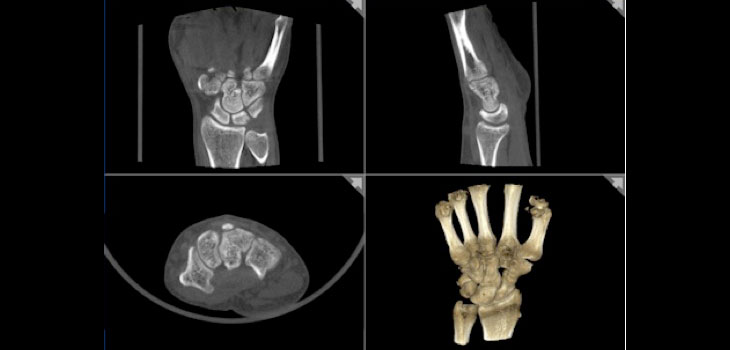
The first CT system that can image seated, supine and standing patients has received FDA 510(k) clearance. Called the Planmed Verity extremity scanner, the device is designed to be used for pre- and post-operative imaging with better resolution, patient adaptability, and significantly lower dose than full-body CTs. Unlike other 3D imaging devices, Planmed Verity also allows weight-bearing imaging of the extremities. Planmed Verity is designed to find subtle extremity fractures at the first visit to the clinic—the sort of fractures that have been the most commonly missed using only 2D radiographs.
New Scanner Reveals Extremity Fractures
1 min read Premium comments
Secondary
According to the manufacturer, the Planmed Verity adapts to the patient’s body with anatomy-specific imaging programs, movements, and carbon-fiber positioning trays.
The device’s easily adjustable, soft surfaced gantry and motorized positioning help in finding a comfortable position for various examination procedures.
“We are excited that this innovative, low dose orthopedic imaging system is now available also in the U.S. We are confident that it will be well received, ” said Vesa Mattila, vice president of Planmed Oy. The company is part of the Finland-based Planmeca Group which manufactures and markets advanced equipment for medical and dental fields. The U.S. subsidiary, Planmed USA, Inc., is located in Roselle, Illinois.
The Planmed Verity has the CE mark and is available for sale in the EU and other countries where the CE certificate permits sales. In the U.S., Planmed Verity has been in clinical test use at the Massachusetts General Hospital in Boston.
Author
React:
Discussion
This is a fascinating development. In my practice we've seen similar outcomes with the revised protocol. The key differentiator seems to be patient selection criteria. Has anyone else noticed the correlation with BMI thresholds?
Great point. I'd push back slightly on the conclusion, the sample size in the cited study is too small to draw population-level inferences. That said, the directional signal is compelling and worth a larger RCT.
We implemented a similar approach last year. Early results are promising but we're still gathering 12-month follow-up data. Happy to share our protocol if anyone is interested.
Join the conversation
Orthopedic professionals are discussing this. Sign in and upgrade to read every comment and add your voice.