
A team of researchers from the University of California, Santa Barbara has developed a new, noninvasive, and low-cost method for the early detection and monitoring of osteoarthritis. The scientists, who are from the Department of Chemical Engineering and the Department of Materials, found a different type of friction that is more likely to cause wear and damage.
New Method to Detect and Monitor OA
2 min read Premium comments
Secondary
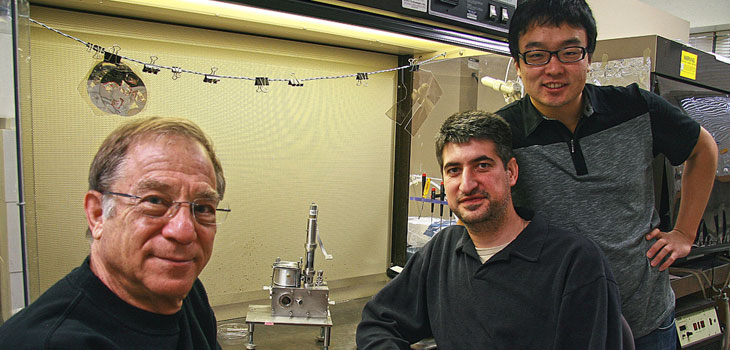
Jacob Israelachvili, UCSB professor of chemical engineering and materials science, graduate student researcher Dong Woog Lee, and postdoctoral researcher Xavier Banquy measured the adhesion and friction forces between surfaces, in this case cartilage.
“It is currently believed that a high-friction force, or ‘coefficient of friction, ’ is the primary factor in surface wear and damage, ” said Professor Israelachvili in the January 29, 2013 news release. “What we found is that this is not the case.”
They say the critical feature is actually “stick-slip” friction, or, sometimes, “stiction.” Both are characterized by surfaces that initially stick together, and then accelerate away quickly once the static friction force is overcome. With stick-slip friction, the surfaces eventually pull slightly apart and slide across each other, stick again, and pull apart, causing jerky movements.
The scientists will continue their work by studying synovial fluid. “There are a number of directions to take, both fundamental and practical, ” Professor Israelachvili said. “But it looks as if we need to focus our research on finding ways to prevent stick-slip motion, rather than lowering the friction force.”
Asked what gave him the idea for this work, Professor Israelachvili told OTW, “About 12 years ago Dr. Charles McCutchen of the McCutchen Foundation asked whether I would do research into why the ‘boundary lubrication’ mechanism in joints breaks down leading to osteoarthritis. Boundary lubrication refers to the molecularly thin lubricating layer of lipids, proteins and polysaccharide polymers like hyaluronic acid on the cartilage surface that, working together, are believed to be responsible for the low friction and wear & tear protection of the delicate and soft cartilage surfaces during articulation. We at UCSB have been exploring the way the different molecular species—in the “synovial fluid” between two cartilage surfaces, on the cartilage surfaces, and inside the cartilage itself (a complex sponge-like porous network of collagen and other bio-macromolecules)—work synergistically in a healthy joint.”
Asked how they will pursue the work on synovial fluid, Professor Israelachvili told OTW, “We will test how changing the molecular weight, precise chemical composition, and concentration of the different components in SF and on the cartilage surface affect the friction characteristics, thereby identifying which properties are more likely to give rise to stick-slip sliding. Then we will try to find ways of monitoring and regulating (controlling) these either through medications (pills, injections), or targeted biochemical modification.”
React:
Discussion
This is a fascinating development. In my practice we've seen similar outcomes with the revised protocol. The key differentiator seems to be patient selection criteria. Has anyone else noticed the correlation with BMI thresholds?
Great point. I'd push back slightly on the conclusion, the sample size in the cited study is too small to draw population-level inferences. That said, the directional signal is compelling and worth a larger RCT.
We implemented a similar approach last year. Early results are promising but we're still gathering 12-month follow-up data. Happy to share our protocol if anyone is interested.
Join the conversation
Orthopedic professionals are discussing this. Sign in and upgrade to read every comment and add your voice.