
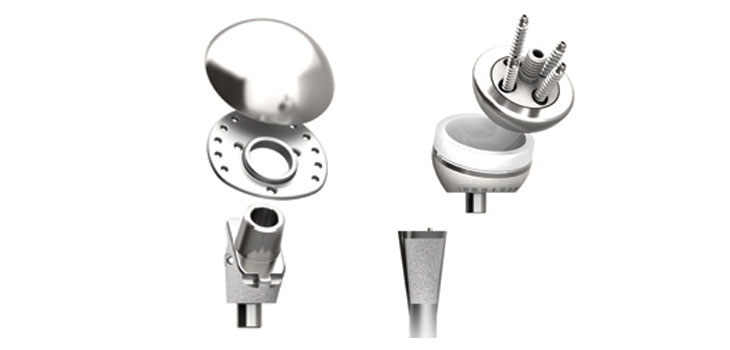
DePuy Synthes Joint Reconstruction has introduced the Global Unite Platform Shoulder Arthroplasty System.
DePuy Synthes’ “Next-Generation” Shoulder System
2 min read Premium comments
Secondary
According to a February 19, 2013 press release, the system enables surgeons to anatomically treat proximal humeral fractures and easily convert to a reverse total shoulder without compromising recognized biomechanical principles.
The system is a modular system that allows 72 different sizing configurations. A suture collar allows secure anatomic reconstruction of the tuberosities and helps return the shoulder to a natural anatomical position. The FDA granted 510(k) clearance of the system and is indicated for press-fit or cemented fixation and offers the only modular system to provide a suture collar, which helps with anatomical reconstruction.
The company describes the Global Unite as a next-generation platform shoulder arthroplasty system which offers:
- Modular proximal bodies available in four sizes and three heights to promote anatomic restoration of humeral head height and tuberosity placement in a press-fit application
- Modular suture collar that allows additional suture fixation and anatomic reconstruction of the tuberosities
- Humeral heads that are available in sizes 40-56mm in both standard and eccentric configurations
- Option to convert to the DELTA XTENDTM Reverse Shoulder Arthroplasty System without the use of a stack on adaptor, which may compromise biomechanics
- Similar stem geometry to the clinically successful DELTA XTEND
- Revision without removal of a well-fixed humeral stem
Joseph Ianotti, M.D., Ph.D., Chairman, Orthopaedic and Rheumatologic Institute, Cleveland Clinic, said that, “Shoulder pathology is exceptionally varied, and with the Global Unite system surgeons have a comprehensive and fully interchangeable system that affords flexibility and versatility designed to address patients’ needs. My personal experience with the system has been very positive. Having a system where the implant is easily convertible gives you confidence that you can restore your patient’s shoulder to a natural anatomical position.”
The system is available worldwide and is also compatible with the following DePuy Synthes Joint Reconstruction glenoid components:
- Global Anchor Peg Glenoid
- Global Steptech, Anchor Peg Glenoid
The company cautioned that the performance of shoulder replacements depends on age, weight, activity level and other factors. There are potential risks and recovery takes time. People with conditions limiting rehabilitation should not have this surgery. Only an orthopedic surgeon can determine if shoulder replacement is indicated based on an individual patient’s condition.
DePuy Synthes Joint Reconstruction is part of DePuy Synthes Companies of Johnson & Johnson.
Author
React:
Discussion
This is a fascinating development. In my practice we've seen similar outcomes with the revised protocol. The key differentiator seems to be patient selection criteria. Has anyone else noticed the correlation with BMI thresholds?
Great point. I'd push back slightly on the conclusion, the sample size in the cited study is too small to draw population-level inferences. That said, the directional signal is compelling and worth a larger RCT.
We implemented a similar approach last year. Early results are promising but we're still gathering 12-month follow-up data. Happy to share our protocol if anyone is interested.
Join the conversation
Orthopedic professionals are discussing this. Sign in and upgrade to read every comment and add your voice.