
“Anterior THA is an efficient surgery, and it’s easy on the surgeon and patient, ” states Sonny Bal. “But, ” says Tom Sculco, “You need a special operating room table, intraoperative fluoroscopy, there is a difficult femoral exposure, increased OR time, and the possibility of higher complications.”
Bal v. Sculco Over Anterior THA
8 min read Premium comments
Great Debates
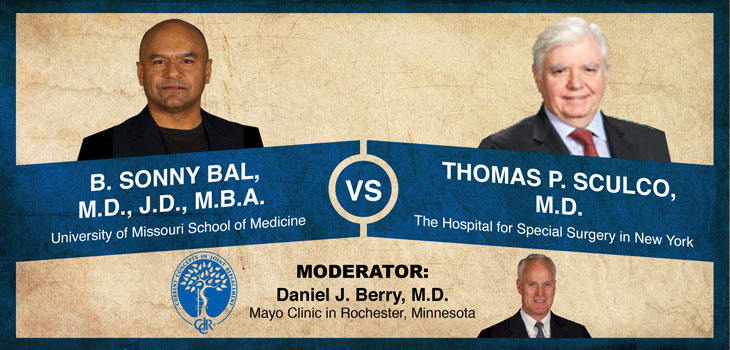
This week’s Orthopaedic Crossfire® debate is “The Anterior Approach Optimizes THA Outcome.” For the proposition was B. Sonny Bal, M.D., J.D., M.B.A. from the University of Missouri School of Medicine. Against the proposition was Thomas P. Sculco, M.D. of The Hospital for Special Surgery in New York. Moderating was Daniel J. Berry, M.D. from Mayo Clinic in Rochester, Minnesota.
Dr. Bal: “The anterior THA [total hip arthroplasty] technique I use involves a fracture table with simple draping; the exposure isn’t compromised at all. This approach is amenable to short and long stems, ream stems, wrasp stems and hip resurfacing. The exposure is excellent with the table. There is a hook that lifts the femur up a line for easier retraction. It’s definitely less traumatic to the muscle. You can do a revision through the anterior approach.”
“In 2009 a study by Bhandari involving nine centers and 1, 152 hips found early return to function and the same learning curve as a conventional hip. The following year Bourne did a study comparing anterior to anterolateral, and found faster return to function with the former.”
“In 2010 Joel Matta reported 1, 345 consecutive cases—unselected. They had reasonable blood loss, three dislocations, none of which needed surgery; patients could ambulate without support at 15 days postop. Nakata’s 2009 study comparing anterior to mini-posterior showed that the anterior had faster recovery and more accurately placed implants.”
“A 2010 study by Restrepo looked at anterior versus direct lateral and found that anterior had better scores and outcomes up to two years…then they equalized. In 2009 Berend compared the direct lateral to the anterior, and found that the anterior resulted in faster discharge; the complications were about the same as the direct lateral.”
“My own data: 500 consecutive anterior hips. At 3.8 years there were two late resections for sepsis, two I&Ds (incision and drainage), one small femur fracture required one wire; one was a postop injury that required two wires and a new stem. There were two dislocations from trauma and six metal-metal bearings were changed; each revision surgery was done through the same approach…which is extensile distally.”
“The clinical outcomes were reasonable, however, at four weeks 17% had reported thigh numbness. HO (heterotopic ossification) was an issue in 15%. The trochanteric tip migrated in seven patients, but this was not clinically relevant. There were very consistent radiographic outcomes.”
“It’s an efficient surgery, and it’s easy on the surgeon and patient. The supine approach is more physiologic, the leg lengths are very easy to measure, and the hip deltoid of the fascia is preserved. Bilateral hip replacements are very easy, there are no precautions specified for any patient, and it’s the easiest total hip replacement for obese patients because the fat is in the back, not the front. If there is any doubt, you can pull in the X-ray and get a fluoroscopic view. All implant companies support it, patients prefer it, it’s easy to get trained, and you have intermediate term outcomes from a number of studies.”
“Disadvantages: a definite learning curve, and quick success with this technique involves training and preceptorship…but that’s true of any new method.”
Dr. Sculco: “There are many ways one can get into the hip with less invasive approaches: medial, anterior, anterolateral, posterolateral (my preference), and two incision. All are good approaches that should be done by people with experience.”
“I like the posterolateral approach because it’s the most commonly used in hip surgery, it can easily be extended, there is less blood loss, and it’s expeditious. The main disadvantage is the increased dislocation rate, which has now been dealt with primarily with larger femoral heads and dual mobility cups (in older women particularly).”
“The incision is between 8-10 centimeters. This approach does vary depending on the size of the patient, but in a thin woman the incision is two-thirds below the tip of the trochanter, one-third above. Note that you must see—circumferentially—the upper portion of femur so that fracture does not occur.”
“We have an ongoing study with 1, 465 patients that we’ve followed for nearly nine years, with an average incision of 8.4 centimeters. Our radiographic evaluations have been the same as with our more dramatic approaches. Cement technique in the cemented ones has been excellent, as has the stem position.”
“We’ve had complications. The dislocation rate was 1.2%, the femoral fracture rate was 0.3%, and the neuropraxia rate was 0.3%, particularly in our earlier patients when we were a bit too aggressive with trying to make the incision too small. Three of those five patients recovered, but two did not. There were few wound complications.”
“The Internet has over 62, 000 websites dealing with the anterior approach…and patients come to me daily asking for this approach because of the media blitz. The claims made are that it is tissue sparing, involves less pain and faster recovery, but there is little evidence in the literature to document these claims.”
“The disadvantages are that you need a special operating room table, intraoperative fluoroscopy, a difficult femoral exposure, increased OR time, and the possibility of higher complications.”
“Menghini did a study looking at whether this approach is really muscle sparing. He found significant injury to muscle about the hip—tensor fascia as well as the external rotators. Another study, done by Pilot, looked at IL-6 and an enzyme followed in muscle to evaluate tissue injury using a posterior and an anterior approach. There was no difference found in these markers of tissue injury in the two series.”
“Looking at dislocation rates reported in large series of the anterior approach: Siguier had 1, 037 THA with a 0.96% dislocation rate; Matta had 437 THA with 0.61%; Kennon had 2, 132 THA with 1.3%; Sariali had 1, 374 THA with 1.5%. I would put that up against the 1.2% incidence in 1, 465 THA that I’ve reported. And I don’t think there’s really any difference in the two operative approaches.”
“In another study by Dr. Matta, who’s a developer of the technique, there were 494 THA-anterior with a 2.4% fracture rate…as opposed to my 0.3% (posterior). And note that there were three ankle fractures when you externally torque the limb in order to expose the anterior part of the femur.”
“My opinion is: keep it simple. Disaster is always a threat.”
Moderator Berry: “Sonny, rebuttal?”
Dr. Bal: “A surgeon of Dr. Sculco’s stature is used to the posterior approach. The anterior approach is not only a shortened incision, but is a brand new approach. So the surgical data that Joel Matta had, I’ve had early on with a two incision approach, which is very similar. The supine position is new for most of us, the acetabular positioning is different, and the femoral exposure requires certain techniques (which if you don’t know can make for a long day in the OR). So I don’t think we’re comparing apples to apples.”
Moderator Berry: “Tom?”
Dr. Sculco: “Use any approach…these are all very useful. This one requires a special table and techniques and takes time to learn; and you’re going to have problems when you do it. When you weigh that against the posterior approach I don’t see a lot of advantages. In Sonny’s hands I’m sure the results are very good. In my hands the posterolateral approach has been very good. I just think it’s easier for the erstwhile joint replacement surgeon out there doing 25-30 joints a year. Sonny, HO…I’ve seen reports that it may be higher in this approach. You had a 15% incidence. Were those Brooker ones and twos?”
Dr. Bal: “My data is at least twice the size I showed you and I’ve never seen more than a Brooker two. Partly because it’s not a simple approach. The table is useful in the sense that the assistant who is holding the foot has to make subtle moves during the case to increase abduction and relieve pressure on the muscle. It’s not a matter of forcing; it’s splitting the muscles and trying to see what you want to see. To your earlier point, the learning involved here includes a mentorship and cadaver dissection, as well as courses where you learn the subtle tips and techniques.”
Moderator Berry: “Sonny, what about the charge that this is a marketing game? And if you ask everyone in the room to learn a whole new approach, use a fracture table, etc., then they’re all going to have to go through that learning curve. Is that really justified?”
Dr. Bal: “The marketing thing is very unfortunate. One of the advantages touted at the meetings (and by the companies) is that if you learn this approach you will increase the volume of your total hip surgery. It gives the wrong message about our profession and it misleads patients. These issues are played out in the lay press and then the scientific evidence comes to light. So I can’t support the websites that say this is a new or different approach.”
Moderator Berry: “Speed of recovery: Tom does a relatively small incision, posterior approach, and theoretically none of the main muscles around the hip are compromised. You do an anterior approach and theoretically none of the main muscles around the hip are compromised. Why should there be any real difference in speed of recovery—or is there one?”
Dr. Sculco: “I don’t think there is any difference. When you hear a lot about speed of recovery you’ve got to look at the patient population. There is a self-selection, and if you operate on very young, fit people, they can walk the next day. If you operate on an 85-year-old sedentary person then they’re going to be less active. So I don’t think it’s the approach…I think it’s the protoplasm you’re dealing with.”
Dr. Bal: “I think the jury is still out. In a number of the papers I showed, some by conservative authors who published in some of the best journals there is a feeling that the recovery rates are faster. Eventually the recoveries are about the same. My data is weak because I didn’t do a direct comparison, but I can tell you that in one month after an anterior hip replacement the patients almost don’t want to see you again. They’re done and want to go on with their lives. I didn’t find that with direct lateral or posterior approaches.”
Moderator Berry: “Sonny, one of the things about the direct anterior approach is that it’s harder to get the femoral component in. One of the solutions has been to change the type of femoral component; sometimes we’ve seen problems with fixation when people have switched around previously reliable femoral components to ones that are designed to just fit through a special approach. How do you counter that concern? Is it a concern?”
Dr. Bal: “It’s not. If you know how to expose the femur then regardless of patient obesity safe exposure is possible such that any femoral stem, particularly the reliable ones with a track history, can be used. If you’re struggling with the approach—with exposure—then you’re resorting to a stem that allows unlimited exposure. Then you’re playing with fire.”
Moderator Berry: “What are the unique problems of the anterior approach?”
Dr. Bal: “Exposure! If you use the table to force exposure you might break the ankle or femur. Wound maceration—same thing. It’s a misguided attempt to try too small an incision.”
Moderator Berry: “Thank you, gentlemen.”
Please visit www.CCJR.com to register for the 2013 CCJR Spring Meeting, May 19 – 22 in Las Vegas, Nevada.

“You may now view CCJR meeting content on your mobile device on the CCJR MobileTM App. Please scan the QR code to download from iTunes.”
React:
Discussion
This is a fascinating development. In my practice we've seen similar outcomes with the revised protocol. The key differentiator seems to be patient selection criteria. Has anyone else noticed the correlation with BMI thresholds?
Great point. I'd push back slightly on the conclusion, the sample size in the cited study is too small to draw population-level inferences. That said, the directional signal is compelling and worth a larger RCT.
We implemented a similar approach last year. Early results are promising but we're still gathering 12-month follow-up data. Happy to share our protocol if anyone is interested.
Join the conversation
Orthopedic professionals are discussing this. Sign in and upgrade to read every comment and add your voice.