
“Mechanical axis restoration represents the target for a successful and durable total knee, ” states Adolph Lombardi. “Well, ” says Mark Pagnano, “At the end of this we’ll all continue to shoot for the same target, but I want you to do that recognizing that our knowledge of ideal TKA alignment is surprisingly weak in 2011.”
Lombardi Debates TKA Alignment With Pagnano
8 min read Premium comments
Great Debates
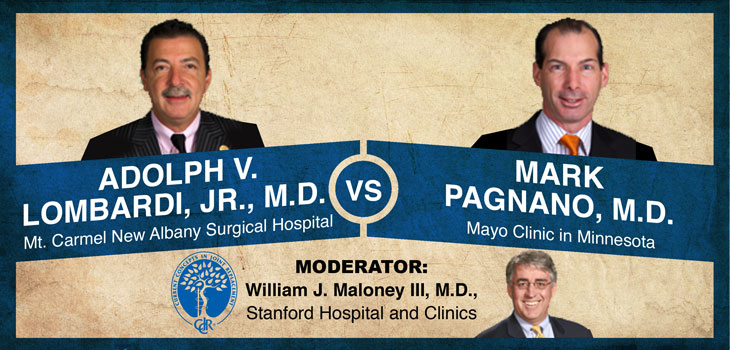
This week’s Orthopaedic Crossfire® debate is “Neutral Mechanical Alignment: Required for Long-Term TKA.” For the proposition was Adolph V. Lombardi, Jr., M.D. from Mt. Carmel New Albany Surgical Hospital in Ohio. Against the proposition was Mark Pagnano, M.D. of Mayo Clinic in Minnesota. Moderating was William J. Maloney III, M.D. from Stanford Hospital and Clinics.
Dr. Lombardi: “What I’m talking about is the tried and true adage that restoring mechanical axis and balancing flexion and extension gaps is the key to durability of total knee arthroplasty (TKA). There are multiple ways to do mechanical axis restoration. Computer navigation has helped eliminate outliers. We’re seeing robotics being used in unis [unicompartmental knees] and being adapted to total knees. And I think they will help us eliminate these outliers.”
“Patient specific guides: facilitate preoperative planning, eliminate intramedullary canal penetration of the femur/tibia, improve alignment and OR efficiency, decrease the potential for contamination of the OR via decreased inventory of instruments.”
“In 1987 John Moreland produced an article showing that overall limb alignment was about 1.3 degrees of relative varus when he measured 20 ‘normal’ males. Studies have been published showing that varus malalignment is a problem. Merrill Ritter has published several papers showing that radiographic alignment and total knee alignment was very effective in optimizing survival.”
“In a paper looking at over 6, 000 knees the failure rate when neutrally aligned was 0.5% versus varus, which was 1.8%—or valgus, which was 1.5%. There are a couple of papers showing that if you do accurately align the knee you can improve some of their physical component scores, as well as their overall Knee Society Score.”
“A paper by Mahoney showed that if you avoid varus you significantly decrease the ratio of failure. One degree of mechanical varus had an odds ratio of 4.6, versus greater than three degrees, which had 6.9. In a biomechanical study looking at the effect of varus alignment (Green et al.) they found that when you align a component in varus you increase the medial load significantly…neutral alignment, therefore, is very protective of the tibial bone.”
“A paper published in 2010 by my debater colleague…398 knees and 280 patients, basically showing that outliers didn’t fail at a higher rate than those that were adequately aligned. Seventy of these 100 or so outliers were four degrees, so they were +/- 4. So there weren’t a lot of significant outliers in this paper. And Mark stresses the fact that when you revise a knee you had better be sure to put it in alignment. That is the key to enhancing the durability of the revision total knee.”
“If we look at why knees fail, we see in an article by Sharkey et al., 11.8% of the failures were secondary to malalignment or malpositioning. Another paper (Mulhall et al.) found that malalignment was 9.4% of the reason for revision. So the take home message today continues to be that mechanical axis restoration represents the target for a successful and durable total knee.”
Dr. Pagnano: “At the end of this we’ll all continue to shoot for the same target, but I want you to do that recognizing that our knowledge of ideal TKA alignment is surprisingly weak in 2011.”
“What is a malaligned knee? Is it outside of +/-3 degrees and therefore 3.1 degrees is bad and 2.9 degrees is good? Our knowledge of alignment is little better than it was in the 1970s when we introduced the total condylar knee. We aimed for a broad, generic target at that point, and that target has remained relatively unchanged. That’s not acceptable for 40 years of use.”
“Is there one simple target for all patients? Is that target broad and generic? Or, as I suspect, is it more narrow and specific for each patient, with a penalty to be paid if you deviate even a small amount.”
“But the scientific support, including many of the papers cited by Dr. Lombardi, have major flaws. Most of the studies have been based on short knee X-rays, which don’t allow us to calculate a mechanical axis…and many of them involved rudimentary total knee designs. The paper that is routinely cited is the Denham knee. This design has an all-polyethylene tibial component that was designed to go in with a Steinmann pin, and a femoral component that’s basically a roller and trough with no cutout for the patella—hardly what we put in today.”
“We looked at the Mayo Clinic experience, with correction of the mechanical axis, and asked, ‘Does it improve the 15 year durability of contemporary total knee arthroplasty?’ ‘Does a postop mechanical axis of 0 +/-3 degrees confer a 15 year survivorship advantage?’ We looked at those 399 knees that you heard about before…it’s in patients that we continue to operate on (mean age of 69, a mean BMI that’s in the obese range)…and the distribution is similar to what you and I take care of in our practices today.”
“There were three modern condylar knee designs used: the Kinematic Condylar 2, the PFC, and the Genesis—all cruciate retaining designs and all done by one surgeon. We couldn’t show that survivorship was better with a neutral mechanical axis than when we had some outliers that were just outside of that. Overall survivorship is actually quite good. At 15 year follow-up with three modern designs small deviations from the mechanical axis had no detectable effect on durability.”
“While alignment clearly plays some role, there’s no knee that belongs in 15 degrees of varus—or 15 degrees of valgus. Factors other than alignment are more important in determining 15 year survival of modern cemented TKA.”
“Scott Banks’ group looked at the Kinemax design at long term follow-up…no difference with alignment or so-called malalignment. Merrill Ritter’s group reported on one of the versions of the AGC—the cementless at 20 years—no difference in survivorship.”
“In the primary osteoarthritis literature gait dynamics are part of what they’ve been researching for years. We also need to think about the rotational position of the implant and the implant design, and how those all interact.”
“It’s my contention that the ideal alignment after TKA involves a complex interplay between limb alignment, component rotation, sizing and balancing…and there may be some implant specific differences.”
“Dynamic loading after TKA…the ideal would be if you had a 0 degree mechanical axis and 50/50 loading of the medial and lateral sides. Instead what you see is that many patients who had ‘ideal’ alignment still had unbalanced dynamic loading at two years after their TKA.”
“We still need to aim for something, and the traditional target of a neutral mechanical axis is a reasonable guide until we know more.”
Moderator Maloney: “Adolph?”
Dr. Lombardi: “We create a Charcot joint for the patient. We take away their pain, and we put in manmade devices that don’t respond the way bone and cartilage do. So I think the protective effect of restoring the mechanical axis is on the manmade devices…the cement, metal, and polyethylene.”
Moderator Maloney: “Mark?”
Dr. Pagnano: “I agree…and I think the difference is that you’re looking at a static X-ray and presuming that if the hip, knee, and ankle are all lined up, you’re going to get 50/50 loading of the knee joint and spread that load out over the biggest area. That intuitively makes sense. The gait lab shows that for many patients when the hip, knee, and ankle are all lined up on a static X-ray, as soon as they start walking they’re loading their knee in a markedly different way.”
Moderator Maloney: “Adolph?”
Dr. Lombardi: “The unpredictability of knowing which patients you’re talking about is what would make me pick one target—the neutral alignment.”
Moderator Maloney: “Those patients who have lived their lives in some varus or valgus you try to get them back…but are those patients where we should be looking for a different axis?”
Dr. Pagnano: “50/50 loading of the knee joint probably gives you the best long term durability so we’re limited by the fact that we’re using metal and plastic and bone cement. Spreading the load out over the biggest area makes the most sense from a durability standpoint. Now, step back and say, ‘What’s the best for function for a patient?’ That’s where the question comes up as to whether some patients might belong in a bit of varus/valgus so that you don’t have to do a big ligament release. So if we get more information over time we might be able to make an educated decision. Maybe I leave that patient in a bit of varus, and for that person I will accept a little higher failure rate, but it’s going to give the best function in the short term.”
Dr. Lombardi: “I assume the patient came to me because they were in varus, had an overloaded medial compartment, developed degenerative joint disease. Now I remove their ACL, I destroy their kinematics, and you want me to leave in varus?”
Moderator Maloney: “So what do you do with that patient with 30 degrees of valgus?”
Dr. Lombardi: “When I use intermedullary alignment guides I cut the distal femur at about three degrees of valgus to make sure that I get them in a neutral alignment.”
Moderator Maloney: “Mark, what are you shooting for in those bad valgus knees?”
Dr. Pagnano: “I’ll aim for six degrees in those patients, but we are just picking a number out of mid air. Adolph is taking the position that he’d rather over-correct it and do some more ligament releases with the idea that that may give me better durability. I favor less ligament releasing with the concept that maybe they’ll get better function.”
Dr. Lombardi: “But my point is that if I shoot for six I wind up at seven or eight, I’ve got a stretched medial collateral…I haven’t done the patient any favors. If I cut at three and line up at five then I’m happy.”
Moderator Maloney: “What’s more important in the OR, a stable reconstruction as it relates to ligament balancing or getting the alignment perfect?”
Dr. Lombardi: “I’d like to have both, but since I’m an advocate of measured resection I go for getting the bones aligned correctly and balancing soft tissues around the bone cuts.”
Moderator Maloney: “Mark, you’re doing a valgus knee and you get it back to six or seven degrees of valgus. You know it’s in a little valgus, but it really feels right. What do you do with that knee?”
Dr. Pagnano: “My priority is balanced flexion and extension gaps as opposed to the bone cuts. I can’t predict how that individual patient is going to load their knee later, but I know that if I start with balanced flexion/extension gaps at least early after surgery that knee has the best chance of functioning well.”
Moderator Maloney: “We really have a gap in knowledge in terms of what we achieve in the OR and how that affects function. One could be critical of your study because you didn’t have many real outliers. Did you also look at things like arthrofibrosis and manipulation as it related to alignment?”
Dr. Pagnano: “We didn’t go into those details as far as other clinical findings. We did report Knee Society scores. I have a fairly robust revision practice…I don’t see that many knees coming in at 12 degrees of varus or 15 degrees of valgus.”
Moderator Maloney: “Thank you.”
Please visit www.CCJR.com to register for the 2013 CCJR Spring Meeting, May 19 – 22 in Las Vegas, Nevada.

“You may now view CCJR meeting content on your mobile device on the CCJR MobileTM App. Please scan the QR code to download from iTunes.”
React:
Discussion
This is a fascinating development. In my practice we've seen similar outcomes with the revised protocol. The key differentiator seems to be patient selection criteria. Has anyone else noticed the correlation with BMI thresholds?
Great point. I'd push back slightly on the conclusion, the sample size in the cited study is too small to draw population-level inferences. That said, the directional signal is compelling and worth a larger RCT.
We implemented a similar approach last year. Early results are promising but we're still gathering 12-month follow-up data. Happy to share our protocol if anyone is interested.
Join the conversation
Orthopedic professionals are discussing this. Sign in and upgrade to read every comment and add your voice.