
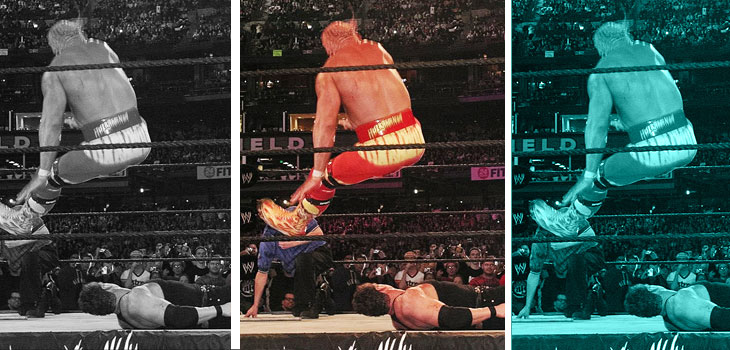
Hulk Hogan is smacking down the Florida-based Laser Spine Institute.
Hulk Hogan Slams Laser Spine Institute for $50 Million
2 min read Premium comments
Secondary
The Hulkster is suing the institute for persuading him to have half a dozen of “unnecessary and ineffective” spinal operations. After all the procedures, his back problems worsened, according to his lawsuit filed on January 14 in Florida state court in Clearwater.
Bloomberg News reported on January 14 that Hogan, whose real name is Terry G. Bollea, said in his lawsuit that he became aware that the surgeries, “may have been unnecessary or performed negligently after reading a 2011 Bloomberg News report that detailed complaints that the care offered at the center is expensive and ineffective.”
According to his complaint, Hogan says he underwent six procedures over 19 months, getting short-term relief of two to three weeks after each one. The relief was the result of doctors using a laser to burn nerves that eventually regenerate.
Hogan alleges, according to the story, that he was unaware that the institute doctor who urged him to have surgery there also had a substantial ownership interest in the center. He said his health insurer was billed “multiple six figure sums” for the procedures.
Hogan was scheduled to have an anterior inter-body fusion at a local hospital when a friend told him he should consider the Laser Spine Institute, according to the lawsuit. Hogan says he stopped in at the institute without an appointment and met with James St. Louis, the founder of the institute and a neighbor of Hogan’s in Belleair, Florida, near St. Petersburg. He said St. Louis talked him out of getting surgery at the hospital and persuaded him to undergo less invasive measures at the institute’s outpatient center.
The Laser Spine Institute falls into a gray area of spine surgery that has sparked scope of practice fights between traditional spine surgeons and interventionalists and pain management physicians. The institute maintains a high public profile through extensive advertising but has scarcely been seen or heard from the podium at spine conferences or published results. The North American Spine Society (NASS) logo is prominently displayed on the institute’s web site. A NASS spokeswoman told us that the institute was not authorized to use the society’s logo and that there was no relationship between the organizations.
One of Hogan’s complaints reported by Bloomberg News was that his name was used without his permission and that in March 2011 his lawyer ordered the spine center to stop using his likeness.
The institute declined to discuss Hogan’s allegations, telling Bloomberg News in an email that the institute, “cares about its patients and their outcomes, and is proud to have helped thousands of patients achieve a better quality of life.”
Hogan seeks $50 million for lost work opportunities while he was a patient of the institute.
Author
React:
Discussion
This is a fascinating development. In my practice we've seen similar outcomes with the revised protocol. The key differentiator seems to be patient selection criteria. Has anyone else noticed the correlation with BMI thresholds?
Great point. I'd push back slightly on the conclusion, the sample size in the cited study is too small to draw population-level inferences. That said, the directional signal is compelling and worth a larger RCT.
We implemented a similar approach last year. Early results are promising but we're still gathering 12-month follow-up data. Happy to share our protocol if anyone is interested.
Join the conversation
Orthopedic professionals are discussing this. Sign in and upgrade to read every comment and add your voice.