
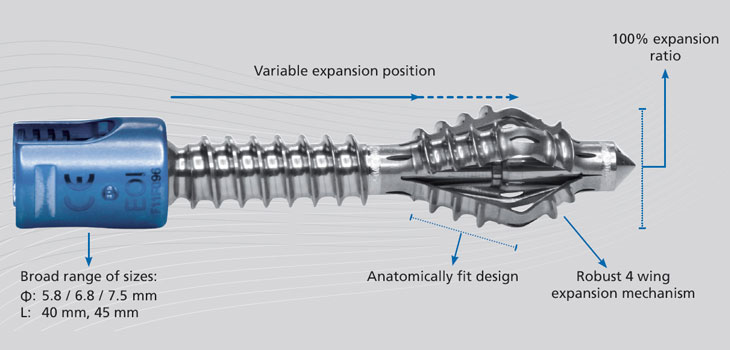
Israel-based Expanding Orthopedics Inc. announced that it has sold its 1, 000th XPED pedicle screw—arguably the most technologically sophisticated pedicle screw in the world. The 1, 000th XPED was implanted at the Rizzoli Institute in Bologna, Italy. The specialty screws are designed to provide enhanced anchoring in compromised bone. Stefano Boriani, M.D., director of the Department of Oncologic and Degenerative Spine Surgery, said, “I have started to use the XPED System to obtain better pull-out strength in my degenerative and oncology patients that are exposed to numerous complications related to frail implant fixation in weak bone. This innovative expandable technology enables me to better and safer meet the needs of my patients.”
Best Pedicle Screw in the World?
1 min read Premium comments
Secondary
Dr. Greggi, head of the Department of Spinal Deformity Surgery and President of the 2013 Italian Spine Society Meeting presented six months of follow-up with the XPED at the 2nd Bologna-Budapest Spine Meeting on Tumors and Osteoporosis. She reported, “We are using the XPED System to treat patients with vertebral fractures and adult deformities and results have been excellent so far with no screw loosening reported. Treating patients with low bone quality is daily routine at the Rizzoli Institute and the need for such unique solutions will grow due to the increase in the aging population.”
Expanding Orthopedics’ CEO Ofer Bokobza said that “this is a very significant achievement and milestone for the company and confirms that the XPED System can provide a valuable treatment option for patients with compromised bone.”
He said that close to 100 spine surgeons have been trained worldwide with the XPED in over 25 medical centers in Germany, Italy, the United Kingdom, Israel and Turkey.
Expanding Orthopedics Inc. is a privately owned company with a patent portfolio covering the XPED and additional spine and orthopedic applications.
Author
React:
Discussion
This is a fascinating development. In my practice we've seen similar outcomes with the revised protocol. The key differentiator seems to be patient selection criteria. Has anyone else noticed the correlation with BMI thresholds?
Great point. I'd push back slightly on the conclusion, the sample size in the cited study is too small to draw population-level inferences. That said, the directional signal is compelling and worth a larger RCT.
We implemented a similar approach last year. Early results are promising but we're still gathering 12-month follow-up data. Happy to share our protocol if anyone is interested.
Join the conversation
Orthopedic professionals are discussing this. Sign in and upgrade to read every comment and add your voice.